


Does lower birth order amplify the association between high socioeconomic status and central adiposity in young adult Filipino males?
- PMID: 20065964
- PMCID: PMC2908417
- DOI: 10.1038/ijo.2009.275
Does lower birth order amplify the association between high socioeconomic status and central adiposity in young adult Filipino males?
Abstract
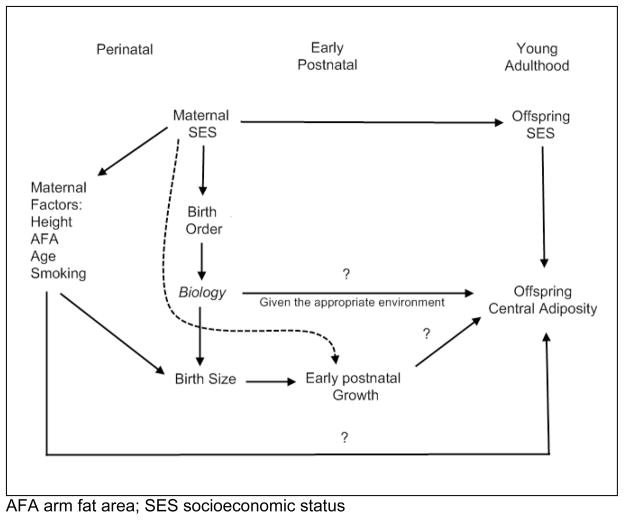
Objectives: To test the hypothesis that lower birth order amplifies the positive association between socioeconomic status and central adiposity in young adult males from a lower income, developing country context.
Design: The Cebu Longitudinal Health and Nutrition Survey is an ongoing community-based, observational study of a 1-year birth cohort (1983).
Subjects: 970 young adult males, mean age 21.5 years (2005).
Measurements: Central adiposity measured by waist circumference; birth order; perinatal maternal characteristics including height, arm fat area, age and smoking behavior; socioeconomic status at birth and in young adulthood.
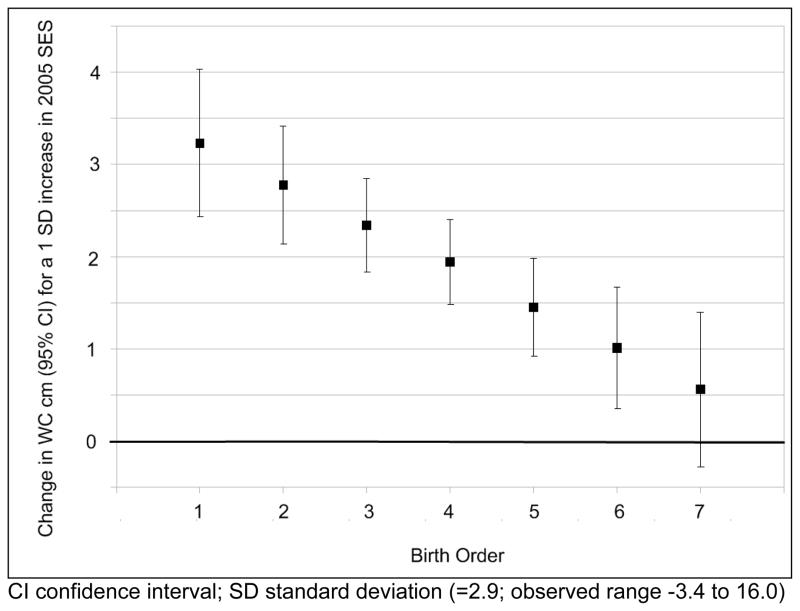
Results: Lower birth order was associated with higher waist circumference and increased odds of high waist circumference, even after adjustment for socioeconomic status in young adulthood and maternal characteristics that could impact later offspring adiposity. Furthermore, the positive association between socioeconomic status and central adiposity was amplified in individuals characterized by lower birth order.
Conclusions: This research has failed to reject the mismatch hypothesis, which posits that maternal constraint of fetal growth acts to program developing physiology in a manner that increases susceptibility to the obesogenic effects of modern environments.
Figures
References
-
- WHO. Obesity: preventing and managing the global epidemic. World Health Organization Technical Report Series. 2000 - PubMed
-
- Hill JO, Wyatt HR, Reed GW, Peters JC. Obesity and the environment: Where do we go from here? Science. 2003;299:853–855. - PubMed
-
- Hill JO, Peters JC. Environmental contributions to the obesity epidemic. Science. 1998;280:1371–1374. - PubMed
-
- French SA, Story M, Jeffery RW. Environmental influences on eating and physical activity. Annu Rev Public Health. 2001;22:309–335. - PubMed
-
- Lake A, Townshend T. Obesogenic environments: exploring the built and food environments. J R Soc Promot Health. 2006;126:262–267. - PubMed
MeSH terms
Grants and funding
LinkOut - more resources
Full Text Sources
Medical
