Gap junctions
- PMID: 20066080
- PMCID: PMC2742079
- DOI: 10.1101/cshperspect.a002576
Gap junctions
Abstract
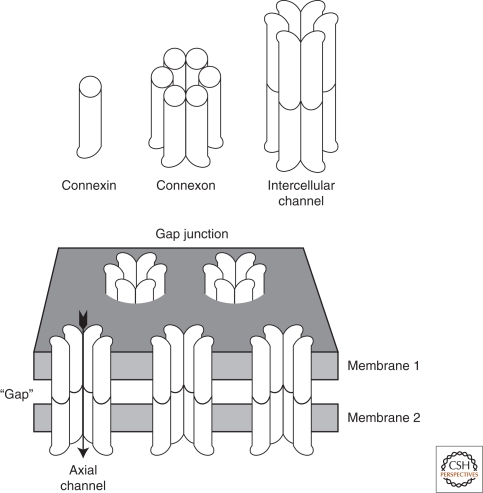
Gap junctions are aggregates of intercellular channels that permit direct cell-cell transfer of ions and small molecules. Initially described as low-resistance ion pathways joining excitable cells (nerve and muscle), gap junctions are found joining virtually all cells in solid tissues. Their long evolutionary history has permitted adaptation of gap-junctional intercellular communication to a variety of functions, with multiple regulatory mechanisms. Gap-junctional channels are composed of hexamers of medium-sized families of integral proteins: connexins in chordates and innexins in precordates. The functions of gap junctions have been explored by studying mutations in flies, worms, and humans, and targeted gene disruption in mice. These studies have revealed a wide diversity of function in tissue and organ biology.
Figures
References
-
- Albertini DF, Anderson E 1975. Structural modifications of lutein cell gap junctions during pregnancy in the rat and the mouse. Anat Rec 181:171–194 - PubMed
-
- Alexopoulos H, Bottger A, Fischer S, Levin A, Wolf A, Fujisawa T, Hayakawa S, Gojobori T, Davies JA, David CN, et al. 2004. Evolution of gap junctions: The missing link? Curr Biol 14:R879–R880 - PubMed
-
- Allen MJ, Godenschwege TA, Tanouye MA, Phelan P 2006. Making an escape: Development and function of the Drosophila giant fibre system. Semin Cell Dev Biol 17:31–41 - PubMed
Publication types
MeSH terms
Substances
Grants and funding
LinkOut - more resources
Full Text Sources
Other Literature Sources
Molecular Biology Databases
Miscellaneous