


Procalcitonin and C-reactive protein in severe 2009 H1N1 influenza infection
- PMID: 20069274
- PMCID: PMC7080172
- DOI: 10.1007/s00134-009-1746-3
Procalcitonin and C-reactive protein in severe 2009 H1N1 influenza infection
Abstract
Purpose: To examine whether, in an adult intensive care unit (ICU), procalcitonin or C-reactive protein (CRP) levels discriminated between 2009 H1N1 influenza infection and community-acquired pneumonia of bacterial origin.
Methods: A retrospective observational study performed at an Australian hospital over a 4-month winter period during the 2009 H1N1 influenza pandemic. Levels on admission of procalcitonin and CRP were compared between patients admitted to the ICU with community-acquired pneumonia of bacterial and 2009 H1N1 origin.
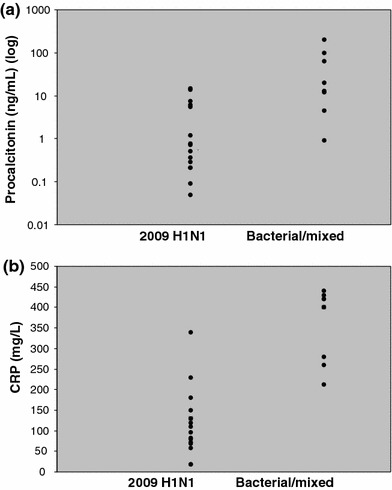
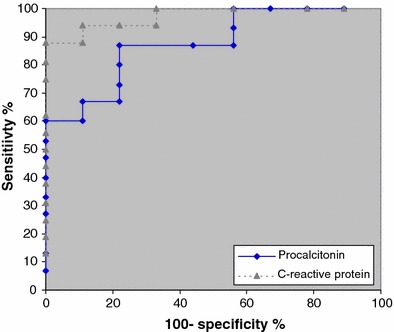
Results: Compared to those with bacterial or mixed infection (n = 9), patients with 2009 H1N1 infection (n = 16) were significantly more likely to have bilateral chest X-ray infiltrates, lower APACHE scores, more prolonged lengths of stay in ICU and lower white cell count, procalcitonin and CRP levels. Using a cutoff of >0.8 ng/ml, the sensitivity and specificity of procalcitonin for detection of patients with bacterial/mixed infection were 100 and 62%, respectively. A CRP cutoff of >200 mg/l best identified patients with bacterial/mixed infection (sensitivity 100%, specificity 87.5%). In combination, procalcitonin levels >0.8 ng/ml and CRP >200 mg/l had optimal sensitivity (100%), specificity (94%), negative predictive value (100%) and positive predictive value (90%). Receiver-operating characteristic curve analysis suggested the diagnostic accuracy of procalcitonin may be inferior to CRP in this setting.
Conclusions: Procalcitonin measurement potentially assists in the discrimination between severe lower respiratory tract infections of bacterial and 2009 H1N1 origin, although less effectively than CRP. Low values, particularly when combined with low CRP levels, suggested bacterial infection, alone or in combination with influenza, was unlikely.
Figures
References
-
- ANZIC Influenza Investigators. Webb SA, Pettilä V, Seppelt I, Bellomo R, Bailey M, Cooper DJ, Cretikos M, Davies AR, Finfer S, Harrigan PW, Hart GK, Howe B, Iredell JR, McArthur C, Mitchell I, Morrison S, Nichol AD, Paterson DL, Peake S, Richards B, Stephens D, Turner A, Yung M. Critical care services and 2009 H1N1 influenza in Australia and New Zealand. N Engl J Med. 2009;361:1991–1993. doi: 10.1056/NEJMe0909666. - DOI - PubMed
-
- Munster VJ, de Wit E, van den Brand JM, Herfst S, Schrauwen EJ, Bestebroer TM, van de Vijver D, Boucher CA, Koopmans M, Rimmelzwaan GF, Kuiken T, Osterhaus AD, Fouchier RA. Pathogenesis and transmission of swine-origin 2009 A(H1N1) influenza virus in ferrets. Science. 2009;325:481–483. - PMC - PubMed
-
- Erratum Clin Infect Dis. 2005;40:1386–1388.
-
- Schuetz P, Christ-Crain M, Thomann R, Falconnier C, Wolbers M, Widmer I, Neidert S, Fricker T, Blum C, Schild U, Regez K, Schoenenberger R, Henzen C, Bregenzer T, Hoess C, Krause M, Bucher HC, Zimmerli W, Mueller B, ProHOSP Study Group Effect of procalcitonin-based guidelines vs standard guidelines on antibiotic use in lower respiratory tract infections. JAMA. 2009;302:1059–1066. doi: 10.1001/jama.2009.1297. - DOI - PubMed
Publication types
MeSH terms
Substances
LinkOut - more resources
Full Text Sources
Other Literature Sources
Medical
Research Materials
Miscellaneous
