


Review
doi: 10.1016/j.mib.2009.12.004.
Epub 2010 Jan 12.
Tipping the balance by manipulating post-translational modifications
Affiliations
- PMID: 20071215
- PMCID: PMC3018334
- DOI: 10.1016/j.mib.2009.12.004
Item in Clipboard
Review
Tipping the balance by manipulating post-translational modifications
Curr Opin Microbiol.
2010 Feb.
Abstract
Bacteria use a variety of mechanisms during infection to ensure their survival including the delivery of virulence factors via a type III secretion system into the infected cell. The factors exhibit diverse activities that in many cases mimic eukaryotic mechanisms used by the host to defend against infection. Herein we describe a class of effectors that use post-translational modifications, some reversible and others irreversible, to manipulate host signaling systems to subvert the host response.
Copyright 2009 Elsevier Ltd. All rights reserved.
Figures

A. ExoS modifies Ras GTPase by attaching ADP-ribose from NAD+, resulting in apoptosis of the targeted cell, as well as blocking wound repair and phagocytosis of bacteria by macrophages. B. VopS AMPylates Rho family GTPases by transferring adenosine monophosphate from ATP to a threonine residue on the GTPase, blocking interaction with downstream targets through steric hindrance.
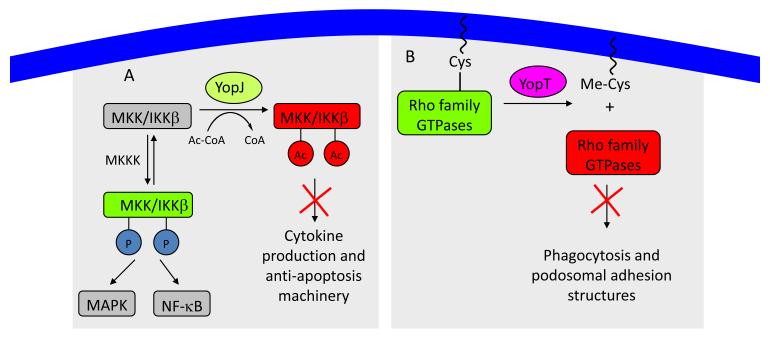
A. YopJ acetylates MAPK kinase on critical serine and threonine residues, blocking phosphorylation and subsequent activation of downstream MAPK and NF-κB pathways. B. YopT cleaves the C-terminal cysteine residue and attached isoprenoid group from Rho family GTPases, causing mis-localization of the GTPase to the cytoplasm with a loss of activity due to lack of substrate.

A. YopH dephosphorylates the tyrosine residue of multiple proteins at the cellular membrane, resulting in loss of focal adhesion complexes and alteration of the actin cytoskeleton blocking phagocytosis of extracellular bacteria. B. SopB alters multiple signaling cascades through the dephosphorylation of inositol moieties at multiple membranes in the host cell. C. YpkA inactivates Gαq by phosphorylating the diphosphate loop, blocking nucleotide binding through steric hindrance leading to a loss of downstream PLC-β and Rho GTPase activation. D. OspF mediates the irreversible β-elimination of a phosphothreonine residue on MAPK to dehydrobutyrine with the release of inorganic phosphate, blocking MAPK signaling.
References
-
- Orth K. Versatile Type III Effector Mechanisms can Disrupt Target-Cell Functions. Microbe. 2007;2:183–186.
-
- Viboud GI, Bliska JB. Yersinia outer proteins: role in modulation of host cell signaling responses and pathogenesis. Annu Rev Microbiol. 2005;59:69–89. - PubMed
-
- Pederson KJ, Pal S, Vallis AJ, Frank DW, Barbieri JT. Intracellular localization and processing of Pseudomonas aeruginosa ExoS in eukaryotic cells. Mol Microbiol. 2000;37:287–299. - PubMed
Publication types
MeSH terms
Substances
Grants and funding
LinkOut - more resources
Full Text Sources
