


Personality traits and dispersal tendency in the invasive mosquitofish (Gambusia affinis)
- PMID: 20071380
- PMCID: PMC2871838
- DOI: 10.1098/rspb.2009.2128
Personality traits and dispersal tendency in the invasive mosquitofish (Gambusia affinis)
Abstract
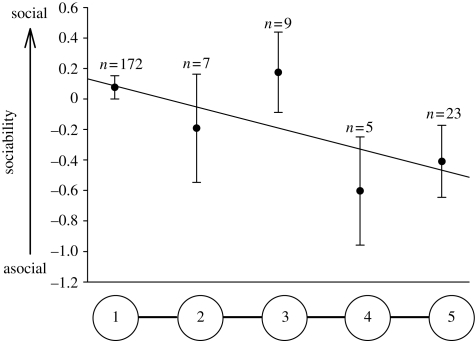
Ecological invasions, where non-native species spread to new areas, grow to high densities and have large, negative impacts on ecological communities, are a major worldwide problem. Recent studies suggest that one of the key mechanisms influencing invasion dynamics is personality-dependent dispersal: the tendency for dispersers to have a different personality type than the average from a source population. We examined this possibility in the invasive mosquitofish (Gambusia affinis). We measured individual tendencies to disperse in experimental streams and several personality traits: sociability, boldness, activity and exploration tendency before and three weeks after dispersal. We found that mosquitofish display consistent behavioural tendencies over time, and significant positive correlations between all personality traits. Most notably, sociability was an important indicator of dispersal distance, with more asocial individuals dispersing further, suggesting personality-biased dispersal on an invasion front. These results could have important ecological implications, as invasion by a biased subset of individuals is likely to have different ecological impacts than invasion by a random group of colonists.
Figures
References
-
- Alemadi S., Jenkins D.2008Behavioral constraints for the spread of the eastern mosquitofish, Gambusia holbrooki (Poeciliidae). Biol. Invas. 10, 59–66 (doi:10.1007/s10530-007-9109-x) - DOI
-
- Bell A.2007Future directions in behavioural syndromes research. Proc. R. Soc. B 274, 755–761 (doi:10.1098/rspb.2006.0199) - DOI - PMC - PubMed
-
- Bell A. M., Hankison S. J., Laskowski K. L.2009The repeatability of behaviour: a meta-analysis. Anim. Behav. 77, 771–783 (doi:10.1016/j.anbehav.2008.12.022) - DOI - PMC - PubMed
-
- Bonte D., Clercq N. d., Zwertvaegher I., Lens L.2009Repeatability of dispersal behaviour in a common dwarf spider: evidence for different mechanisms behind short- and long-distance dispersal. Ecol. Entomol. 34, 271–276 (doi:10.1111/j.1365-2311.2008.01070.x) - DOI
-
- Botham M., Kerfoot C., Louca V., Krause J.2005Predator choice in the field: grouping guppies, Poecilia reticulata, receive more attacks. Behav. Ecol. Sociobiol. 59, 181–184 (doi:10.1007/s00265-005-0018-7) - DOI
Publication types
MeSH terms
LinkOut - more resources
Full Text Sources
