


Direct ertapenem disk screening method for identification of KPC-producing Klebsiella pneumoniae and Escherichia coli in surveillance swab specimens
- PMID: 20071553
- PMCID: PMC2832415
- DOI: 10.1128/JCM.01988-09
Direct ertapenem disk screening method for identification of KPC-producing Klebsiella pneumoniae and Escherichia coli in surveillance swab specimens
Abstract
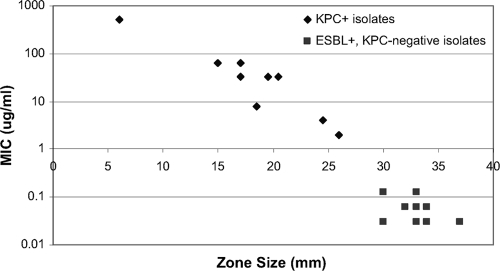
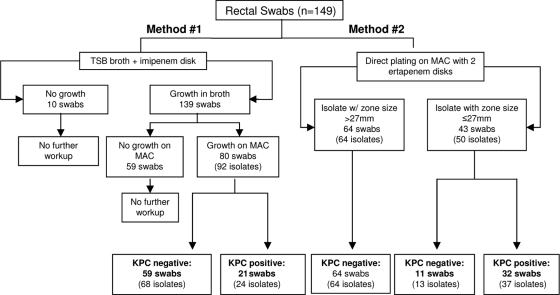
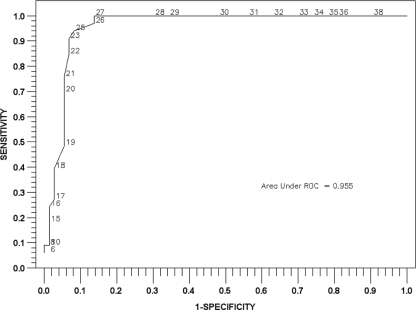
Klebsiella pneumoniae carbapenemase (KPC) production in Gram-negative bacilli is an increasing problem worldwide. Rectal swab surveillance is recommended as a component of infection prevention programs, yet few screening methods are published. We compared detection of KPC-producing Klebsiella pneumoniae and Escherichia coli in surveillance specimens by 2 methods: (i) inoculation of swabs in tryptic soy broth containing 2 microg/ml imipenem followed by plating to MacConkey agar (MAC) (method 1) and (ii) streaking swabs on MAC onto which a 10-microg ertapenem disk was then placed (method 2). Simulated rectal swab specimens of challenge isolates from a collection of well-characterized K. pneumoniae and E. coli strains and salvage rectal swab specimens collected from patients at 4 different health care facilities over a 7-month period were tested. The gold-standard comparator was bla(KPC) PCR testing of isolates. Method 1 detected 4/9 (44%) KPC-positive challenge isolates. By method 2, 9/9 KPC-positive challenge isolates exhibited zones of inhibition of < or = 27 mm; all KPC-negative isolates exhibited zones of inhibition greater than 27 mm. The sensitivity and specificity of method 1 for detection of KPC-positive K. pneumoniae and E. coli in 149 rectal swab specimens were 65.6% (95% confidence interval [CI], 46.8% to 80.8%) and 49.6% (95% CI, 40.3% to 58.9%), respectively. With method 2, a zone diameter of < or = 27 mm had a sensitivity of 97.0% (95% CI, 82.5% to 99.8%) and specificity of 90.5% (95% CI, 83.3% to 94.9%) for detection of KPC in rectal swab specimens. Direct ertapenem disk testing is simpler, more sensitive, and more specific than selective broth enrichment with imipenem for detection of KPC-producing K. pneumoniae and E. coli in surveillance specimens.
Figures
References
-
- Bradford, P. A., S. Bratu, C. Urban, M. Visalli, N. Mariano, D. Landman, J. J. Rahal, S. Brooks, S. Cebular, and J. Quale. 2004. Emergence of carbapenem-resistant Klebsiella species possessing the class A carbapenem-hydrolyzing KPC-2 and inhibitor-resistant TEM-30 beta-lactamases in New York City. Clin. Infect. Dis. 39:55-60. - PubMed
-
- Centers for Disease Control and Prevention. 2009. Laboratory protocol for detection of carbapenem-resistant or carbapenemase-producing Klebsiella spp. and E. coli from rectal swabs. Centers for Disease Control and Prevention, Atlanta, GA. http://www.cdc.gov/NCIDOD/DHQP/pdf/ar/Klebsiella_or_Ecoli.pdf.
-
- Centers for Disease Control and Prevention. 2009. Guidance for control of infections with carbapenem-resistant or carbapenemase-producing enterobacteriaceae in acute care facilities. MMWR Morb. Mortal. Wkly. Rep. 58:256-260. - PubMed
-
- CLSI. 2008. Methods for dilution antimicrobial susceptibility tests for bacteria that grow aerobically; approved standard, eighth edition. Clinical Laboratory Standards Institute, Wayne, PA.
-
- CLSI. 2009. Performance standards for antimicrobial susceptibility testing; nineteenth informational supplement. M100-S19. Clinical Laboratory Standards Institute, Wayne, PA.
Publication types
MeSH terms
Substances
LinkOut - more resources
Full Text Sources
Other Literature Sources
Medical
