. 2010 Apr;84(7):3413-20.
doi: 10.1128/JVI.02304-09. Epub 2010 Jan 13.

Measles virus selectively blind to signaling lymphocytic activation molecule (SLAM; CD150) is attenuated and induces strong adaptive immune responses in rhesus monkeys

Affiliations

Measles virus selectively blind to signaling lymphocytic activation molecule (SLAM; CD150) is attenuated and induces strong adaptive immune responses in rhesus monkeys

Vincent H J Leonard et al. J Virol. 2010 Apr.

Abstract

The signaling lymphocytic activation molecule (SLAM; CD150) is the immune cell receptor for measles virus (MV). To assess the importance of the SLAM-MV interactions for virus spread and pathogenesis, we generated a wild-type IC-B MV selectively unable to recognize human SLAM (SLAM-blind). This virus differs from the fully virulent wild-type IC-B strain by a single arginine-to-alanine substitution at amino acid 533 of the attachment protein hemagglutinin and infects cells through SLAM about 40 times less efficiently than the isogenic wild-type strain. Ex vivo, this virus infects primary lymphocytes at low levels regardless of SLAM expression. When a group of six rhesus monkeys (Macaca mulatta) was inoculated intranasally with the SLAM-blind virus, no clinical symptoms were documented. Only one monkey had low-level viremia early after infection, whereas all the hosts in the control group had high viremia levels. Despite minimal, if any, viremia, all six hosts generated neutralizing antibody titers close to those of the control monkeys while MV-directed cellular immunity reached levels at least as high as in wild-type-infected monkeys. These findings prove formally that efficient SLAM recognition is necessary for MV virulence and pathogenesis. They also suggest that the selectively SLAM-blind wild-type MV can be developed into a vaccine vector.


Figures
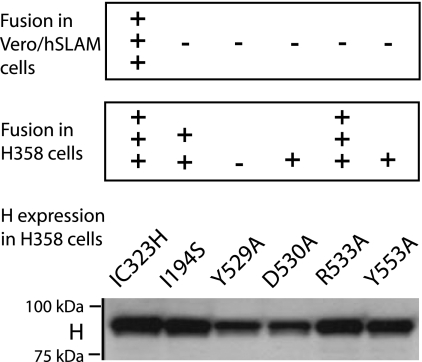
FIG. 1.
FIG. 1.
Impact of five single amino acid changes on wild-type H protein function. Vero/hSLAM and H358 cells were cotransfected with expression plasmids encoding GFP, IC323-F, and IC323-H or the corresponding mutants. (Top) SLAM-dependent fusion support on Vero/hSLAM cells. (Center) EpR-dependent fusion support on H358 cells. Fusion was graded as indicated in the Materials and Methods section, based on the average of three independent experiments; identification of syncytia was facilitated by the combination of phase-contrast analysis and observation of GFP expression. (Bottom) H protein expression levels in H358 cells at 24 h posttransfection of the corresponding plasmids. H protein was visualized by immunoblotting using an antibody directed against the cytoplasmic tail of H (3).
FIG. 2.
FIG. 2.
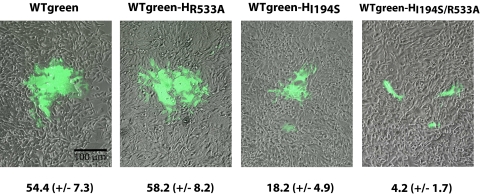
Extent of cell fusion elicited by four different SLAM-blind viruses on EpR-expressing H358 cells 2 days after infection. Phase-contrast pictures of the cells were overlaid with fluorescence microscopy images. Panels show representative pictures. Bottom numbers indicate the number of nuclei per syncytium (averages of nuclei count in 20 syncytia per virus); standard deviations are indicated in parenthesis.
FIG. 3.
FIG. 3.
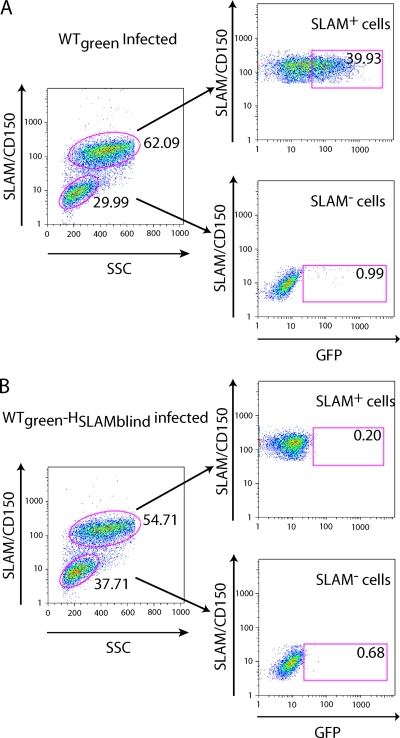
Receptor specificity of WTgreen-HSLAMblind. Two cell populations, Vero/hSLAM expressing SLAM or Vero cells, were mixed and infected with either WTgreen (A) or WTgreen-HSLAMblind (B). After 12 h the mixed cells were analyzed by flow cytometry; an anti-SLAM antibody was used to quantify SLAM expression (vertical axis). In the left panels side scatter analysis (SSC) was used to differentiate the two cell populations (horizontal axis); in the right panels GFP expression analysis was used to identify infected cells (horizontal axis). Percentages report the number of cells in the red gate divided by the total number of cells in the plot, multiplied by 100.
FIG. 4.
FIG. 4.
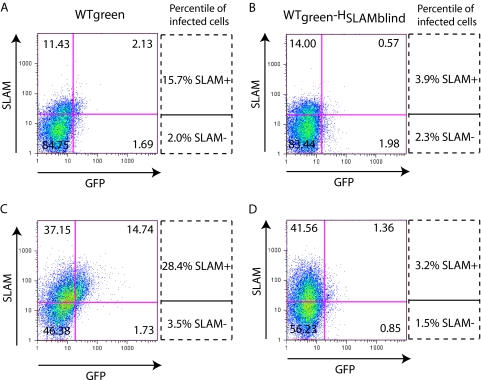
WTgreen and WTgreen-HSLAMblind infection of CD3-positive human PBMCs. Human PBMCs, either nonactivated (A and B) or PHA activated (C and D), were infected with WTgreen (A and C) or WTgreen-HSLAMblind (B and D), and the level of infected SLAM-positive and SLAM-negative CD3+ T cells was determined by FACS analysis. The vertical axis shows SLAM expression levels. The threshold of positive SLAM expression was set using the corresponding isotype control. The horizontal axis shows GFP fluorescence. The percentage of infected cells was calculated by dividing the number of GFP-expressing cells (right quadrants, upper or lower) by the total number of cells in the corresponding pairs of upper or lower quadrants, respectively.
FIG. 5.
FIG. 5.
Analysis of the humoral and cellular immune responses elicited by WT-HSLAMblind. (A) Neutralizing antibody response of monkeys infected with WT or WT-HSLAMblind (SLAMb). Serum obtained before or 14 or 28 days postinoculation was assayed for MV neutralization. The vertical axis shows the reciprocals of the neutralization titers. Each dot represents an animal, and the short horizontal bar indicates the mean of the group. The interrupted line represents the limit of detection; all preinoculation sera had titers below this value. (B) MV-specific IFN-γ-secreting cells in monkeys infected with WT or WT-HSLAMblind. PBMCs were obtained 28 or 90 days postinoculation and stimulated with live MV Edmonston strain, and the number of spot-forming cells per 106 PBMCs was measured with an IFN-γ-specific ELISPOT assay. Each dot represents the number of spot-forming cells for an animal, and the horizontal bar indicates the mean of the group.

References

    1. Billeter, M. A., H. Y. Naim, and S. A. Udem. 2009. Reverse genetics of measles virus and resulting multivalent recombinant vaccines: applications of recombinant measles viruses. Curr. Top. Microbiol. Immunol. 329:129-162. - PMC - PubMed
    1. Cattaneo, R., and M. B. Mc Chesney. 2008. Measles virus, p. 285-291. In B. Mahy and M. Van Regenmortel (ed.), In Encyclopedia of virology, 3rd ed., vol. 3. Academic Press, San Diego, CA.
    1. Cattaneo, R., and J. K. Rose. 1993. Cell fusion by the envelope glycoproteins of persistent measles viruses which caused lethal human brain disease. J. Virol. 67:1493-1502. - PMC - PubMed
    1. Cocks, B. G., C. C. Chang, J. M. Carballido, H. Yssel, J. E. de Vries, and G. Aversa. 1995. A novel receptor involved in T-cell activation. Nature 376:260-263. - PubMed
    1. Condack, C., J. C. Grivel, P. Devaux, L. Margolis, and R. Cattaneo. 2007. Measles virus vaccine attenuation: suboptimal infection of lymphatic tissue and tropism alteration. J. Infect. Dis. 196:541-549. - PubMed

Publication types

LinkOut - more resources