


Late release of circulating endothelial cells and endothelial progenitor cells after chemotherapy predicts response and survival in cancer patients
- PMID: 20072657
- PMCID: PMC2805887
- DOI: 10.1593/neo.91460
Late release of circulating endothelial cells and endothelial progenitor cells after chemotherapy predicts response and survival in cancer patients
Abstract
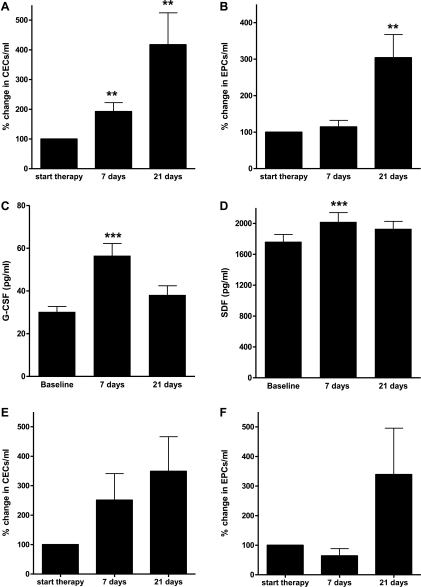
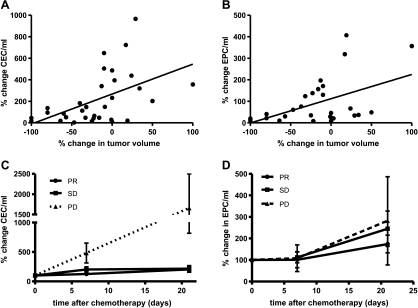
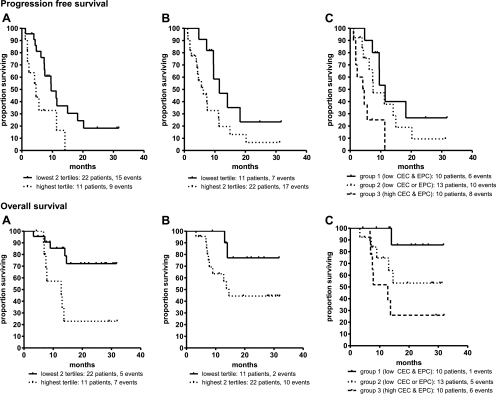
We and others have previously demonstrated that the acute release of progenitor cells in response to chemotherapy actually reduces the efficacy of the chemotherapy. Here, we take these data further and investigate the clinical relevance of circulating endothelial (progenitor) cells (CE(P)Cs) and modulatory cytokines in patients after chemotherapy with relation to progression-free and overall survival (PFS/OS). Patients treated with various chemotherapeutics were included. Blood sampling was performed at baseline, 4 hours, and 7 and 21 days after chemotherapy. The mononuclear cell fraction was analyzed for CE(P)C by FACS analysis. Plasma was analyzed for cytokines by ELISA or Luminex technique. CE(P)Cs were correlated with response and PFS/OS using Cox proportional hazard regression analysis. We measured CE(P)Cs and cytokines in 71 patients. Only patients treated with paclitaxel showed an immediate increase in endothelial progenitor cell 4 hours after start of treatment. These immediate changes did not correlate with response or survival. After 7 and 21 days of chemotherapy, a large and consistent increase in CE(P)C was found (P < .01), independent of the type of chemotherapy. Changes in CE(P)C levels at day 7 correlated with an increase in tumor volume after three cycles of chemotherapy and predicted PFS/OS, regardless of the tumor type or chemotherapy. These findings indicate that the late release of CE(P)C is a common phenomenon after chemotherapeutic treatment. The correlation with a clinical response and survival provides further support for the biologic relevance of these cells in patients' prognosis and stresses their possible use as a therapeutic target.
Figures
References
-
- Rafii S, Lyden D, Benezra R, Hattori K, Heissig B. Vascular and haematopoietic stem cells: novel targets for anti-angiogenesis therapy? Nat Rev Cancer. 2002;2:826–835. - PubMed
-
- Asahara T, Murohara T, Sullivan A, Silver M, van der ZR, Li T, Witzenbichler B, Schatteman G, Isner JM. Isolation of putative progenitor endothelial cells for angiogenesis. Science. 1997;275:964–967. - PubMed
-
- Gao D, Nolan DJ, Mellick AS, Bambino K, McDonnell K, Mittal V. Endothelial progenitor cells control the angiogenic switch in mouse lung metastasis. Science. 2008;319:195–198. - PubMed
-
- Lyden D, Hattori K, Dias S, Costa C, Blaikie P, Butros L, Chadburn A, Heissig B, Marks W, Witte L, et al. Impaired recruitment of bone-marrow-derived endothelial and hematopoietic precursor cells blocks tumor angiogenesis and growth. Nat Med. 2001;7:1194–1201. - PubMed
-
- Davidoff AM, Ng CY, Brown P, Leary MA, Spurbeck WW, Zhou J, Horwitz E, Vanin EF, Nienhuis AW. Bone marrow-derived cells contribute to tumor neovasculature and, when modified to express an angiogenesis inhibitor, can restrict tumor growth in mice. Clin Cancer Res. 2001;7:2870–2879. - PubMed
MeSH terms
Substances
LinkOut - more resources
Full Text Sources
Medical
Molecular Biology Databases