


Statin drugs, serum cholesterol, and prostate-specific antigen in the National Health and Nutrition Examination Survey 2001-2004
- PMID: 20072809
- PMCID: PMC3008565
- DOI: 10.1007/s10552-009-9494-9
Statin drugs, serum cholesterol, and prostate-specific antigen in the National Health and Nutrition Examination Survey 2001-2004
Abstract
Purpose: We evaluated the associations of statins and serum cholesterol with PSA to understand whether the inverse associations of statins and low cholesterol with aggressive prostate cancer are explained by detection bias.
Methods: We analyzed data from 2,574 men aged > or =40 years without prostate cancer in The National Health and Nutrition Examination Survey 2001-2004. We estimated multivariable-adjusted geometric mean PSA by statin use and cholesterol quintiles. To limit the influence of correlates of statin use and cholesterol on PSA, we stratified by comorbidities.
Results: Statin users had a non-statistically significantly lower PSA than non-users (0.90 vs. 0.95 ng/mL, p = 0.22), especially in men without comorbidities (n = 1,680; 0.86 vs. 0.99 ng/mL p = 0.02). In men with comorbidities, statin users had a non-statistically significantly higher PSA than non-users (0.91 vs. 0.83 ng/mL, p = 0.14). Men with lower cholesterol had lower PSA (bottom vs. top quintile: 0.92, 1.02 ng/mL, p-trend = 0.06).
Conclusion: Statin users and men with lower cholesterol may have lower PSA. If so, the probability of detecting asymptomatic prostate cancer might be lower at present, but these cases might be more likely to be diagnosed at an advanced stage in the future. Thus, PSA-associated bias is unlikely to explain the inverse association of statins with advanced prostate cancer.
Figures

 = PSA screening test when PSA concentration reached the level for referral for biopsy
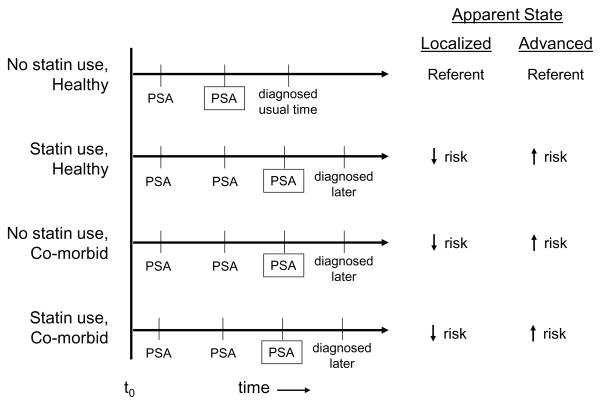 = PSA screening test when PSA concentration reached the level for referral for biopsy
References
-
- Shannon J, Tewoderos S, Garzotto M, et al. Statins and prostate cancer risk: a case-control study. American Journal of Epidemiology. 162(4):318–25. - PubMed
-
- Platz EA, Leitzmann MF, Visvanathan K, et al. Statin Drugs and Risk of Advanced Prostate Cancer. Journal of the National Cancer Institute. 98(24):1819–25. - PubMed
-
- Flick ED, Habel LA, Chan KA, et al. Statin use and risk of prostate cancer in the California Men's Health Study cohort. Cancer epidemiology, biomarkers & prevention. 16(11):2218–25. - PubMed
-
- Jacobs EJ, Rodriguez C, Bain EB, et al. Cholesterol-lowering drugs and advanced prostate cancer incidence in a large U.S. cohort. Cancer epidemiology, biomarkers & prevention. 16(11):2213–7. - PubMed
-
- Murtola TJ, Tammela TL, Lahtela J, Auvinen A. Cholesterol-lowering drugs and prostate cancer risk: a population-based case-control study. Cancer epidemiology, biomarkers & prevention. 16(11):2226–32. - PubMed
Publication types
MeSH terms
Substances
Grants and funding
LinkOut - more resources
Full Text Sources
Other Literature Sources
Medical
Research Materials
Miscellaneous
