. 2010 Jan 15:11:32.
doi: 10.1186/1471-2164-11-32.

Integrative analysis of the heat shock response in Aspergillus fumigatus

Affiliations

Integrative analysis of the heat shock response in Aspergillus fumigatus

Daniela Albrecht et al. BMC Genomics. .

Abstract

Background: Aspergillus fumigatus is a thermotolerant human-pathogenic mold and the most common cause of invasive aspergillosis (IA) in immunocompromised patients. Its predominance is based on several factors most of which are still unknown. The thermotolerance of A. fumigatus is one of the traits which have been assigned to pathogenicity. It allows the fungus to grow at temperatures up to and above that of a fevered human host. To elucidate the mechanisms of heat resistance, we analyzed the change of the A. fumigatus proteome during a temperature shift from 30 degrees C to 48 degrees C by 2D-fluorescence difference gel electrophoresis (DIGE). To improve 2D gel image analysis results, protein spot quantitation was optimized by missing value imputation and normalization. Differentially regulated proteins were compared to previously published transcriptome data of A. fumigatus. The study was augmented by bioinformatical analysis of transcription factor binding sites (TFBSs) in the promoter region of genes whose corresponding proteins were differentially regulated upon heat shock.

Results: 91 differentially regulated protein spots, representing 64 different proteins, were identified by mass spectrometry (MS). They showed a continuous up-, down- or an oscillating regulation. Many of the identified proteins were involved in protein folding (chaperones), oxidative stress response, signal transduction, transcription, translation, carbohydrate and nitrogen metabolism. A correlation between alteration of transcript levels and corresponding proteins was detected for half of the differentially regulated proteins. Interestingly, some previously undescribed putative targets for the heat shock regulator Hsf1 were identified. This provides evidence for Hsf1-dependent regulation of mannitol biosynthesis, translation, cytoskeletal dynamics and cell division in A. fumigatus. Furthermore, computational analysis of promoters revealed putative binding sites for an AP-2alpha-like transcription factor upstream of some heat shock induced genes. Until now, this factor has only been found in vertebrates.

Conclusions: Our newly established DIGE data analysis workflow yields improved data quality and is widely applicable for other DIGE datasets. Our findings suggest that the heat shock response in A. fumigatus differs from already well-studied yeasts and other filamentous fungi.


Figures
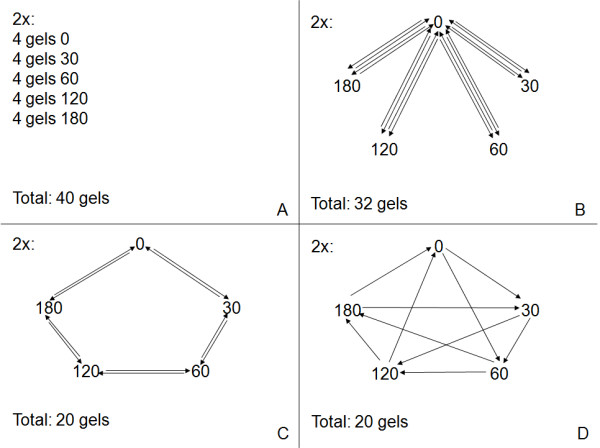
Figure 1
Figure 1
Possible experimental designs for time series experiments. 0, 30, 60, 120, and 180 each represent one biological sample taken at this time point (min.) after temperature shift; arrows point from the Cy3 labeled sample to the Cy5 labeled sample and represent gels; A -- non DIGE; B -- DIGE, reference design; C -- DIGE, loop design; D -- DIGE, extended loop design.
Figure 2
Figure 2
2D-gel electrophoresis of protein extracts of A. fumigatus grown at 30°C (Cy3-blue colored) and 48°C (120 minutes after temperature shift; Cy5-green colored) including the pooled internal standard (Cy2-red colored). Proteins were stained with the difference in gel electrophoresis (DIGE) labeling technique. The orientation of the IEF is indicated and numbers refer to proteins whose levels changed significantly during growth at elevated temperature (see additional file 1, MS_results.xls, for protein information).
Figure 3
Figure 3
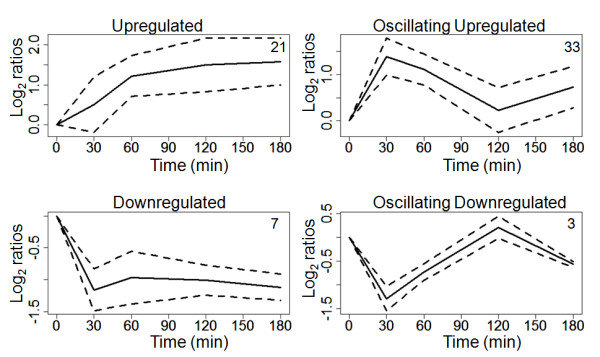
Differentially regulated proteins in the heat response form four groups with similar time courses. Solid lines represent median time courses and dashed lines the median absolute deviation of every time course group. Time is given in minutes and the relative abundance of protein spots in log2 ratios. In the right upper corner of every plot, the number of proteins in the group is displayed.
Figure 4
Figure 4
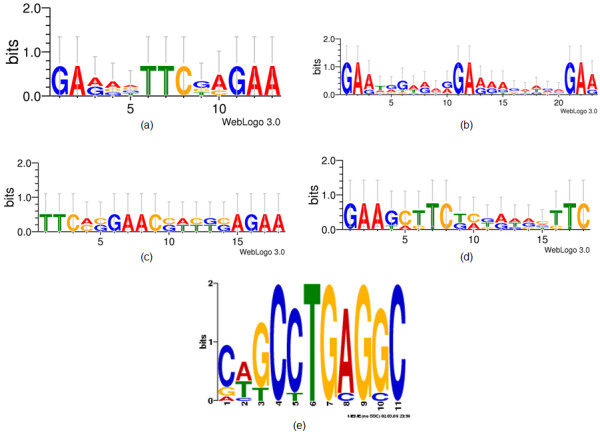
Sequence logos for Hsf1 and AP-2alphaA binding motifs as found in the promoter region of genes whose proteins were differentially regulated upon heat shock. Hsf: a (perfect), b (step), c (gap variant 1), d (gap variant 2), created with Weblogo, http://weblogo.threeplusone.com/; AP-2alphaA: e, created with MEME.
Figure 5
Figure 5
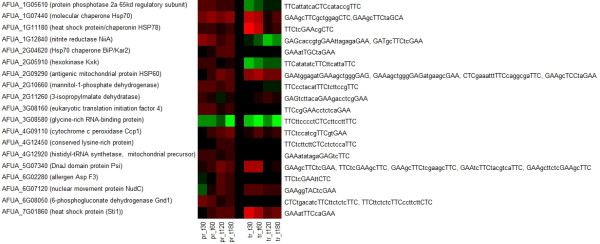
Heatmap of potentially Hsf1 regulated proteins and transcripts. Red color depicts upregulation, green color depicts downregulation. The gene/protein names are shown as well as the detected HSE.

References

    1. Tekaia F, Latge JP. Aspergillus fumigatus: saprophyte or pathogen? Curr Opin Microbiol. 2005;8:385–392. doi: 10.1016/j.mib.2005.06.017. - DOI - PubMed
    1. Brakhage AA, Langfelder K. Menacing mold: the molecular biology of Aspergillus fumigatus. Annu Rev Microbiol. 2002;56:433–455. doi: 10.1146/annurev.micro.56.012302.160625. - DOI - PubMed
    1. Bhabhra R, Askew DS. Thermotolerance and virulence of Aspergillus fumigatus: role of the fungal nucleolus. Med Mycol. 2005;43(Suppl 1):S87–93. doi: 10.1080/13693780400029486. - DOI - PubMed
    1. Zhou H, Hu H, Zhang L, Li R, Ouyang H, Ming J, Jin C. O-Mannosyltransferase 1 in Aspergillus fumigatus (AfPmt1p) is crucial for cell wall integrity and conidium morphology, especially at an elevated temperature. Eukaryot Cell. 2007;6:2260–2268. doi: 10.1128/EC.00261-07. - DOI - PMC - PubMed
    1. Chang YC, Tsai HF, Karos M, Kwon-Chung KJ. THTA, a thermotolerance gene of Aspergillus fumigatus. Fungal Genet Biol. 2004;41:888–896. doi: 10.1016/j.fgb.2004.06.004. - DOI - PubMed

Publication types

MeSH terms

LinkOut - more resources