. 2010 Jan;11(1):84-92.
doi: 10.1016/j.cmet.2009.11.003.

Irs1 serine 307 promotes insulin sensitivity in mice

Affiliations

Irs1 serine 307 promotes insulin sensitivity in mice

Kyle D Copps et al. Cell Metab. 2010 Jan.

Abstract

Phosphorylation of the insulin receptor substrates (Irs) on serine residues-typified by Ser307 of rodent Irs1-is thought to mediate insulin resistance. To determine whether Ser307 negatively regulates Irs1 in vivo, we generated knockin mice in which Ser307 (human Ser312) was replaced with alanine (A/A). Unexpectedly, A/A mice that were fed a high-fat diet developed more severe insulin resistance than control mice, accompanied by enhanced pancreatic compensation and impaired muscle insulin signaling. Chow-fed mice whose livers lacked Irs2 but retained a single knockin allele (A/lox::LKO2) were profoundly insulin resistant (versus +/lox::LKO2 mice), and their hepatocytes showed impaired insulin signaling ex vivo. Similarly, mutant A307 Irs1 adenovirus only partially restored the response to injected insulin in mice lacking hepatic Irs1 and Irs2. Thus, contrary to the results of cell-based experiments, Ser307 in mice is a positive regulatory site that moderates the severity of insulin resistance by maintaining proximal insulin signaling.


Figures

Figure 1
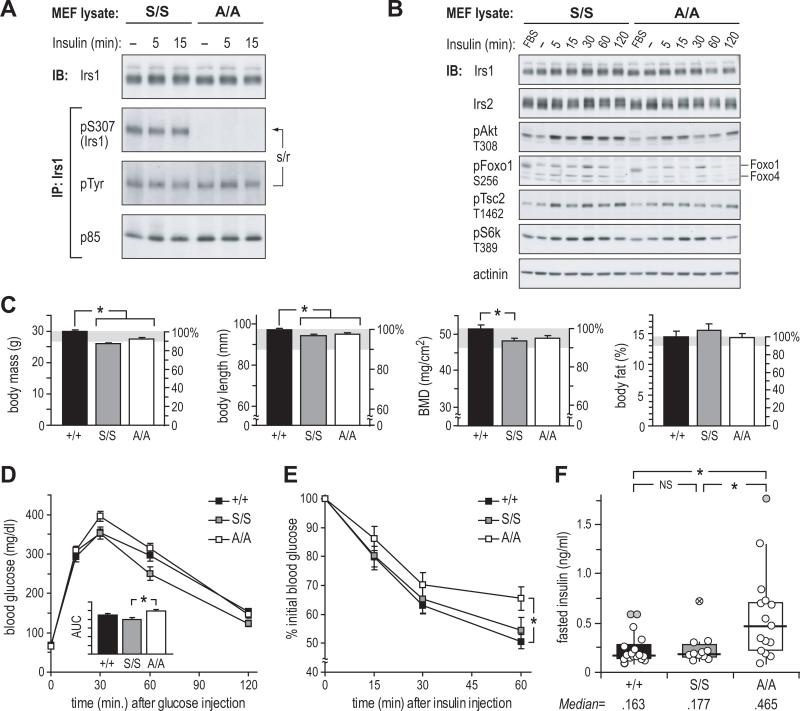
Figure 1. Irs1 Ser307Ala Knock-in Mice Are Insulin Resistant Versus Control Knock-in and WT Mice
(A and B) Immunoblot analysis of insulin signaling in control (S/S) and mutant (A/A) knock-in mouse embryonic fibroblasts (MEF); cells were maintained in 10% serum (FBS), or fasted (–) 16h before treatment with 100nM insulin; IP: immunoprecipitation; IB: immunoblot; s/r: stripped/reprobed membrane. (C) DEXA analysis of 16-week-old WT (+/+), control knock-in (S/S), and mutant knock-in mice (A/A). Bars show mean ± SEM; BMD: bone mineral density. (D and E) Glucose tolerance test and (E) insulin tolerance test in 5-month-old chow-fed mice; AUC: area under curve (mean ± SEM, arbitrary units). (F) Fasted plasma insulin at time=0 of GTT; box: interquartile range (IQR); horizontal bar: median; vertical bar: 95% of distribution. The exclusion of tailing outliers (> 1.5×IQR: formula image and > 3×IQR: formula image) gave trimmed medians of 159 (+/+), 175 (S/S) and 404 pg/ml (A/A), yielding significance (p < 0.05) for the comparison of A/A vs. S/S insulin distributions. * = p < 0.05.
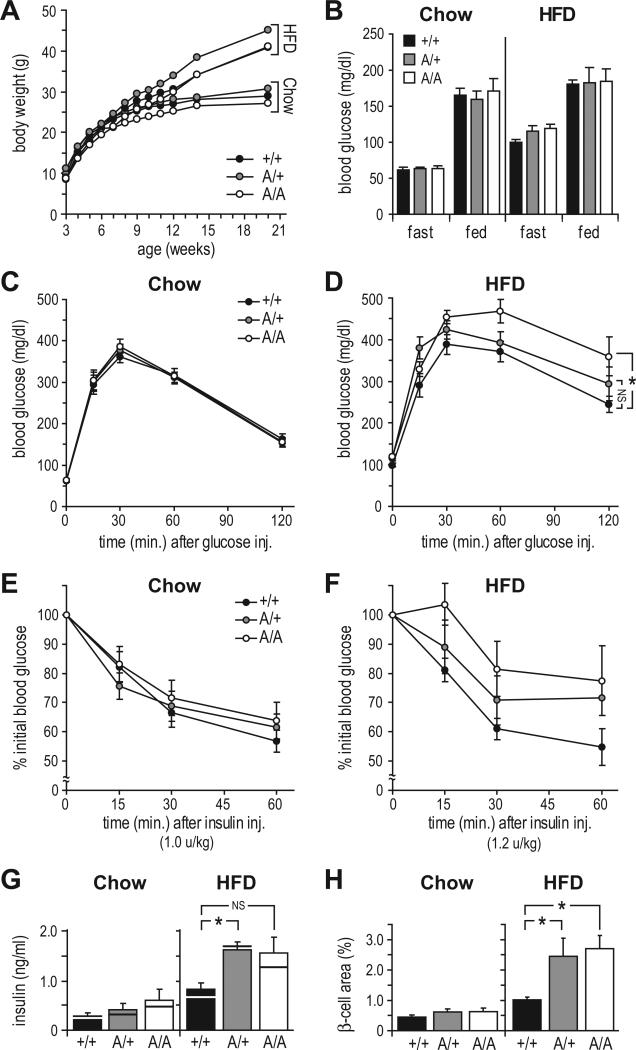
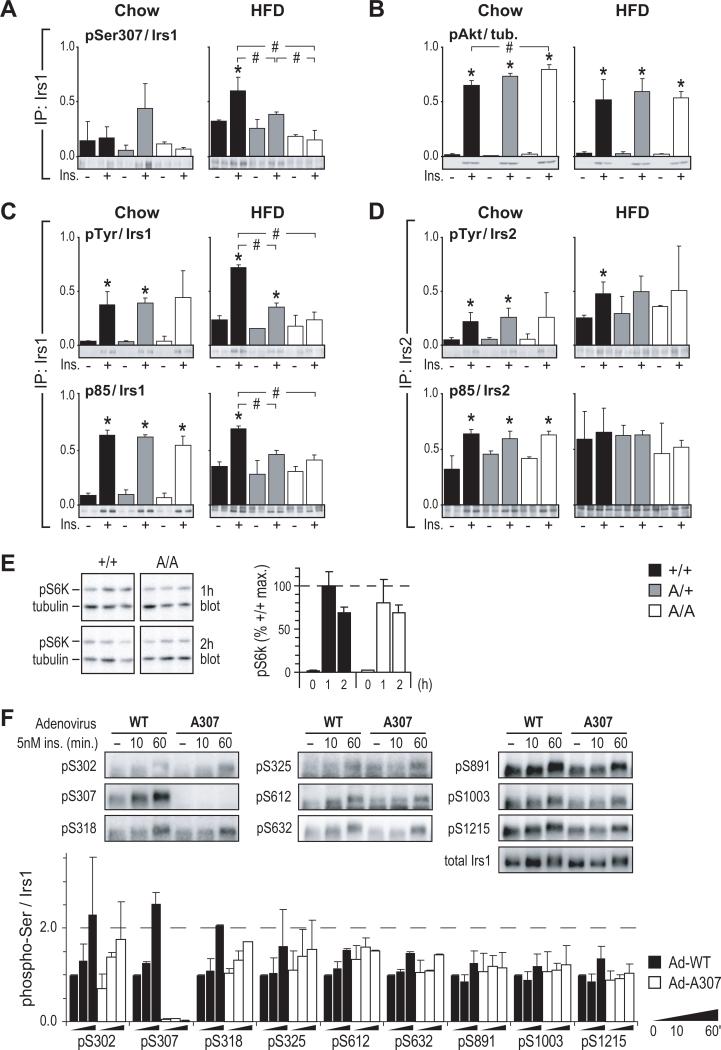
Figure 2
Figure 2. Ser307 Protects Mice Against High Fat Diet-Induced Insulin Resistance
(A) Body weight gain (mean ± SEM) in mice fed regular chow (Chow) or high fat diet (HFD). (B) Effect of diet on fasting and fed blood glucose (mean ± SEM) at 5 months of age. (C-F) Glucose tolerance tests (C-D) and insulin tolerance tests (E-F) on 5-month-old mice maintained on chow or HFD. Graphs show mean ± SEM at each point; * = p < 0.05, NS=not significant for area under curve. (G) Fasting plasma insulin concentrations (mean ± SEM) at time=0 of GTT in chow- and HFD-fed mice; horizontal bars: median values. (H) β-cell area (pixel %, mean ± SEM) in pancreatic sections from chow- and HFD-fed mice. * = p < 0.05, NS=not significant.
Figure 3
Figure 3. Mutation of Ser307 Fails To Protect Against HFD-Induced Desensitization of Insulin Signaling
(A) Immunoblot analysis of basal (–) and insulin-stimulated (+) Ser307 phosphorylation in hindlimb muscle of 5 to 6-month-old mice fed chow (Chow) or high-fat diet (HFD). Immunoprecipitated Irs1 (IP: Irs1) was detected using a phospho-specific antibody against 15 residues of mouse Irs1. (B) Corresponding Akt (Thr308) phosphorylation. (C-D) Immunoprecipitation (IP:) and immunoblot analysis of insulin signaling by Irs1 (C) or Irs2 (D) in muscle of chow- and HFD-fed mice; pTyr: phosphotyrosine. In panels A-D, the estimated means of phosphotyrosine, p85, or phospho-Thr308Akt signals (see methods) were normalized to the average total Irs1, Irs2, or tubulin concentrations; * = significant difference (Bonferroni p<0.05) vs. unstimulated; # = significant difference (Bonferroni p<0.05) between indicated insulin-stimulated samples. (E) Immunoblot analysis of p70 S6 kinase (Thr389) phosphorylation (mean ± SEM) in livers of overnight fasted mice re-fed for 1 or 2 h. Mice were previously fed chow diet. (F) Immunoblot analysis of Irs1 Ser/Thr phosphorylation. Primary hepatocytes from mice lacking hepatic Irs1 and Irs2 (‘LDKO’ Dong et al., 2008) were infected with wild-type (Ad-WT) or mutant (Ad-A307) Irs1 adenovirus for 24 h, then treated as shown after 16 h of serum starvation. Relative Irs1 phosphorylation (mean ± SEM) at each site is graphed as fold of Ad-WT-infected cells without insulin (–).
Figure 4
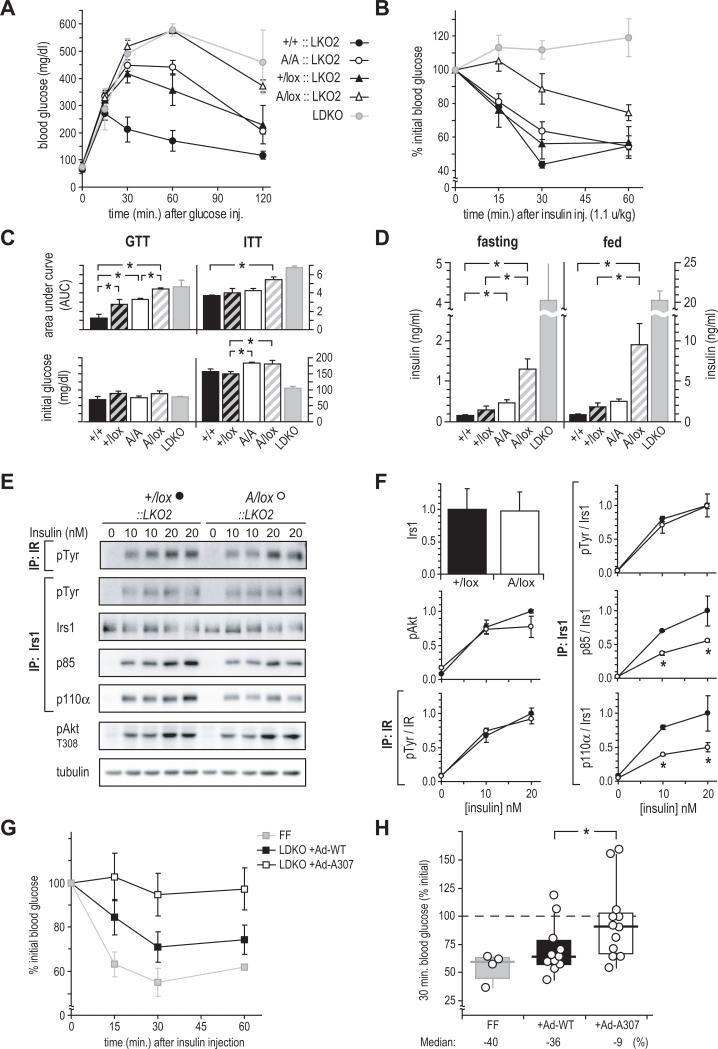
Figure 4. In vivo and ex vivo function of A307Irs1 in the absence of Irs2-mediated signaling
(A and B) GTT and (B) ITT of 6-month-old mice lacking hepatic Irs2 (LKO2::) with varying Irs1 allelic composition. Owing to the action of Cre recombinase on the Irs1lox allele (lox), A/lox::LKO2 and +/lox::LKO2 mice retained a single active Irs1 allele. (C and D) Areas under GTT and ITT curves (AUC), with corresponding initial blood glucose and (D) insulin concentrations. LDKO mice are shown for qualitative comparison. Labels show Irs1 genotype only. Data are mean ± SEM; * = p < 0.05. (E) Insulin signaling in hepatocytes of 10-week-old +/lox::LKO2 and A/lox::LKO2 mice. IP: immunoprecipitation; IB: immunoblot. (F) Quantitation of blots in E; &25cf;: +/lox::LKO2; ○: +/lox::LKO2. Signals were normalized to the average value in 20 nM insulin-stimulated +/lox::LKO2 cells measured in duplicate in two separate experiments. Data represent mean values ± standard deviation. * = p < 0.05 by (Student t test). (G) Insulin tolerance (mean ± SEM at each point) in LDKO mice infected with wild-type (+Ad-WT) or mutant (+Ad-A307) Irs1 adenovirus. Insulin tolerance in non-infected, Cre-negative double-floxed mice (FF) is shown for qualitative comparison. (H) Maximum hypoglycemic response (time=30 min) during the insulin tolerance test in G; box: interquartile range; horizontal bar: median; vertical bar: 95% of distribution. * = p < 0.05.

References

    1. Aguirre V, Uchida T, Yenush L, Davis R, White MF. The c-Jun NH(2)-terminal kinase promotes insulin resistance during association with insulin receptor substrate-1 and phosphorylation of Ser(307). J. Biol. Chem. 2000;275:9047–9054. - PubMed
    1. Bruning JC, Winnay J, Cheatham B, Kahn CR. Differential signaling by insulin receptor substrate 1 (IRS-1) and IRS-2 in IRS-1-deficient cells. Mol. Cell Biol. 1997;17:1513–1521. - PMC - PubMed
    1. Dong XC, Copps KD, Guo S, Li Y, Kollipara R, DePinho RA, White MF. Inactivation of hepatic Foxo1 by insulin signaling is required for adaptive nutrient homeostasis and endocrine growth regulation. Cell Metab. 2008;8:65–76. - PMC - PubMed
    1. Giraud J, Haas M, Feener EP, Copps KD, Dong X, Dunn SL, White MF. Phosphorylation of Irs1 at SER-522 inhibits insulin signaling. Mol. Endocrinol. 2007;21:2294–2302. - PubMed
    1. Harrington LS, Findlay GM, Gray A, Tolkacheva T, Wigfield S, Rebholz H, Barnett J, Leslie NR, Cheng S, Shepherd PR, Gout I, Downes CP, Lamb RF. The TSC1-2 tumor suppressor controls insulin-PI3K signaling via regulation of IRS proteins. J Cell Biol. 2004;166:213–223. - PMC - PubMed

Publication types