Immediate anatomic results after the endovascular treatment of ruptured intracranial aneurysms: analysis in the CLARITY series
- PMID: 20075090
- PMCID: PMC7964183
- DOI: 10.3174/ajnr.A1954
Immediate anatomic results after the endovascular treatment of ruptured intracranial aneurysms: analysis in the CLARITY series
Abstract
Background and purpose: The efficacy of the endovascular treatment in providing stable occlusion of intracranial aneurysms is still controversial and should be precisely analyzed. A first step is to carefully study immediate anatomical results. CLARITY (Clinical and Anatomical Results in the Treatment of Ruptured Intracranial Aneurysms) is a prospective multicenter consecutive series including patients treated by coiling for ruptured aneurysms. Immediate anatomic results are presented.
Materials and methods: Postoperative anatomic results were evaluated by DSA by the treating physician and anonymously and independently by 2 experienced neuroradiologists by using the 3-point Montreal Scale. Patients were divided into 2 groups: patients treated with GDC and those treated with Matrix detachable coils.
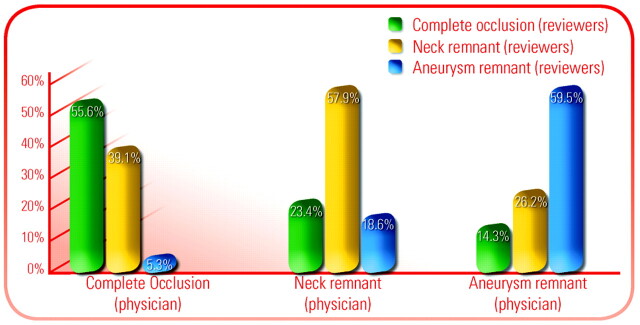
Results: A total of 773 patients (461 women, 312 men; 19-80 years of age; mean, 51.2 +/- 13.2 years) with 773 ruptured aneurysms were included in the study. The rate of occlusion as determined by the treating physician was designated complete for 586 aneurysms (75.8%), neck remnant for 145 aneurysms (18.8%), and aneurysm remnant for 42 aneurysms (5.4%). The same evaluation as reported by the 2 independent reviewers was complete occlusion for 366 aneurysms (47.4%), neck remnant for 324 aneurysms (41.9%), and aneurysm remnant for 83 aneurysms (10.7%). Postoperative anatomic results were significantly linked to age but not to the technique of endovascular treatment or aneurysm characteristics (location, size, dome-to neck ratio). Results were not significantly different between the GDC and Matrix group.
Conclusions: Endovascular treatment of ruptured intracranial aneurysms resulted in a high rate of satisfactory occlusion (complete occlusion and neck remnant in 89.3%). Patient age was the only factor associated with the rate of occlusion. The rate of aneurysm occlusion differed insignificantly between GDC and Matrix coils.
Figures
References
-
- Molyneux AJ, Kerr RS, Yu LM, et al. , for the International Subarachnoid Aneurysm Trial (ISAT) Collaborative Group. International subarachnoid aneurysm trial (ISAT) of neurosurgical clipping versus endovascular coiling in 2143 patients with ruptured intracranial aneurysms: a randomised comparison of effects on survival, dependency, seizures, rebleeding, subgroups, and aneurysm occlusion. Lancet 2005;366:809–17 - PubMed
-
- Raymond J, Guilbert F, Weill A, et al. Long-term angiographic recurrences after selective endovascular treatment of aneurysms with detachable coils. Stroke 2003;34:1398–403 - PubMed
-
- Johnston SC, Dowd CF, Higashida RT, et al. , for the CARAT investigators. Predictors of rehemorrhage after treatment of ruptured intracranial aneurysm: the Cerebral Aneurysm Rerupture After Treatment (CARAT) study. Stroke 2008;39:120–25 - PubMed
Publication types
MeSH terms
LinkOut - more resources
Full Text Sources
Medical