


Brain edema in acute liver failure: inhibition by L-histidine
- PMID: 20075201
- PMCID: PMC2832159
- DOI: 10.2353/ajpath.2010.090756
Brain edema in acute liver failure: inhibition by L-histidine
Abstract
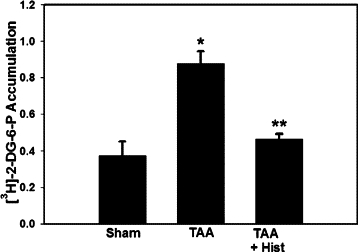
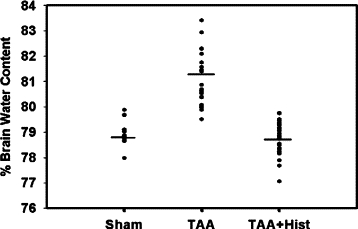
Brain edema and the associated increase in intracranial pressure are potentially lethal complications of acute liver failure (ALF). Astrocyte swelling (cytotoxic edema) represents a significant component of the brain edema in ALF, and elevated blood and brain ammonia levels have been strongly implicated in its formation. We earlier showed in cultured astrocytes that oxidative stress (OS) and the mitochondrial permeability transition (mPT) play major roles in the mechanism of ammonia-induced astrocyte swelling. Glutamine, a byproduct of ammonia metabolism, has also been shown to induce OS, the mPT, and astrocyte swelling. Such effects of glutamine were suggested to be mediated by its hydrolysis in mitochondria, potentially yielding high levels of ammonia in this organelle and leading to OS and the mPT. L-histidine, an inhibitor of mitochondrial glutamine transport, was recently shown to mitigate OS, mPT, and cell swelling in cultured astrocytes treated with ammonia. The present study examined whether L-histidine similarly abolishes OS, the mPT, and brain edema in a rat model of ALF. Treatment of rats with thioacetamide caused a significant degree of brain edema, which was associated with induction of OS and the mPT. These changes were completely abolished by L-histidine, supporting a key role of mitochondrial glutamine transport and hydrolysis in the mechanism of the brain edema associated with ALF.
Figures
References
-
- Capocaccia L, Angelico M. Fulminant hepatic failure. Clinical features, etiology, epidemiology, and current management. Dig Dis Sci. 1991;36:775–779. - PubMed
-
- Hoofnagle JH, Carithers RL, Jr, Shapiro C, Ascher N. Fulminant hepatic failure: summary of a workshop. Hepatology. 1995;21:240–252. - PubMed
-
- Bismuth H, Samuel D, Castaing D, Williams R, Pereira SP. Liver transplantation in Europe for patients with acute liver failure. Semin Liver Dis. 1996;16:415–425. - PubMed
-
- Traber PG, Dal Canto M, Ganger DR, Blei AT. Electron microscopic evaluation of brain edema in rabbits with galactosamine-induced fulminant hepatic failure: ultrastructure and integrity of the blood-brain barrier. Hepatology. 1987;7:1272–1277. - PubMed
-
- Kato M, Sugihara J, Nakamura T, Muto Y. Electron microscopic study of the blood-brain barrier in rats with brain edema and encephalopathy due to acute hepatic failure. Gastroenterol Jpn. 1989;24:135–142. - PubMed
Publication types
MeSH terms
Substances
Grants and funding
LinkOut - more resources
Full Text Sources
