Current Challenges for the Early Detection of Alzheimer's Disease: Brain Imaging and CSF Studies
- PMID: 20076796
- PMCID: PMC2806537
- DOI: 10.3988/jcn.2009.5.4.153
Current Challenges for the Early Detection of Alzheimer's Disease: Brain Imaging and CSF Studies
Abstract
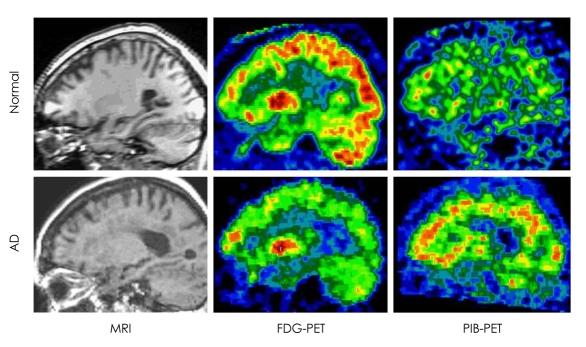
The development of prevention therapies for Alzheimer's disease (AD) would greatly benefit from biomarkers that are sensitive to the subtle brain changes that occur in the preclinical stage of the disease. Reductions in the cerebral metabolic rate of glucose (CMRglc), a measure of neuronal function, have proven to be a promising tool in the early diagnosis of AD. In vivo brain 2-[(18)F]fluoro-2-Deoxy-D-glucose-positron emission tomography (FDG-PET) imaging demonstrates consistent and progressive CMRglc reductions in AD patients, the extent and topography of which correlate with symptom severity. There is increasing evidence that hypometabolism appears during the preclinical stages of AD and can predict decline years before the onset of symptoms. This review will give an overview of FDG-PET results in individuals at risk for developing dementia, including: presymptomatic individuals carrying mutations responsible for early-onset familial AD; patients with Mild Cognitive Impairment (MCI), often a prodrome to late-onset sporadic AD; non-demented carriers of the Apolipoprotein E (ApoE) epsilon4 allele, a strong genetic risk factor for late-onset AD; cognitively normal subjects with a family history of AD; subjects with subjective memory complaints; and normal elderly followed longitudinally until they expressed the clinical symptoms and received post-mortem confirmation of AD. Finally, we will discuss the potential to combine different PET tracers and CSF markers of pathology to improve the early detection of AD.
Keywords: Alzheimer disease; CSF markers; PET.
Figures
References
-
- Kung HC, Hoyert DL, Xu J, Murphy SL. Deaths: final data for 2005. Natl Vital Stat Rep. 2008;56:1–120. - PubMed
-
- McKhann G, Drachman D, Folstein M, Katzman R, Price D, Stadlan EM. Clinical diagnosis of Alzheimer's disease: report of the NINCDS-ADRDA Work Group under the auspices of Department of Health and Human Services Task Force on Alzheimer's Disease. Neurol. 1984;34:939–944. - PubMed
-
- Hebert LE, Scherr PA, Bienias JL, Bennett DA, Evans DA. Alzheimer disease in the US population: prevalence estimates using the 2000 census. Arch Neurol. 2003;60:1119–1122. - PubMed
-
- Mirra SS, Heyman A, McKeel D, Sumi SM, Crain BJ, Brownlee LM, et al. The Consortium to Establish a Registry for Alzheimer's Disease (CERAD). Part II. Standardization of the neuropathologic assessment of Alzheimer's disease. Neurol. 1991;41:479–486. - PubMed
-
- Price JL, Morris JC. Tangles and plaques in nondemented aging and "preclinical" Alzheimer's disease. Ann Neurol. 1999;45:358–368. - PubMed
Grants and funding
LinkOut - more resources
Full Text Sources
Other Literature Sources
Miscellaneous