Clinical Trial
. 2010 Jun;12(2):117-29.
doi: 10.1208/s12248-009-9164-6. Epub 2010 Jan 15.

Quantitative pharmacology approach in Alzheimer's disease: efficacy modeling of early clinical data to predict clinical outcome of tesofensine

Affiliations
Clinical Trial

Quantitative pharmacology approach in Alzheimer's disease: efficacy modeling of early clinical data to predict clinical outcome of tesofensine

Thorsten Lehr et al. AAPS J. 2010 Jun.

Abstract

Effective therapeutic options for Alzheimer's disease (AD) are limited and much research is currently ongoing. The high attrition rate in drug development is a critical issue. Here, the quantitative pharmacology approach (QP-A) and model-based drug development (MBDD) provide a valuable opportunity to support early selection of the most promising compound and facilitate a fast, efficient, and rational drug development process. The aim of this analysis was to exemplify the QP-A by eventually predicting the clinical outcome of a proof-of-concept (PoC) trial of tesofensine in AD patients from two small phase IIa trials. Retrospective population pharmacokinetic/pharmacodynamic (PK/PD) modeling of tesofensine, its metabolite M1, and assessment scale-cognitive subscale data from two 4-week placebo-controlled studies in 62 mild AD patients was performed using non-linear mixed effects modeling. The final PK/PD model was used to predict data of a negative 14-week phase IIb PoC trial (430 AD patients). For the PK, one-compartment models for tesofensine and M1 with first-order absorption and elimination were sufficient. An extended Emax model including disease progression best described the PK/PD relationship using effect compartments. The placebo effect was also implemented in the final PK/PD model based on a published placebo model developed in a large AD cohort. Various internal evaluation techniques confirmed the reliability and predictive performance of the PK/PD model, which also successfully predicted the 14-week PoC data. For tesofensine, the dose concentration-effect relationship has successfully been described in mild AD patients demonstrating the supportive value of PK/PD models in QP-A/MBDD in early phases of clinical development for decision-making.


Figures
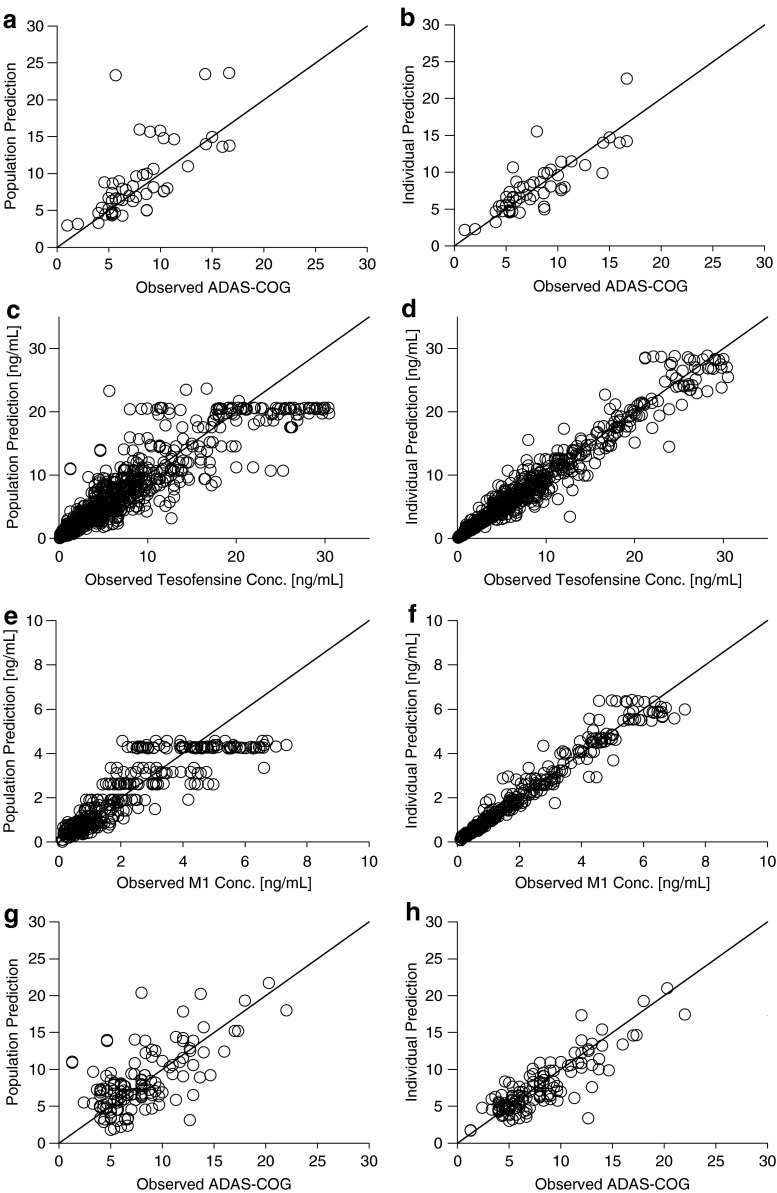
Fig. 1
Fig. 1
Goodness-of-fit plots for the final PK/PD model: population predictions (left panel) and individual predictions (right panel) versus ADAS-Cog measurements of placebo (a, b) and active treatment (g, h) and versus observed plasma concentrations of tesofensine (c, d), and M1 (e, f). Solid line indicates line of identity
Fig. 2
Fig. 2
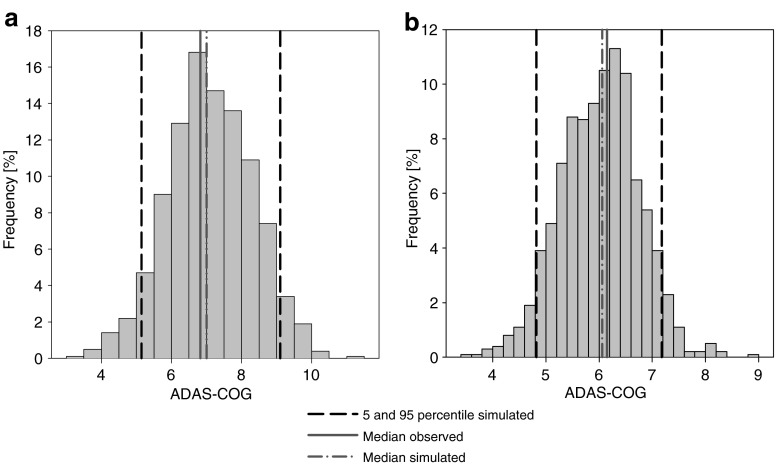
Internal evaluation: quantitative predictive check for the ADAS-Cog at the end of treatment (4 weeks) of a placebo and b active treatment
Fig. 3
Fig. 3
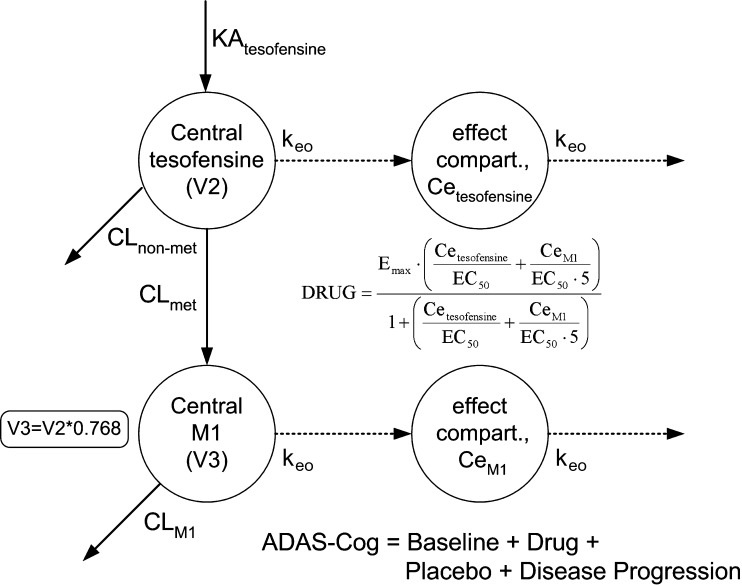
Schematic final PK/PD model
Fig. 4
Fig. 4
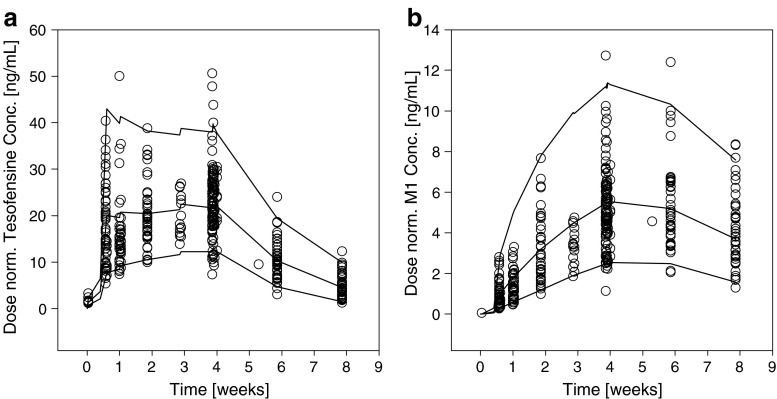
Internal evaluation: visual predictive checks for a tesofensine and b M1. Observed concentrations (circles) and calculated fifth, 50th (median), and 95th percentiles (solid lines) from simulations are shown over time
Fig. 5
Fig. 5
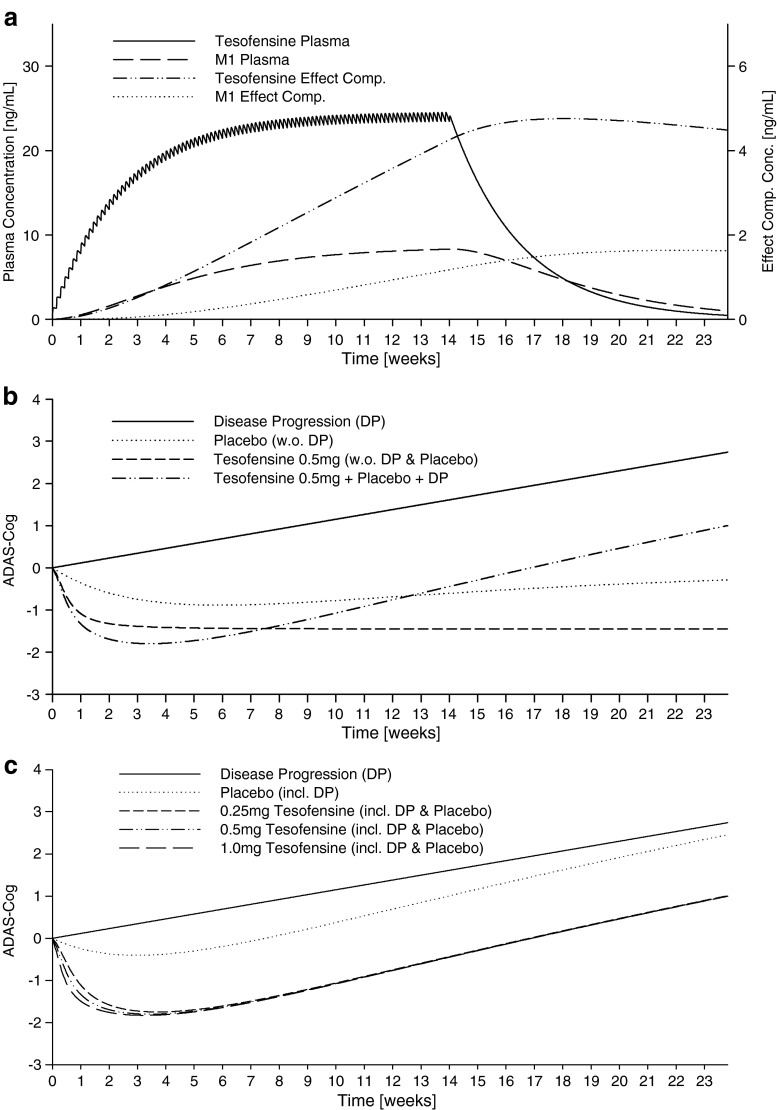
Simulated pharmacokinetic and pharmacodynamic profiles using the final PK/PD model: a simulated median plasma and effect compartment concentration–time profiles after once-daily oral dosing of 0.5 mg tesofensine; b simulated median ADAS-Cog over time after a 14 week once daily oral administration of placebo, 0.25, 0.5, and 1.0 mg tesofensine and for disease progression; c simulated median ADAS-cog (including disease progression) over time after a 4- and 14-week administration of placebo and 0.5 mg tesofensine and for disease progression, respectively
Fig. 6
Fig. 6
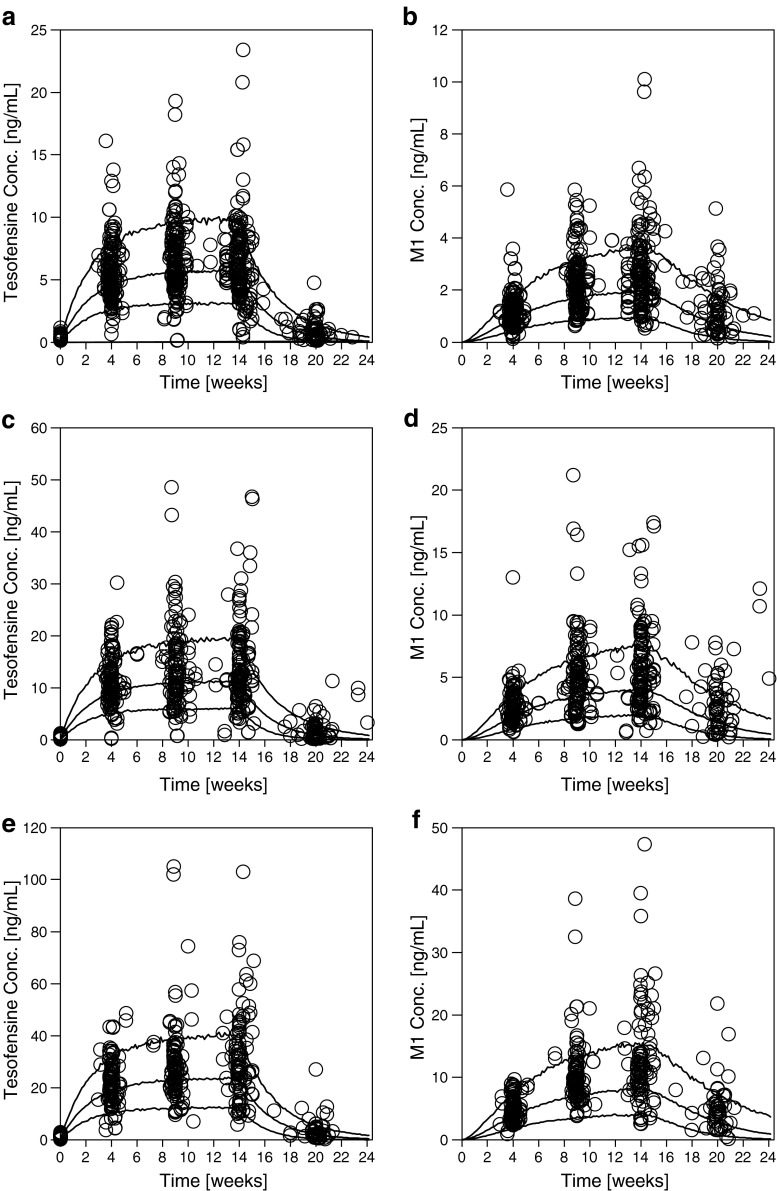
External PK predictions for tesofensine (left panels) and M1 (right panels) for the 0.25 mg (a, b), 0.5 mg (c, d), and 1.0 mg (e, f) dose group. Observed concentrations (circles) and calculated fifth, 50th (median), and 95th percentiles (solid lines) from simulations are shown over time
Fig. 7
Fig. 7
External PD predictions of the baseline-subtracted ADAS-Cog measurements: observed concentrations (circles) and calculated median, fifth and 95th percentiles (solid lines) from simulations are shown over time for the 0.25 (a), 0.5 (b), 1.0 mg (c), and placebo (d) dose group. Box-whisker plot (e) (box 25th, 50th, and 75th percentile, whiskers tenth and 90th percentile, open circles fifth and 95 percentile) of observed (OBS) and simulated (SIM) ADAS-Cog values at week 14 of the 0.25, 0.5, 1.0 mg, and placebo dose group
Fig. 8
Fig. 8
Simulated pharmacokinetic (a) and pharmacodynamic (b) profiles using the final PK/PD model with parameter estimates of the phase IIa dataset and the combined phase IIa and IIb dataset once-daily oral dosing of 0.5 mg tesofensine for 14 weeks

References

    1. Kola I, Landis J. Can the pharmaceutical industry reduce attrition rates? Nat Rev Drug Discov. 2004;3:711–5. doi: 10.1038/nrd1470. - DOI - PubMed
    1. Tufts Center for the Study of Drug Development. Impact Report: Fastest drug developers consistently best peers on key performance metrics, Tufts University, Boston, 2006.
    1. US Food and Drug Administration. Innovation or Stagnation: Challenge and opportunity on the critical path to new medical products, Rockville, 2004.
    1. Frantz S. Pipeline problems are increasing the urge to merge. Nat Rev. 2006;5:977–9. doi: 10.1038/nrd2206. - DOI - PubMed
    1. Bhattaram VA, Booth BP, Ramchandani RP, et al. Impact of pharmacometrics on drug approval and labeling decisions: a survey of 42 new drug applications. AAPS J. 2005;7:E503–12. doi: 10.1208/aapsj070351. - DOI - PMC - PubMed

Publication types

MeSH terms

Substances