


Varying target prevalence reveals two dissociable decision criteria in visual search
- PMID: 20079642
- PMCID: PMC2818748
- DOI: 10.1016/j.cub.2009.11.066
Varying target prevalence reveals two dissociable decision criteria in visual search
Abstract
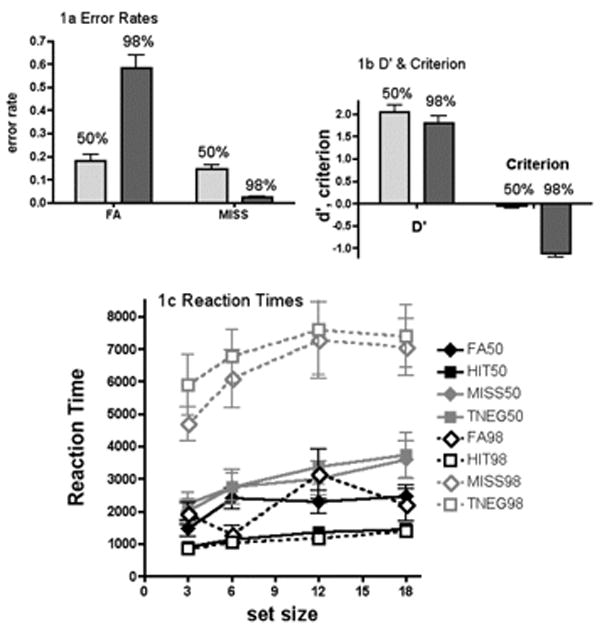
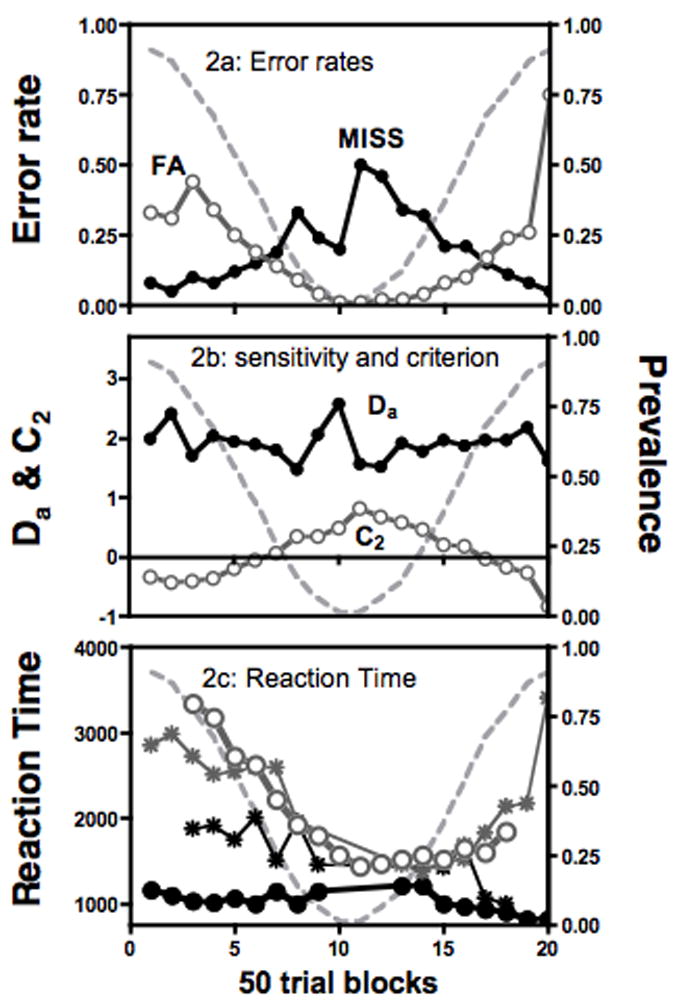
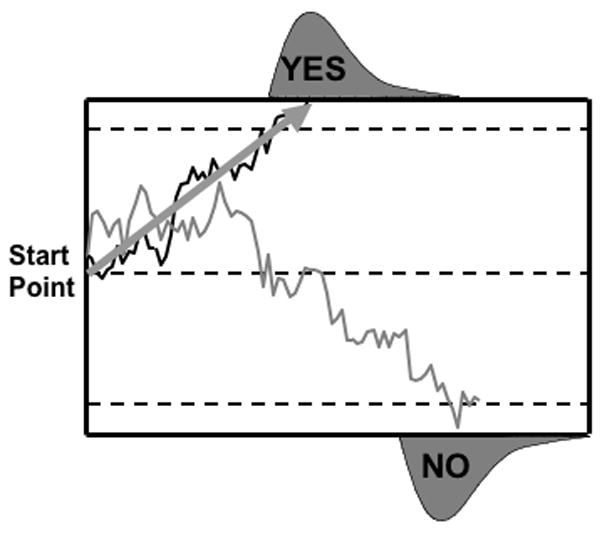
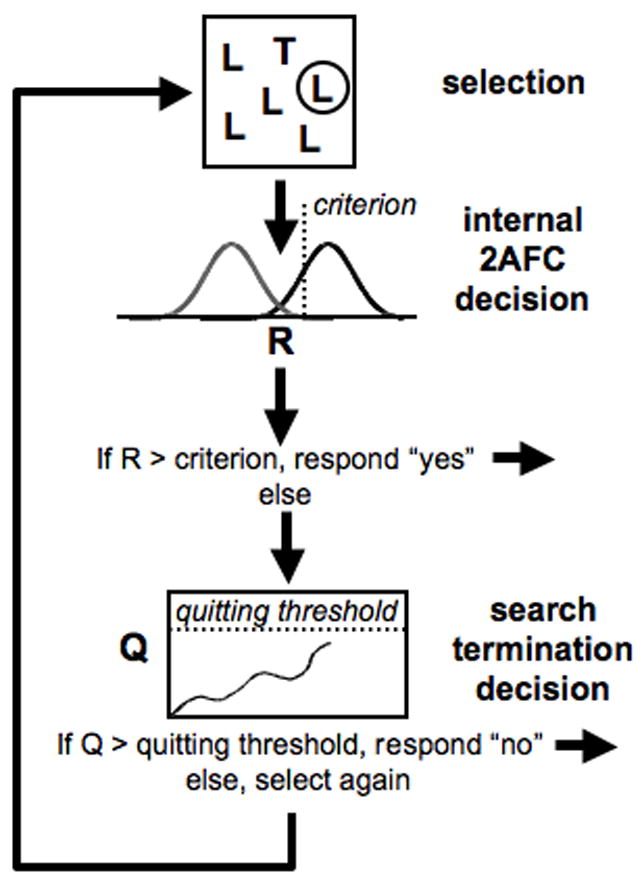
Target prevalence powerfully influences visual search behavior. In most visual search experiments, targets appear on at least 50% of trials [1-3]. However, when targets are rare (as in medical or airport screening), observers shift response criteria, leading to elevated miss error rates [4, 5]. Observers also speed target-absent responses and may make more motor errors [6]. This could be a speed/accuracy tradeoff with fast, frequent absent responses producing more miss errors. Disproving this hypothesis, our experiment one shows that very high target prevalence (98%) shifts response criteria in the opposite direction, leading to elevated false alarms in a simulated baggage search. However, the very frequent target-present responses are not speeded. Rather, rare target-absent responses are greatly slowed. In experiment two, prevalence was varied sinusoidally over 1000 trials as observers' accuracy and reaction times (RTs) were measured. Observers' criterion and target-absent RTs tracked prevalence. Sensitivity (d') and target-present RTs did not vary with prevalence [7-9]. These results support a model in which prevalence influences two parameters: a decision criterion governing the series of perceptual decisions about each attended item, and a quitting threshold that governs the timing of target-absent responses. Models in which target prevalence only influences an overall decision criterion are not supported.
Copyright 2010 Elsevier Ltd. All rights reserved.
Figures
References
-
- Wolfe JM. Visual search. In: Pashler H, editor. Attention. Hove, East Sussex, UK: Psychology Press Ltd; 1998. pp. 13–74.
-
- Verghese P. Visual search and attention: A signal detection approach. Neuron. 2001;31:523–535. - PubMed
-
- Wolfe JM, Reynolds JH. Visual Search. In: Basbaum AI, Kaneko A, Shepherd GM, Westheimer G, editors. The Senses: A Comprehensive Reference. Vol. 2. San Diego: Academic Press; 2008. pp. 275–280. VIsion II.
Publication types
MeSH terms
Grants and funding
LinkOut - more resources
Full Text Sources
Molecular Biology Databases
