


Comment
doi: 10.1073/pnas.0913576107.
Epub 2010 Jan 8.
CFTR: break a pump, make a channel
Affiliations
- PMID: 20080601
- PMCID: PMC2824264
- DOI: 10.1073/pnas.0913576107
Item in Clipboard
Comment
CFTR: break a pump, make a channel
Proc Natl Acad Sci U S A.
.
No abstract available
Conflict of interest statement
The author declares no conflict of interest.
Figures
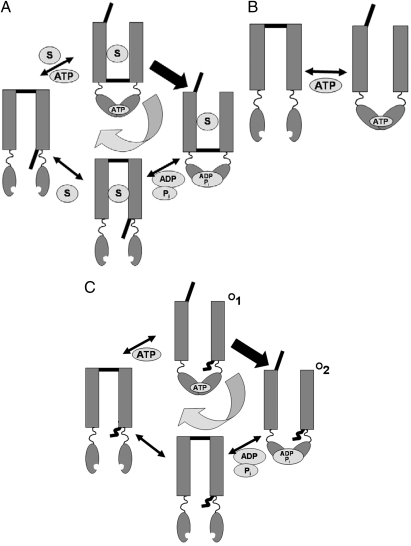
Skeleton mechanisms of ABC transporters and ligand-gated ion channels. (A) ABC transporter pumping cycle. A grossly oversimplified ABC-type pump is composed of two nucleotide-binding domains (NBD) attached to a membrane-spanning domain, which binds substrate S between two “gates.” Two conformations can exist, outward-facing (upper gate open, NBDs occupied) or inward-facing (lower gate open, NBDs empty). Double-headed arrows represent reversible steps, single-headed arrow an irreversible step. The scheme ignores details crucial to ABC mechanisms, such as the participation of two ATP molecules in the cycle, and intends merely to emphasize net cycling (curved arrow) resulting from including an irreversible step. (B) Equilibrium gating for idealized ATP-gated ion channel. The membrane-embedded part of the channel carries a single gate, open only when ATP is bound. Opening is thus driven merely by ATP binding, closing by dissociation. (C) Hydrolysis-driven CFTR gating. CFTR viewed as adhering to an ABC-like conformational cycle as in A, but with an always-open vestigial inner gate (for which no evidence exists). ATP hydrolysis drives the irreversible transition between the two Cl−-conducting states, O1 and O2.
Comment on
-
Strict coupling between CFTR's catalytic cycle and gating of its Cl- ion pore revealed by distributions of open channel burst durations.Proc Natl Acad Sci U S A. 2010 Jan 19;107(3):1241-6. doi: 10.1073/pnas.0911061107. Epub 2009 Dec 4. Proc Natl Acad Sci U S A. 2010. PMID: 19966305 Free PMC article.
References
-
- Csanády, et al. This Issue.
-
- Baukrowitz T, Hwang T-C, Nairn AC, Gadsby DC. Coupling of CFTR Cl− channel gating to an ATP hydrolysis cycle. Neuron. 1994;12:473–482. - PubMed
Publication types
MeSH terms
Substances
Grants and funding
LinkOut - more resources
Full Text Sources
