


High throughput sequencing reveals a complex pattern of dynamic interrelationships among human T cell subsets
- PMID: 20080641
- PMCID: PMC2824416
- DOI: 10.1073/pnas.0913939107
High throughput sequencing reveals a complex pattern of dynamic interrelationships among human T cell subsets
Abstract
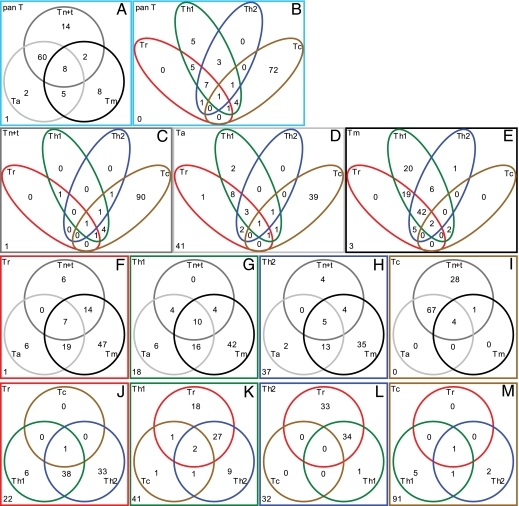
Developing T cells face a series of cell fate choices in the thymus and in the periphery. The role of the individual T cell receptor (TCR) in determining decisions of cell fate remains unresolved. The stochastic/selection model postulates that the initial fate of the cell is independent of TCR specificity, with survival dependent on additional TCR/coreceptor "rescue" signals. The "instructive" model holds that cell fate is initiated by the interaction of the TCR with a cognate peptide-MHC complex. T cells are then segregated on the basis of TCR specificity with the aid of critical coreceptors and signal modulators [Chan S, Correia-Neves M, Benoist C, Mathis (1998) Immunol Rev 165: 195-207]. The former would predict a random representation of individual TCR across divergent T cell lineages whereas the latter would predict minimal overlap between divergent T cell subsets. To address this issue, we have used high-throughput sequencing to evaluate the TCR distribution among key T cell developmental and effector subsets from a single donor. We found numerous examples of individual subsets sharing identical TCR sequence, supporting a model of a stochastic process of cell fate determination coupled with dynamic patterns of clonal expansion of T cells bearing the same TCR sequence among both CD4(+) and CD8+ populations.
Conflict of interest statement
The authors declare no conflict of interest.
Figures

References
-
- Harrington LE, et al. Interleukin 17-producing CD4+ effector T cells develop via a lineage distinct from the T helper type 1 and 2 lineages. Nat Immunol. 2005;6:1123–1132. - PubMed
-
- Paul WE. Fundamental Immunology. 6th Ed. Lippincott Williams & Wilkins, Philadelphia, PA; 2008. p. 1632.
Publication types
MeSH terms
Substances
Grants and funding
LinkOut - more resources
Full Text Sources
Other Literature Sources
Research Materials
