


Symbolic use of marine shells and mineral pigments by Iberian Neandertals
- PMID: 20080653
- PMCID: PMC2824307
- DOI: 10.1073/pnas.0914088107
Symbolic use of marine shells and mineral pigments by Iberian Neandertals
Abstract
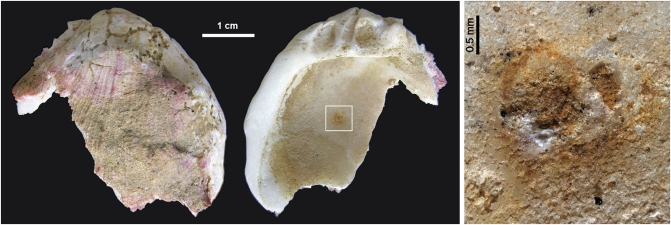
Two sites of the Neandertal-associated Middle Paleolithic of Iberia, dated to as early as approximately 50,000 years ago, yielded perforated and pigment-stained marine shells. At Cueva de los Aviones, three umbo-perforated valves of Acanthocardia and Glycymeris were found alongside lumps of yellow and red colorants, and residues preserved inside a Spondylus shell consist of a red lepidocrocite base mixed with ground, dark red-to-black fragments of hematite and pyrite. A perforated Pecten shell, painted on its external, white side with an orange mix of goethite and hematite, was abandoned after breakage at Cueva Antón, 60 km inland. Comparable early modern human-associated material from Africa and the Near East is widely accepted as evidence for body ornamentation, implying behavioral modernity. The Iberian finds show that European Neandertals were no different from coeval Africans in this regard, countering genetic/cognitive explanations for the emergence of symbolism and strengthening demographic/social ones.
Conflict of interest statement
The authors declare no conflict of interest.
Figures



References
-
- d’Errico F, Henshilwood C, Vanhaeren M, van Niekerk K. Nassarius kraussianus shell beads from Blombos Cave: Evidence for symbolic behaviour in the Middle Stone Age. J Hum Evol. 2005;48:3–24. - PubMed
-
- Mellars P, Stringer C. The Human Revolution. Edinburgh: University Press; 1989.
-
- Klein R. Whither the Neanderthals? Science. 2003;299:1525–1527. - PubMed
Publication types
MeSH terms
Substances
LinkOut - more resources
Full Text Sources
Medical
Molecular Biology Databases
