


Variation in child cognitive ability by week of gestation among healthy term births
- PMID: 20080810
- PMCID: PMC3435092
- DOI: 10.1093/aje/kwp413
Variation in child cognitive ability by week of gestation among healthy term births
Abstract
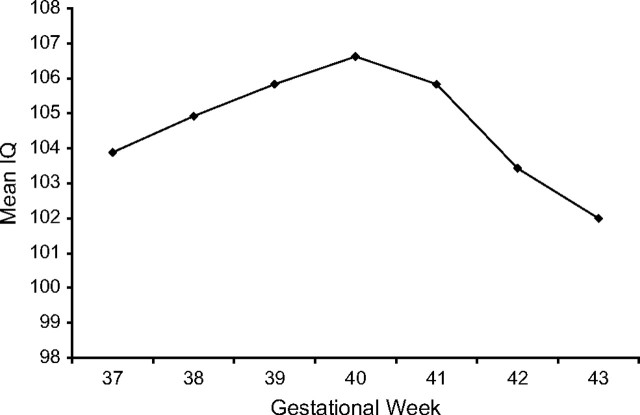
The authors investigated variations in cognitive ability by gestational age among 13,824 children at age 6.5 years who were born at term with normal weight, using data from a prospective cohort recruited in 1996-1997 in Belarus. The mean differences in the Wechsler Abbreviated Scales of Intelligence were examined by gestational age in completed weeks and by fetal growth after controlling for maternal and family characteristics. Compared with the score for those born at 39-41 weeks, the full-scale intelligence quotient (IQ) score was 1.7 points (95% confidence interval (CI): -2.7, -0.7) lower in children born at 37 weeks and 0.4 points (95% CI: -1.1, 0.02) lower at 38 weeks after controlling for confounders. There was also a graded relation in postterm children: a 0.5-points (95% CI: -2.6, 1.6) lower score at 42 weeks and 6.0 points (95% CI: -15.1, 3.1) lower at 43 weeks. Compared with children born large for gestational age (>90th percentile), children born small for gestational age (<10th percentile) had the lowest IQ, followed by those at the 10th-50th percentile and those at the >50th-90th percentile. These findings suggest that, even among healthy children born at term, cognitive ability at age 6.5 years is lower in those born at 37 or 38 weeks and those with suboptimal fetal growth.
Figures
References
-
- Heimstad R, Romundstad PR, Eik-Nes SH, et al. Outcomes of pregnancy beyond 37 weeks of gestation. Obstet Gynecol. 2006;108(3 pt 1):500–508. - PubMed
-
- Nicholson JM, Kellar LC, Kellar GM. The impact of the interaction between increasing gestational age and obstetrical risk on birth outcomes: evidence of a varying optimal time of delivery. J Perinatol. 2006;26(7):392–402. - PubMed
-
- Zhang X, Kramer MS. Variations in mortality and morbidity by gestational age among infants born at term. J Pediatr. 2009;154(3):358–362. - PubMed
-
- Fitzhardinge PM, Steven EM. The small-for-date infant. II. Neurological and intellectual sequelae. Pediatrics. 1972;50(1):50–57. - PubMed
-
- Calame A, Fawer CL, Claeys V, et al. Neurodevelopmental outcome and school performance of very-low-birth-weight infants at 8 years of age. Eur J Pediatr. 1986;145(6):461–466. - PubMed
Publication types
MeSH terms
Grants and funding
LinkOut - more resources
Full Text Sources
Medical
