Involvement of transducer of regulated cAMP response element-binding protein activity on corticotropin releasing hormone transcription
- PMID: 20080871
- PMCID: PMC2840689
- DOI: 10.1210/en.2009-0963
Involvement of transducer of regulated cAMP response element-binding protein activity on corticotropin releasing hormone transcription
Abstract
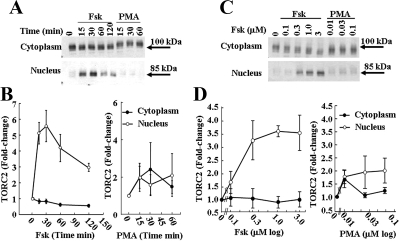
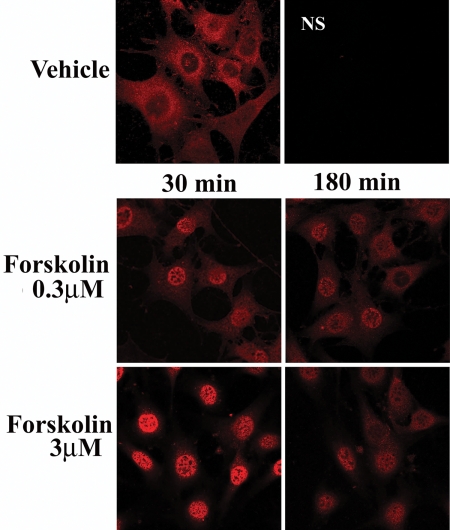
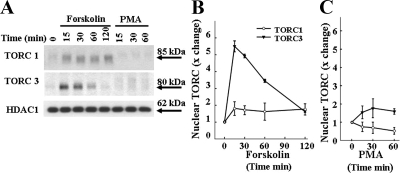
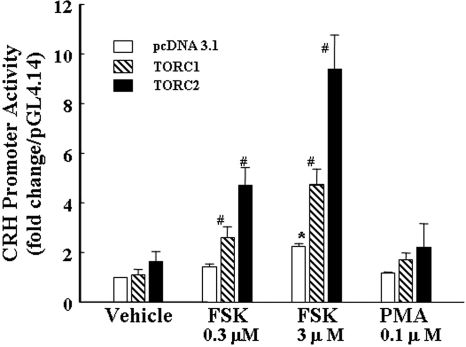
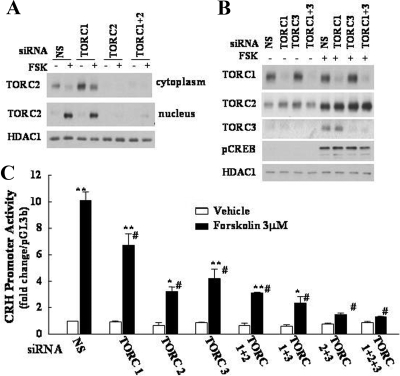
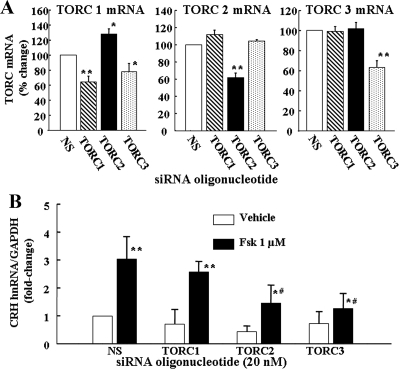
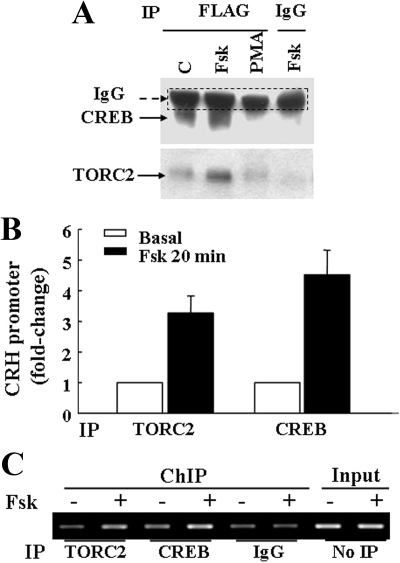
We have recently shown that phospho-cAMP response element-binding protein (CREB) is essential but not sufficient for activation of CRH transcription, suggesting the requirement of a coactivator. Here, we test the hypothesis that the CREB coactivator, transducer of regulated CREB activity (TORC), is required for activation of CRH transcription, using the cell line 4B and primary cultures of hypothalamic neurons. Immunohistochemistry and Western blot experiments in 4B cells revealed time-dependent nuclear translocation of TORC1,TORC 2, and TORC3 by forskolin [but not by the phorbol ester, phorbol 12-myristate 13-acetate (PMA)] in a concentration-dependent manner. In reporter gene assays, cotransfection of TORC1 or TORC2 potentiated the stimulatory effect of forskolin on CRH promoter activity but had no effect in cells treated with PMA. Knockout of endogenous TORC using silencing RNA markedly inhibited forskolin-activated CRH promoter activity in 4B cells, as well as the induction of endogenous CRH primary transcript by forskolin in primary neuronal cultures. Coimmunoprecipitation and chromatin immunoprecipitation experiments in 4B cells revealed association of CREB and TORC in the nucleus, and recruitment of TORC2 by the CRH promoter, after 20-min incubation with forskolin. These studies demonstrate a correlation between nuclear translocation of TORC with association to the CRH promoter and activation of CRH transcription. The data suggest that TORC is required for transcriptional activation of the CRH promoter by acting as a CREB coactivator. In addition, cytoplasmic retention of TORC during PMA treatment is likely to explain the failure of phorbolesters to activate CRH transcription in spite of efficiently phosphorylating CREB.
Figures
Comment in
-
TORC: a new twist on corticotropin-releasing hormone gene expression.Endocrinology. 2010 Mar;151(3):855-8. doi: 10.1210/en.2009-1503. Endocrinology. 2010. PMID: 20172974 Free PMC article. No abstract available.
References
-
- Aguilera G 1994 Regulation of pituitary ACTH secretion during chronic stress. Front Neuroendocrinol 15:321–350 - PubMed
-
- Dallman MF, Akana SF, Levin N, Walker C-D, Bradbury MJ, Suemaru S, Scribner KS 1994 Corticosteroids and the control of function in the hypothalamo-pituitary-adrenal (HPA) axis. Ann NY Acad Sci 746:22–28 - PubMed
-
- Munck A, Naray-Fejes-Toth A 1994 Glucocorticoids and stress: permissive and suppressive actions. Ann NY Acad Sci 746:115–130 - PubMed
-
- Herbert J, Goodyer IM, Grossman AB, Hastings MH, de Kloet ER, Lightman SL, Lupien SJ, Roozendaal B, Seckl JR 2006 Do corticosteroids damage the brain? J Neuroendocrinol 18:393–411 - PubMed
-
- McEwen BS, Brinton RE, Sapolsky RM 1988 Glucocorticoid receptors and behavior: implications for the stress response. Adv Exp Med Biol 245:35–45 - PubMed