. 2010 Mar;192(6):1719-29.
doi: 10.1128/JB.01429-09. Epub 2010 Jan 15.

Proteomic alterations explain phenotypic changes in Sinorhizobium meliloti lacking the RNA chaperone Hfq

Affiliations

Proteomic alterations explain phenotypic changes in Sinorhizobium meliloti lacking the RNA chaperone Hfq

Lise Barra-Bily et al. J Bacteriol. 2010 Mar.

Abstract

The ubiquitous bacterial RNA-binding protein Hfq is involved in stress resistance and pathogenicity. In Sinorhizobium meliloti, Hfq is essential for the establishment of symbiosis with Medicago sativa and for nitrogen fixation. A proteomic analysis identifies 55 proteins with significantly affected expression in the hfq mutant; most of them are involved in cell metabolism or stress resistance. Important determinants of oxidative stress resistance, such as CysK, Gsh, Bfr, SodC, KatB, KatC, and a putative peroxiredoxine (SMc00072), are downregulated in the hfq mutant. The hfq mutant is affected for H(2)O(2), menadione, and heat stress resistance. Part of these defects could result from the reductions of rpoE1, rpoE2, rpoE3, and rpoE4 expression levels in the hfq mutant. Some proteins required for efficient symbiosis are reduced in the hfq mutant, contributing to the drastic defect in nodulation observed in this mutant.


Figures
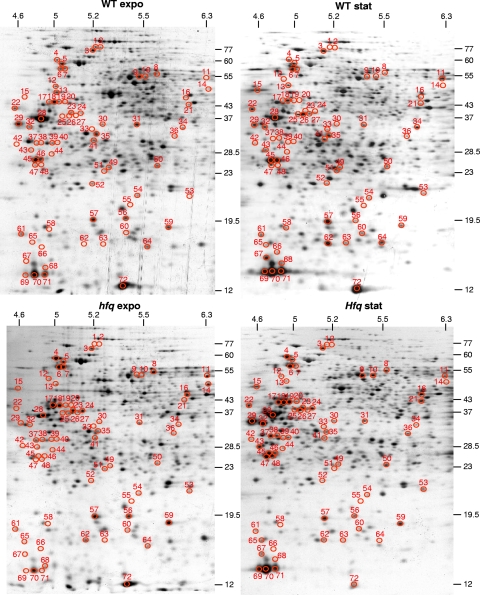
FIG. 1.
FIG. 1.
Detection of proteins affected in the hfq mutant. WT and hfq strains were grown in GAS medium and collected during exponential growth phase (expo) or in late stationary growth phase (stat). Protein extracts were resolved by 2-D gel electrophoresis.
FIG. 2.
FIG. 2.
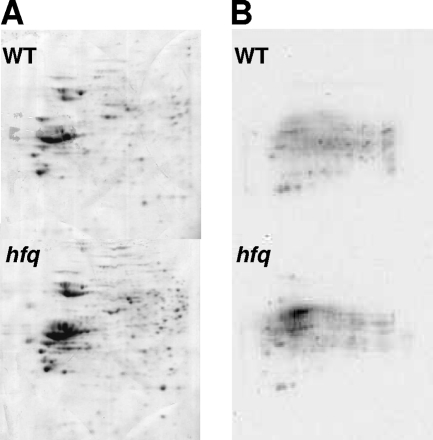
Visualization of protein carbonylation. WT and hfq strains were grown on GAS medium and collected during late stationary growth phase. Proteins were separated by 2-D gel electrophoresis. Gels were stained with Coomassie blue (A) or transferred on a nitrocellulose sheet for carbonyl detection (B) using the OxyBlot protein oxidation detection system.
FIG. 3.
FIG. 3.
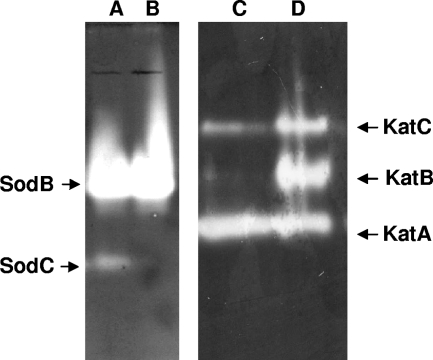
Gel assays of SOD and catalase activities. WT (A, D) and hfq (B, C) strains were grown on GAS medium and collected during stationary growth phase, and SOD (A, B) or catalase (C, D) activities were revealed on nondenaturing polyacrylamide gels as described in Materials and Methods.
FIG. 4.
FIG. 4.
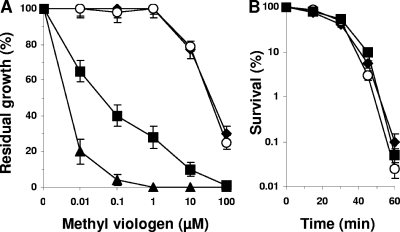
Resistance to superoxide. (A) Influence of methyl viologen on the growth of WT (closed diamonds), hfq (closed squares), sodB (closed triangles), and sodC (open circles) strains. Cells were grown in GAS medium containing 0 to 100 μM methyl viologen to late stationary growth phase. Residual growth corresponds to the ratio of maximal growth yield in GAS medium supplemented with methyl viologen to maximal growth yield in GAS medium for each strain. The results are the averages from three independent experiments, and the bars represent the standard deviations. (B) Influence of pyrogallol on bacterial survival. Cells of WT (closed diamonds), hfq (closed squares), and sodC (open circles) strains were grown in GAS medium, collected by centrifugation, and incubated in PBS buffer containing 2 mM pyrogallol and 1,000 U ml−1 of bovine liver catalase. Aliquots were removed periodically, and survival was estimated by serial dilution and plating on LB plates. The results are the means from five independent experiments, and the standard deviations are indicated.
FIG. 5.
FIG. 5.
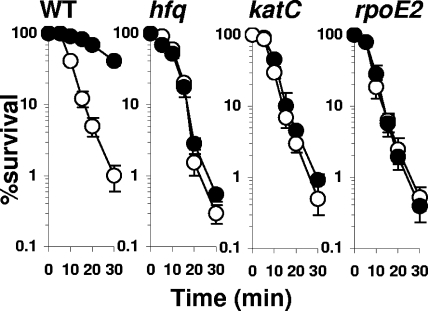
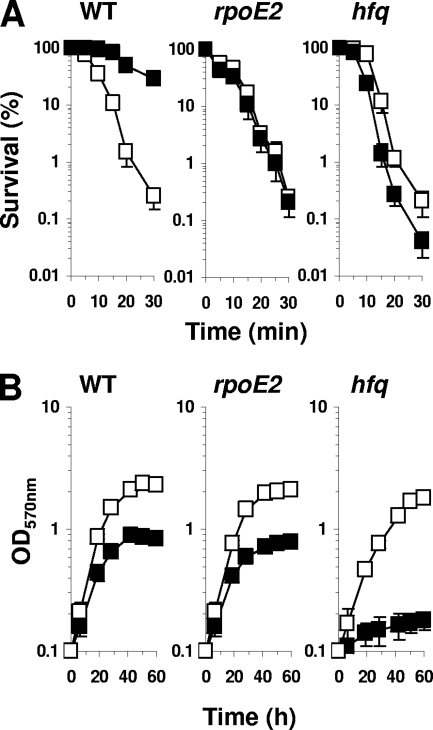
Sensitivity of S. meliloti WT, hfq, katC, and rpoE2 strains to H2O2. All the strains were grown in GAS medium. Cells were collected in exponential (open symbols) or stationary (closed symbols) phases of growth and challenged with 100 mM H2O2. The data are represented as percent survival relative to the level for unstressed cells (t = 0 min). The results are the means from five independent experiments.
FIG. 6.
FIG. 6.
Resistance to heat stress of WT, hfq, and rpoE2 strains. (A) Cells were grown in GAS medium and collected during exponential (open symbols) or stationary (closed symbols) growth phase. Cells were challenged at 50°C for 0 to 30 min. The results are the means from five independent experiments. (B) Cells were grown in GAS medium at 30°C (open symbols) or at 40°C (closed symbols).
FIG. 7.
FIG. 7.
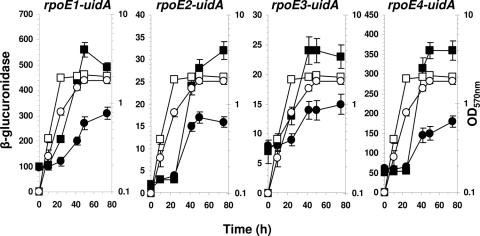
Hfq affects rpoE expression. Strains bearing an uidA transcriptional fusion with rpoE1, rpoE2, rpoE3, and rpoE4 in a WT genetic background (squares) or in an hfq genetic background (circles) were grown in GAS medium. Growth, represented by the OD570 of the culture (open symbols) and β-glucuronidase specific activity (closed symbols), was determined periodically. β-Glucuronidase is expressed as nanomoles of substrate hydrolyzed per min and mg of protein. The results are the averages from at least three independent experiments, and the standard deviations are indicated.

References

    1. Ackerley, D. F., Y. Barak, S. V. Lynch, J. Curtin, and A. Matin. 2006. Effect of chromate stress on Escherichia coli K-12. J. Bacteriol. 188:3371-3381. - PMC - PubMed
    1. Ammendola, S., P. Pasquali, F. Pacello, G. Rotilio, M. Castor, S. J. Libby, N. Figueroa-Bossi, L. Bossi, F. C. Fang, and A. Battistoni. 2008. Regulatory and structural differences in the Cu, Zn-superoxide dismutases of Salmonella enterica and their significance for virulence. J. Biol. Chem. 283:13688-13699. - PMC - PubMed
    1. Ampe, F., E. Kiss, F. Sabourdy, and J. Batut. 2003. Transcriptome analysis of Sinorhizobium meliloti during symbiosis. Genome Biol. 4:R15. - PMC - PubMed
    1. Balleza, E., L. N. Lopez-Bojorquez, A. Martinez-Antonio, O. Resendis-Antonio, I. Lozada-Chavez, Y. I. Balderas-Martinez, S. Encarnacion, and J. Collado-Vides. 2009. Regulation by transcription factors in bacteria: beyond description. FEMS Microbiol. Rev. 33:133-151. - PMC - PubMed
    1. Bardin, S., S. Dan, M. Osteras, and T. M. Finan. 1996. A phosphate transport system is required for symbiotic nitrogen fixation by Rhizobium meliloti. J. Bacteriol. 178:4540-4547. - PMC - PubMed

Publication types

MeSH terms

Substances

LinkOut - more resources