


Exploring the role of a nicotine quantity-frequency use criterion in the classification of nicotine dependence and the stability of a nicotine dependence continuum over time
- PMID: 20081041
- PMCID: PMC2825099
- DOI: 10.1093/ntr/ntp196
Exploring the role of a nicotine quantity-frequency use criterion in the classification of nicotine dependence and the stability of a nicotine dependence continuum over time
Abstract
Introduction: This study investigated (a) the utility of a cigarette quantity-frequency (QF) use criterion as an indicator for nicotine dependence (ND) and (b) the stability of the ND continuum of severity over time.
Method: Data from individuals who smoked cigarettes in the year prior to both time points of the National Epidemiologic Survey on Alcohol and Related Conditions were analyzed (n = 6,185). The Alcohol Use Disorder and Associated Disabilities Interview Schedule DSM-IV Version (AUDADIS-IV) assessed for DSM-IV ND and nicotine use. Three QF criteria were created to represent daily consumption of > or = 5 cigarettes, > or = 10 cigarettes, or > or = 20 cigarettes. Confirmatory factor analysis and item response theory analysis were used to explore the latent structure of ND. Differential item functioning (DIF) analysis investigated the stability of the ND continuum over time.
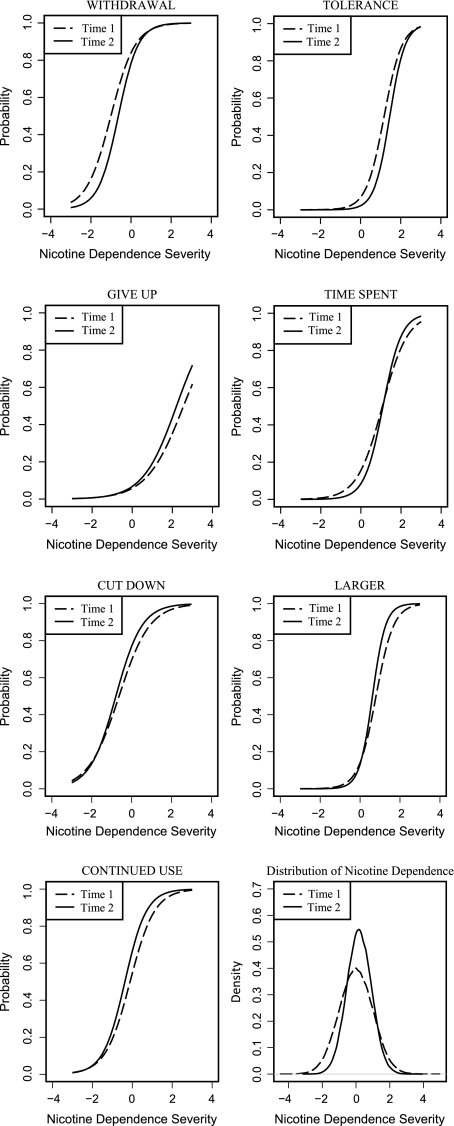
Results: A one-factor model, representing the DSM-IV conceptualization of ND, was an acceptable fit to the data at both time points. The inclusion of QF criteria decreased the fit of the one-factor model of ND. DIF in the severity and discrimination parameters of the diagnostic criteria was evident across the time points of the survey.
Discussion: Although QF of cigarette use is related to ND, it appears to be a separate construct. Researchers using the AUDADIS-IV should be aware that the characteristics of the DSM-IV ND criteria do vary slightly across time, even though the changes appear to be relatively small and of minor clinical or practical significance.
Figures
References
-
- American Psychiatric Association. Diagnostic and statistical manual of mental disorders. 4th ed. Washington, DC: Author; 1994.
-
- Benjamini Y, Hochberg Y. Controlling false discovery rate: A practical and powerful approach to multiple testing. Journal of the Royal Statistical Society Series B. 1995;57:289–300.
-
- Bentler PM. Comparative fit indices in structural models. Psychological Bulletin. 1990;107:238–246. - PubMed
-
- Beseler CL, Shmulewitz D, Aharonovich E, Hasin D. DSM-IV alcohol abuse and dependence: An IRT analysis in Israeli household residents. Alcoholism: Clinical and Experimental Research. 2009;33(Suppl.):66A.
-
- Birnbaum A. Some latent trait models and their use in inferring an examinee’s ability. In: Lord FM, Novick MR, editors. Statistical theories of mental test scores. Reading, MA: Addison-Wesley; 1968. pp. 395–479.
Publication types
MeSH terms
LinkOut - more resources
Full Text Sources
