High-dose RHAMM-R3 peptide vaccination for patients with acute myeloid leukemia, myelodysplastic syndrome and multiple myeloma
- PMID: 20081055
- PMCID: PMC2895045
- DOI: 10.3324/haematol.2009.014704
High-dose RHAMM-R3 peptide vaccination for patients with acute myeloid leukemia, myelodysplastic syndrome and multiple myeloma
Abstract
Background: Recently, we demonstrated immunological and clinical responses to a RHAMM-R3 peptide vaccine in patients with acute myeloid leukemia, myelodysplastic syndrome and multiple myeloma. To improve the outcome of the vaccine, a second cohort was vaccinated with a higher dose of 1,000 microg peptide.
Design and methods: Nine patients received four vaccinations subcutaneously at a biweekly interval. Immunomonitoring of cytotoxic CD8(+) as well as regulatory CD4(+) T cells was performed by flow cytometry as well as by enzyme-linked immunospot (ELISpot) assays. Parameters of clinical response were assessed.
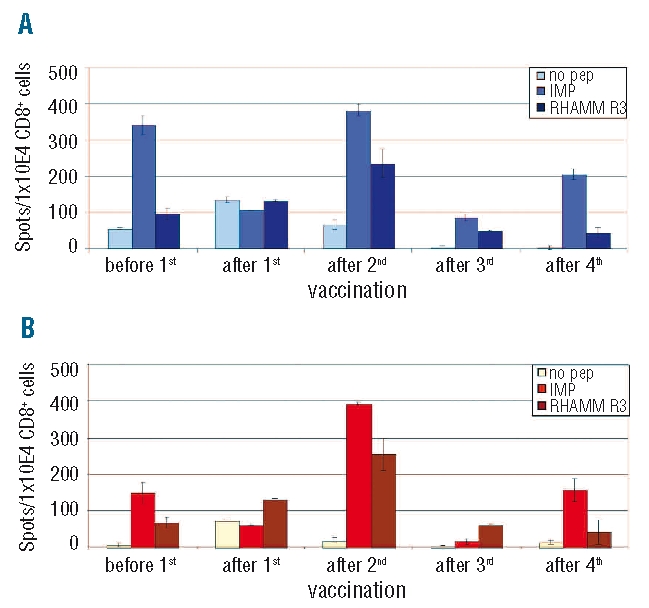
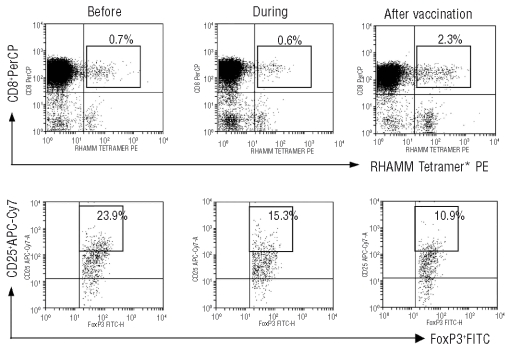
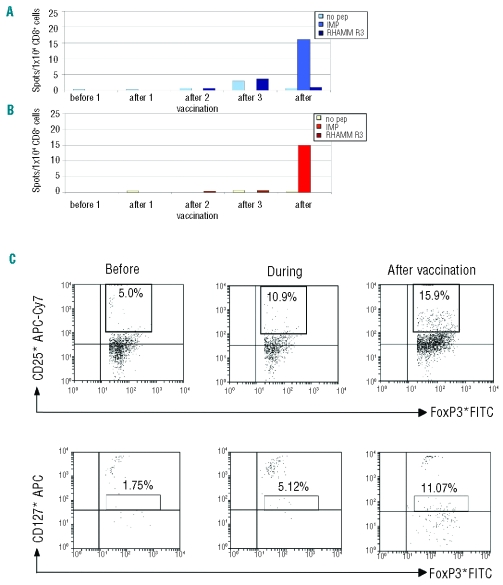
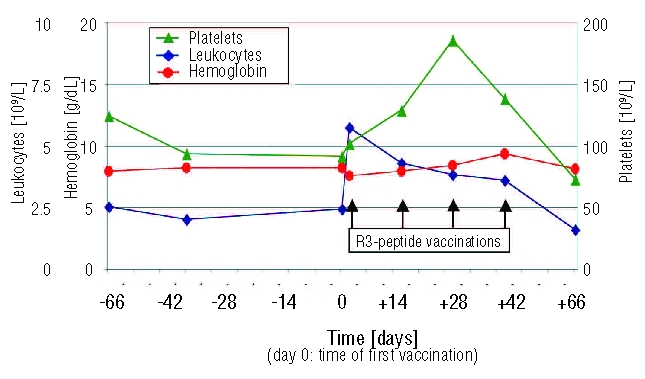
Results: In 4 of 9 patients (44%) we detected positive immunological responses. These patients showed an increase of CD8(+)RHAMM-R3_tetramer(+)/CD45RA(+)/CCR7(-)/CD27(-)/CD28(-) effector T cells and an increase of R3-specific CD8+ T cells. Two of these patients showed a significant decrease of regulatory T cells (Tregs). In one patient without response Tregs frequency increased from 5 to 16%. Three patients showed clinical effects: one patient with myelodysplastic syndrome RAEB-1 showed a reduction of leukemic blasts in the bone marrow, another myelodysplastic syndrome patient an improvement of peripheral blood counts and one patient with multiple myeloma a reduction of free light chains. Clinical and immunological reactions were lower in this cohort than in the 300 microg cohort.
Conclusions: High-dose RHAMM-R3 peptide vaccination induced immunological responses and positive clinical effects. Therefore, RHAMM constitutes a promising structure for further targeted immunotherapies in patients with different hematologic malignancies. However, higher doses of peptide did not improve the frequency and intensity of immune responses in this trial.
Figures
References
-
- Greiner J, Schmitt M, Li L, Giannopoulos K, Bosch K, Schmitt A, et al. Expression of tumor-associated antigens in acute myeloid leukemia: Implications for specific immunotherapeutic approaches. Blood. 2006;108(13):4109–17. - PubMed
-
- Greiner J, Li L, Ringhoffer M, Barth TF, Giannopoulos K, Guillaume P, et al. Identification and characterization of epitopes of the receptor for hyaluronic acid-mediated motility (RHAMM/CD168) recognized by CD8+ T cells of HLA-A2-positive patients with acute myeloid leukemia. Blood. 2005;106(3):938–45. - PubMed
-
- Greiner J, Ringhoffer M, Taniguchi M, Li L, Schmitt A, Shiku H, et al. mRNA expression of leukemia-associated antigens in patients with acute myeloid leukemia for the development of specific immunotherapies. Int J Cancer. 2004;108(5):704–11. - PubMed
-
- Greiner J, Bullinger L, Guinn BA, Dohner H, Schmitt M. Leukemia-associated antigens are critical for the proliferation of acute myeloid leukemia cells. Clin Cancer Res. 2008;14(22):7161–6. - PubMed
-
- Schmitt M, Schmitt A, Rojewski MT, Chen J, Giannopoulos K, Fei F, et al. RHAMM-R3 peptide vaccination in patients with acute myeloid leukemia, myelodysplastic syndrome, and multiple myeloma elicits immunologic and clinical responses. Blood. 2008;111(3):1357–65. - PubMed
Publication types
MeSH terms
Substances
LinkOut - more resources
Full Text Sources
Other Literature Sources
Research Materials