Review
. 2010 Jan;9(1):65-78.
doi: 10.1093/bfgp/elp056. Epub 2010 Jan 16.

Lineage-specific transcription factors and the evolution of gene regulatory networks

Affiliations
Review

Lineage-specific transcription factors and the evolution of gene regulatory networks

Katja Nowick et al. Brief Funct Genomics. 2010 Jan.

Abstract

Nature is replete with examples of diverse cell types, tissues and body plans, forming very different creatures from genomes with similar gene complements. However, while the genes and the structures of proteins they encode can be highly conserved, the production of those proteins in specific cell types and at specific developmental time points might differ considerably between species. A full understanding of the factors that orchestrate gene expression will be essential to fully understand evolutionary variety. Transcription factor (TF) proteins, which form gene regulatory networks (GRNs) to act in cooperative or competitive partnerships to regulate gene expression, are key components of these unique regulatory programs. Although many TFs are conserved in structure and function, certain classes of TFs display extensive levels of species diversity. In this review, we highlight families of TFs that have expanded through gene duplication events to create species-unique repertoires in different evolutionary lineages. We discuss how the hierarchical structures of GRNs allow for flexible small to large-scale phenotypic changes. We survey evidence that explains how newly evolved TFs may be integrated into an existing GRN and how molecular changes in TFs might impact the GRNs. Finally, we review examples of traits that evolved due to lineage-specific TFs and species differences in GRNs.


Figures
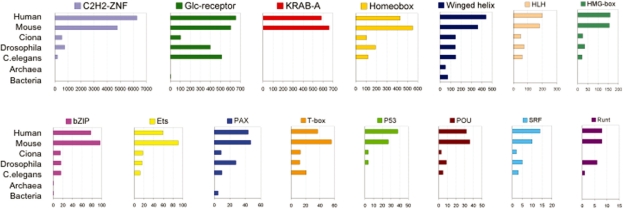
Figure 1:
Figure 1:
DBD repertoire in different taxa. The examples shown correspond to the largest mammalian domain families. For bacteria and archaea, mean numbers are given. All metazoan genomes from which these data were taken are completely sequenced with the exception of Ciona intestinalis, which is currently a draft assembly at 11× coverage. Data are taken from Pfam, Superfamily and ref. [20]. Note that the scale of the x-axis corresponding to the number of proteins of each type in different genomes varies between plots.
Figure 2:
Figure 2:
Schematics of a GRN. Illustration of a typical GRN structure. The nodes represent TFs (orange, large circles) and their targets (blue, small circles). The links represent the regulation of target genes by TFs, indicated by the direction of the arrow. Links between TFs are shown in bold. TFs usually regulate multiple target genes and targets can be regulated by several TFs. Examples for a feed-forward loop (left) and for a bi-fan motif (right) are shown by black-green double arrows. Nodes with many links are called hubs. Subsets of highly interconnected nodes form distinct but interconnected network modules (shaded). GRNs are hierarchically organized. Tiers are labeled according to the different concepts used in the text. Top layer, kernels or initial TFs affect most other modules in the network and are often involved in initiating certain functions or pathways. Bottom layer, differentiation batteries, or terminal TFs act more downstream and usually function in differentiation programs.
Figure 3:
Figure 3:
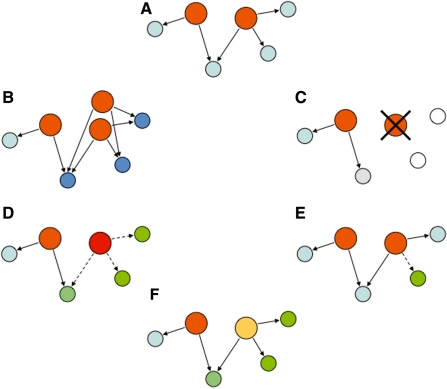
Predicted impact of molecular changes on GRN. Variations of a simple model of a network consisting of two TFs (orange/red/yellow, large circles), four target genes (blue/green/gray, small circles) and their interactions (black arrows). (A) Putative ancestral GRN. (B) Duplication of a TF. New TF inherits all links of parent TF which leads to a stronger regulation of the target genes. (C) Deletion of a TF. Two targets of this TF are not regulated anymore, while the third target is now only regulated by the other TF. (D) Protein sequence change in a TF (trans). Regulation of all targets is changed and can be stronger or weaker. Targets also regulated by other TFs are less affected. (E) Sequence change in the promoter of one target gene (cis). Only the link between the TF and this target is affected and leads to different regulation. (F) Expression change of one TF (caused by cis change in its promoter or trans change upstream of this TF). Expression of all target genes is affected. The effect on targets regulated also by other TFs is smaller.

References

    1. Ranz JM, Machado CA. Uncovering evolutionary patterns of gene expression using microarrays. Trends Ecol Evol. 2006;21:29–37. - PubMed
    1. Carroll SB. Evo-devo and an expanding evolutionary synthesis: a genetic theory of morphological evolution. Cell. 2008;134:25–36. - PubMed
    1. Hoekstra HE, Coyne JA. The locus of evolution: evo devo and the genetics of adaptation. Evolution. 2007;61:995–1016. - PubMed
    1. Babu MM, Luscombe NM, Aravind L, et al. Structure and evolution of transcriptional regulatory networks. Curr Opin Struct Biol. 2004;14:283–91. - PubMed
    1. Vaquerizas JM, Kummerfeld SK, Teichmann SA, et al. A census of human transcription factors: function, expression and evolution. Nat Rev Genet. 2009;10:252–63. - PubMed

Publication types

Substances