


Review
doi: 10.3748/wjg.v16.i3.398.
Cerebral lipiodol embolism following transcatheter arterial chemoembolization for hepatocellular carcinoma
Affiliations
- PMID: 20082490
- PMCID: PMC2807965
- DOI: 10.3748/wjg.v16.i3.398
Item in Clipboard
Review
Cerebral lipiodol embolism following transcatheter arterial chemoembolization for hepatocellular carcinoma
World J Gastroenterol.
.
Abstract
Cerebral lipiodol embolism (CLE) is an extremely rare complication of transcatheter arterial chemoembolization for hepatocellular carcinoma (HCC). The authors present a case of CLE that occurred after the second hepatic arterial chemoembolization for HCC, and attempt to introduce several plausible mechanisms of CLE, after reporting the clinical and radiological findings and reviewing the medical literature.
Figures
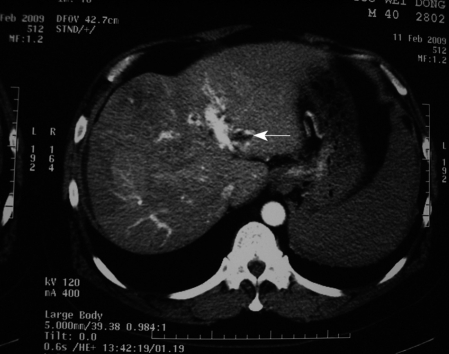
Computed tomography (CT) scan obtained before the first Transcatheter arterial chemoembolization (TACE) procedure. Portal vein was shown during the arterial period, which suggested that the tumor embolus invaded the portal vein (arrow).
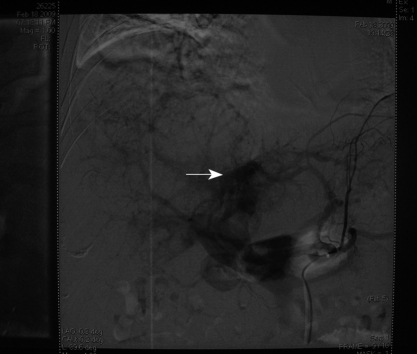
First TACE procedure. Arterial-portal fistula (arrow).
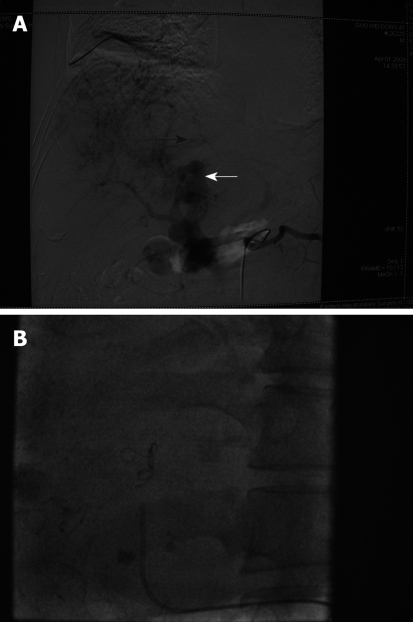
Second TACE procedure. A: Hepatic arteriovenous fistula (black arrow), arterial-portal fistula (white arrow); B: Coils (5-8 mm).
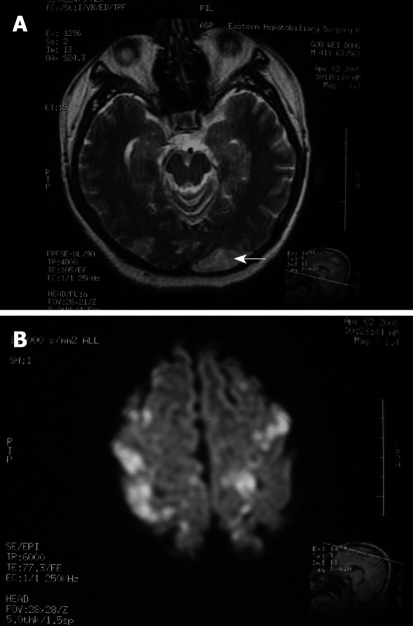
Cranial magnetic resonance imaging (MRI) obtained after the second TACE procedure. A: cerebral lipiodol embolism (arrow); B: cerebral lipiodol embolism (multiple high signals).
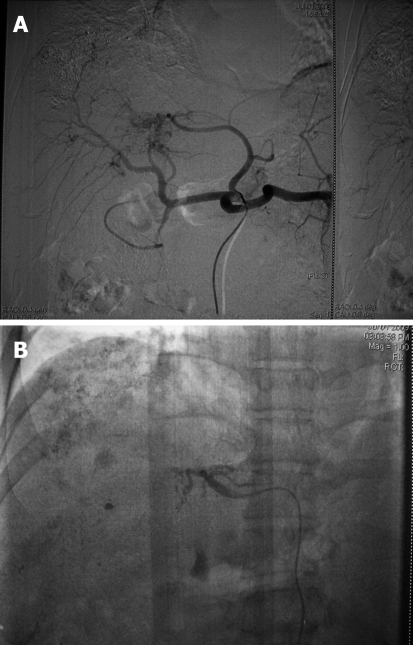
Third TACE procedure. A: Hepatic arteriovenous fistula was not seen, and the arterial-portal fistula was still present but improved; B: Lipiodol and gelatin sponge were injected through the left gastric artery and the arterial-portal fistula was embolized.
References
-
- Yoo KM, Yoo BG, Kim KS, Lee SU, Han BH. Cerebral lipiodol embolism during transcatheter arterial chemoembolization. Neurology. 2004;63:181–183. - PubMed
-
- Takao H, Makita K, Doi I, Watanabe T. Cerebral lipiodol embolism after transcatheter arterial chemoembolization of hepatocellular carcinoma. J Comput Assist Tomogr. 2005;29:680–682. - PubMed
-
- Wu RH, Tzeng WS, Chang CM. Iodized oil embolization to brain following transcatheter arterial embolization of liver. J Gastroenterol Hepatol. 2005;20:1465–1467. - PubMed
-
- Sakamoto I, Aso N, Nagaoki K, Matsuoka Y, Uetani M, Ashizawa K, Iwanaga S, Mori M, Morikawa M, Fukuda T, et al. Complications associated with transcatheter arterial embolization for hepatic tumors. Radiographics. 1998;18:605–619. - PubMed
-
- Matsumoto K, Nojiri J, Takase Y, Egashira Y, Azama S, Kato A, Kitahara K, Miyazaki K, Kudo S. Cerebral lipiodol embolism: a complication of transcatheter arterial chemoembolization for hepatocellular carcinoma. Cardiovasc Intervent Radiol. 2007;30:512–514. - PubMed
Publication types
MeSH terms
Substances
LinkOut - more resources
Full Text Sources
Medical
