


Single nucleotide polymorphisms for assessing genetic diversity in castor bean (Ricinus communis)
- PMID: 20082707
- PMCID: PMC2832895
- DOI: 10.1186/1471-2229-10-13
Single nucleotide polymorphisms for assessing genetic diversity in castor bean (Ricinus communis)
Abstract
Background: Castor bean (Ricinus communis) is an agricultural crop and garden ornamental that is widely cultivated and has been introduced worldwide. Understanding population structure and the distribution of castor bean cultivars has been challenging because of limited genetic variability. We analyzed the population genetics of R. communis in a worldwide collection of plants from germplasm and from naturalized populations in Florida, U.S. To assess genetic diversity we conducted survey sequencing of the genomes of seven diverse cultivars and compared the data to a reference genome assembly of a widespread cultivar (Hale). We determined the population genetic structure of 676 samples using single nucleotide polymorphisms (SNPs) at 48 loci.
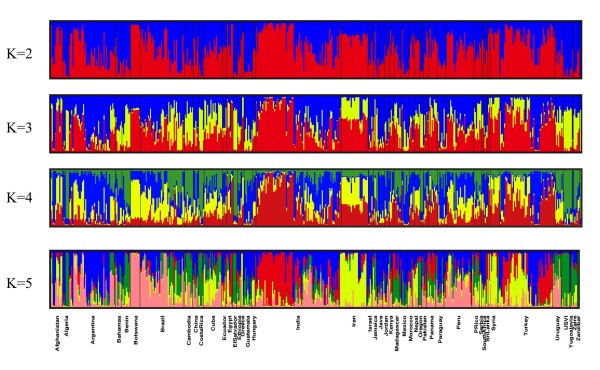
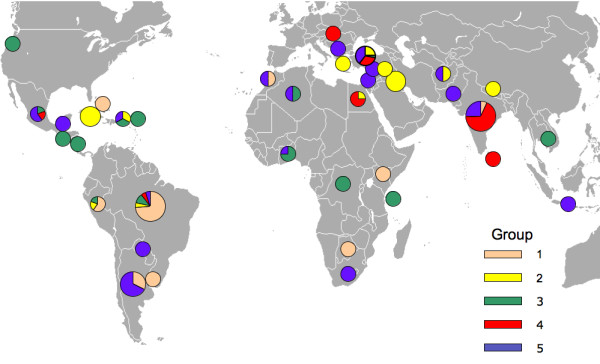
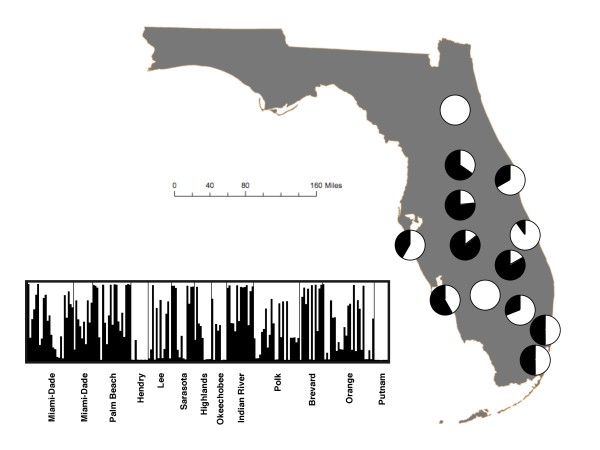
Results: Bayesian clustering indicated five main groups worldwide and a repeated pattern of mixed genotypes in most countries. High levels of population differentiation occurred between most populations but this structure was not geographically based. Most molecular variance occurred within populations (74%) followed by 22% among populations, and 4% among continents. Samples from naturalized populations in Florida indicated significant population structuring consistent with local demes. There was significant population differentiation for 56 of 78 comparisons in Florida (pairwise population phiPT values, p < 0.01).
Conclusion: Low levels of genetic diversity and mixing of genotypes have led to minimal geographic structuring of castor bean populations worldwide. Relatively few lineages occur and these are widely distributed. Our approach of determining population genetic structure using SNPs from genome-wide comparisons constitutes a framework for high-throughput analyses of genetic diversity in plants, particularly in species with limited genetic diversity.
Figures
References
-
- Estoup A, Angers B. In: Advances in Molecular Ecology. Carvalho GR, editor. Amsterdam: IOS Press; 1998. Microsatellites and minisatellites for molecular ecology: theoretical and empirical considerations; pp. 55–86.
-
- Brumfield RT, Beerli P, Nickerson DA, Edwards SV. The utility of single nucleotide polymorphisms in inferences of population history. Trends in Ecology & Evolution. 2003;18:249–256.
-
- He GH, Prakash CS. Evaluation of genetic relationship among botanical varieties of cultivated peanut (Arachis hypogaea L.) using AFLP markers. Genetic Resources and Crop Evolution. 2001;48:347–352. doi: 10.1023/A:1012019600318. - DOI
Publication types
MeSH terms
Substances
LinkOut - more resources
Full Text Sources
