


Are changes in cardiovascular disease risk factors in midlife women due to chronological aging or to the menopausal transition?
- PMID: 20082925
- PMCID: PMC2856606
- DOI: 10.1016/j.jacc.2009.10.009
Are changes in cardiovascular disease risk factors in midlife women due to chronological aging or to the menopausal transition?
Abstract
Objectives: This prospective study examined whether changes in traditional and novel coronary heart disease (CHD) risk factors are greater within a year of the final menstrual period (FMP), relative to changes that occur before or after that interval, in a multiethnic cohort.
Background: Understanding the influence of menopause on CHD risk remains elusive and has been evaluated primarily in Caucasian samples.
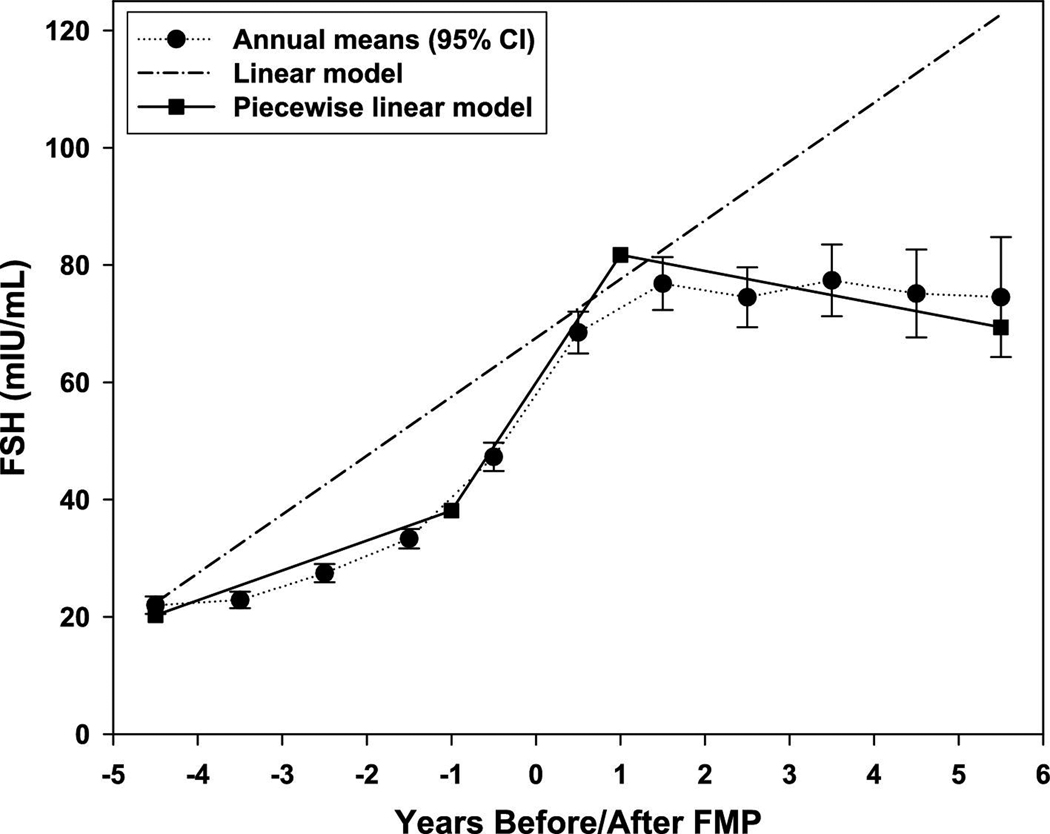
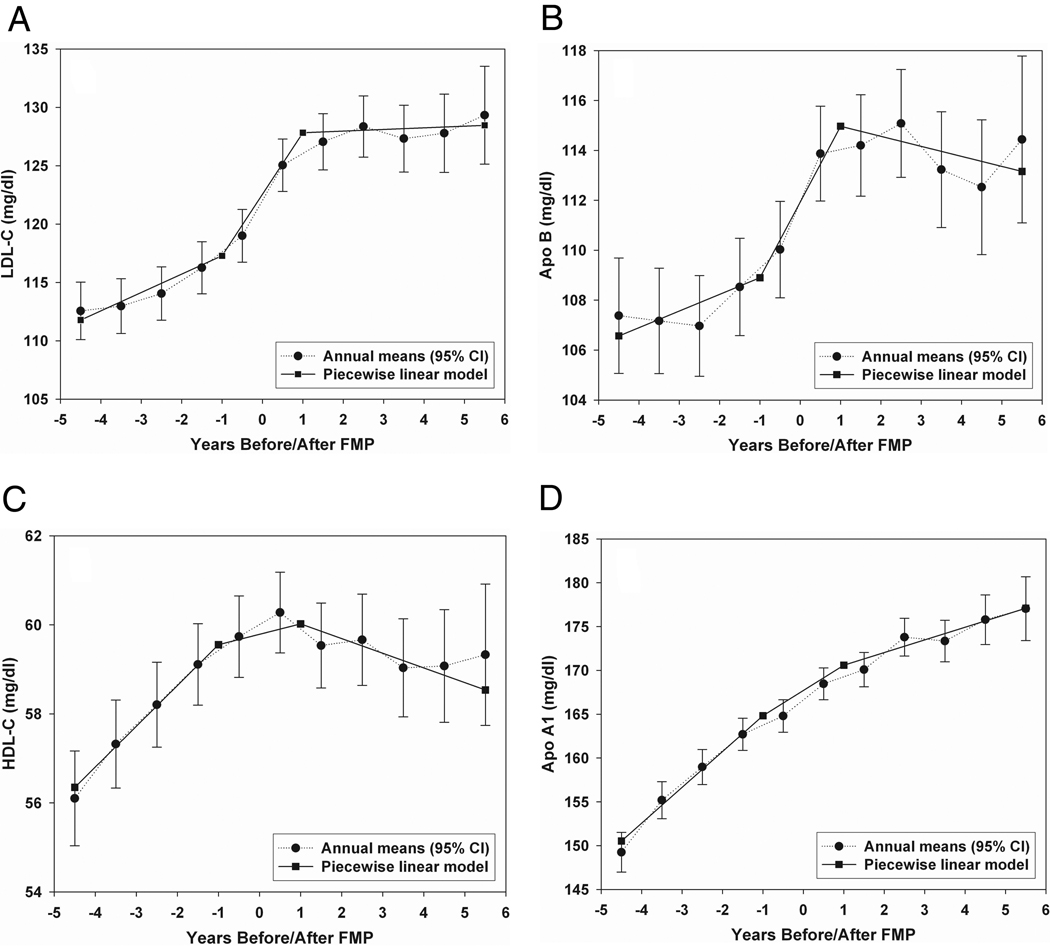
Methods: SWAN (Study of Women's Health Across the Nation) is a prospective study of the menopausal transition in 3,302 minority (African American, Hispanic, Japanese, or Chinese) and Caucasian women. After 10 annual examinations, 1,054 women had achieved an FMP not due to surgery and without hormone therapy use before FMP. Measured CHD risk factors included lipids and lipoproteins, glucose, insulin, blood pressure, fibrinogen, and C-reactive protein. We assessed which of 2 models provided a better fit with the observed risk factor changes over time in relation to the FMP: a linear model, consistent with chronological aging, or a piecewise linear model, consistent with ovarian aging.
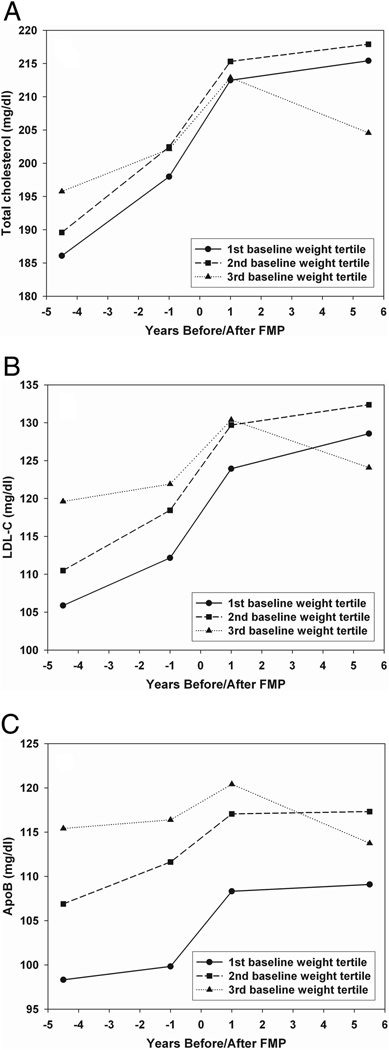
Results: Only total cholesterol, low-density lipoprotein cholesterol, and apolipoprotein B demonstrated substantial increases within the 1-year interval before and after the FMP, consistent with menopause-induced changes. This pattern was similar across ethnic groups. The other risk factors were consistent with a linear model, indicative of chronological aging.
Conclusions: Women experience a unique increase in lipids at the time of the FMP. Monitoring lipids in perimenopausal women should enhance primary prevention of CHD.
Conflict of interest statement
All authors report no conflicts of interest.
Figures
Comment in
-
Menopause, age, and cardiovascular risk: a complex relationship.J Am Coll Cardiol. 2009 Dec 15;54(25):2374-5. doi: 10.1016/j.jacc.2009.10.008. J Am Coll Cardiol. 2009. PMID: 20082926 No abstract available.
References
-
- Tunstall-Pedoe H. Myth and paradox of coronary risk and the menopause. Lancet. 1998;351:1425–1427. - PubMed
-
- Colditz GA, Willet WC, Stampfer MJ, Rosner B, Speizer FE, Hennekens CH. Menopause and the risk of coronary heart disease in women. N Engl J Med. 1987;316:1105–1110. - PubMed
-
- Howard BV, Kuller L, Langer R, et al. Risk of cardiovascular disease by hysterectomy status, with and without oophorectomy: the Women’s Health Initiative Observational Study. Circulation. 2005;111:1462–1470. - PubMed
-
- Kok HS, van Asselt KM, van der Schouw YT, et al. Heart disease risk determines menopausal age rather than the reverse. J Am Coll Cardiol. 2006;47:1976–1984. - PubMed
-
- Bittner V. Menopause and cardiovascular risk: cause or consequence? J Am Coll Cardiol. 2006;47:1984–1986. - PubMed
Publication types
MeSH terms
Substances
Grants and funding
- AG012553/AG/NIA NIH HHS/United States
- AG012554/AG/NIA NIH HHS/United States
- AG012539/AG/NIA NIH HHS/United States
- AG012531/AG/NIA NIH HHS/United States
- U01 AG012495/AG/NIA NIH HHS/United States
- U01 AG012505/AG/NIA NIH HHS/United States
- AG012535/AG/NIA NIH HHS/United States
- AG012546/AG/NIA NIH HHS/United States
- NR004061/NR/NINR NIH HHS/United States
- U01 AG012554/AG/NIA NIH HHS/United States
- U01 AG012535/AG/NIA NIH HHS/United States
- U01 AG012553/AG/NIA NIH HHS/United States
- U01 NR004061/NR/NINR NIH HHS/United States
- U01 AG012539/AG/NIA NIH HHS/United States
- AG012495/AG/NIA NIH HHS/United States
- U01 AG012546/AG/NIA NIH HHS/United States
- U01 AG012531/AG/NIA NIH HHS/United States
- AG012505/AG/NIA NIH HHS/United States
LinkOut - more resources
Full Text Sources
Medical
Research Materials
