


Nicotinamide-rich diet protects the heart against ischaemia-reperfusion in mice: a crucial role for cardiac SUR2A
- PMID: 20083200
- PMCID: PMC2859200
- DOI: 10.1016/j.phrs.2010.01.008
Nicotinamide-rich diet protects the heart against ischaemia-reperfusion in mice: a crucial role for cardiac SUR2A
Abstract
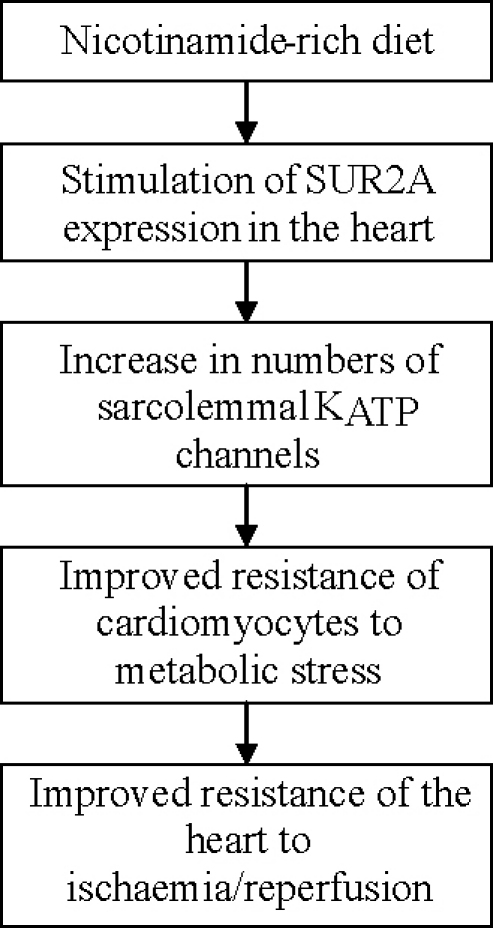
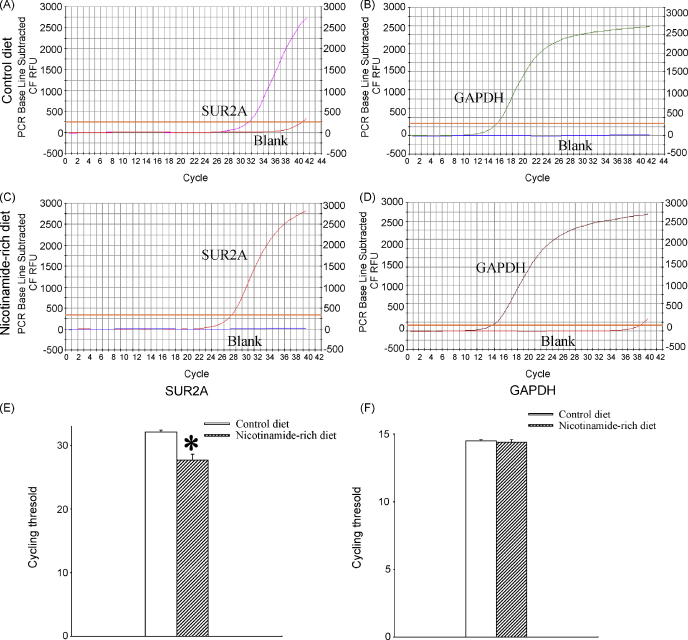
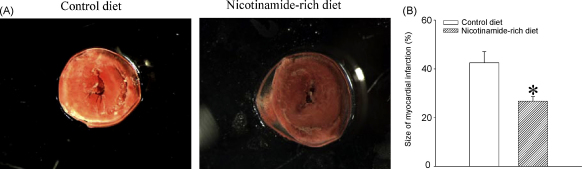
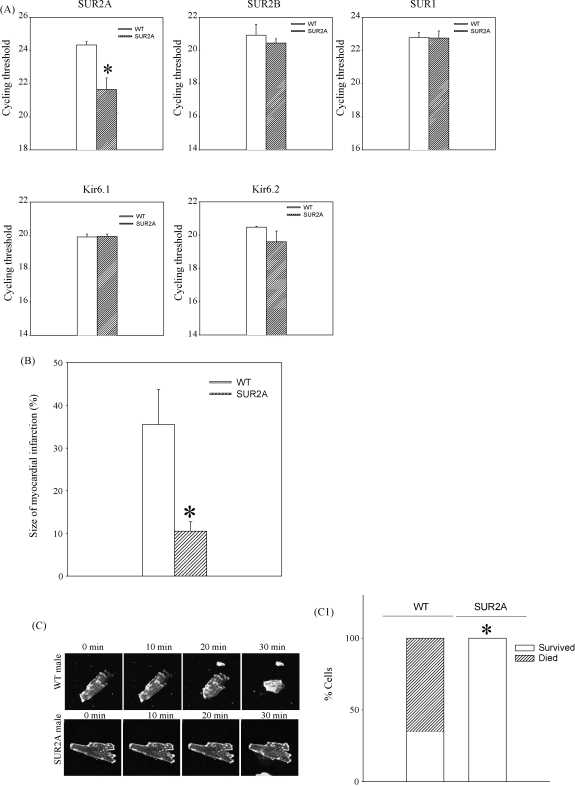
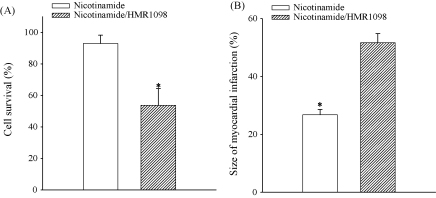
It is a consensus view that a strategy to increase heart resistance to ischaemia-reperfusion is a warranted. Here, based on our previous study, we have hypothesized that a nicotinamide-rich diet could increase myocardial resistance to ischaemia-reperfusion. Therefore, the purpose of this study was to determine whether nicotinamide-rich diet would increase heart resistance to ischaemia-reperfusion and what is the underlying mechanism. Experiments have been done on mice on control and nicotinamide-rich diet (mice were a week on nicotinamide-rich diet) as well as on transgenic mice overexpressing SUR2A (SUR2A mice), a regulatory subunit of cardioprotective ATP-sensitive K(+) (K(ATP)) channels and their littermate controls (WT). The levels of mRNA in heart tissue were measured by real-time RT-PCR, whole heart and single cell resistance to ischaemia-reperfusion and severe hypoxia was measured by TTC staining and laser confocal microscopy, respectively. Nicotinamide-rich diet significantly decreased the size of myocardial infarction induced by ischaemia-reperfusion (from 42.5+/-4.6% of the area at risk zone in mice on control diet to 26.8+/-1.8% in mice on nicotinamide-rich diet, n=6-12, P=0.031). The cardioprotective effect of nicotinamide-rich diet was associated with 11.46+/-1.22 times (n=6) increased mRNA levels of SUR2A in the heart. HMR1098, a selective inhibitor of the sarcolemmal K(ATP) channels opening, abolished cardioprotection afforded by nicotinamide-rich diet. Transgenic mice with a sole increase in SUR2A expression had also increased cardiac resistance to ischaemia-reperfusion. We conclude that nicotinamide-rich diet up-regulate SUR2A and increases heart resistance to ischaemia-reperfusion.
(c) 2010 Elsevier Ltd. All rights reserved.
Figures
References
-
- Noma A. ATP-regulated K+ channels in cardiac muscle. Nature. 1983;305:147–148. - PubMed
-
- Inagaki N., Gonoi T., Clement J.P., Wang C.Z., Aguilar-Bryan L., Bryan J. A family of sulfonylurea receptors determines the pharmacological properties of ATP-sensitive K+ channels. Neuron. 1996;16:1011–1017. - PubMed
Publication types
MeSH terms
Substances
Grants and funding
- S18744/BB_/Biotechnology and Biological Sciences Research Council/United Kingdom
- 059528/Z/99/Z/JMW/CP/JF/WT_/Wellcome Trust/United Kingdom
- PG/08/106/26155/BHF_/British Heart Foundation/United Kingdom
- PG/09/059/27851/BHF_/British Heart Foundation/United Kingdom
- G0400608/MRC_/Medical Research Council/United Kingdom
LinkOut - more resources
Full Text Sources
Other Literature Sources
Molecular Biology Databases
