


Retention of skills in neonatal resuscitation
- PMID: 20084205
- PMCID: PMC2804451
- DOI: 10.1093/pch/6.1.31
Retention of skills in neonatal resuscitation
Abstract
Objectives: To evaluate the impact of a neonatal resuscitation course on the theoretical knowledge and practical skills of birthing room personnel, and to evaluate the performance of skills at different times after the course.
Design: A program evaluation using a before and after cohort study.
Setting: Seven level II perinatal centres in the central-east region of Ontario.
Participants: Seven hundred thirty-seven individuals (medical staff, nurses and respiratory technologists) who worked in birthing rooms.
Intervention: During an eight-month period, a course in neonatal resuscitation was presented at the perinatal centres. A cohort of 108 (15%) participants received testing before and after the course; the theoretical knowledge and practical performance of 62 of these participants were retested after six and 12 months.
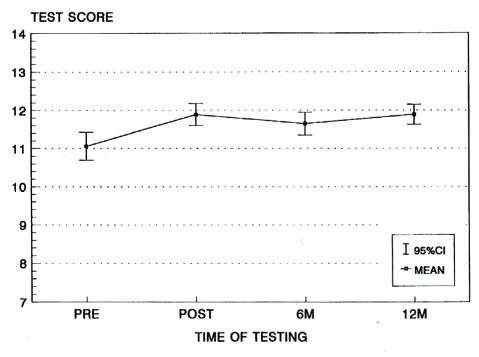
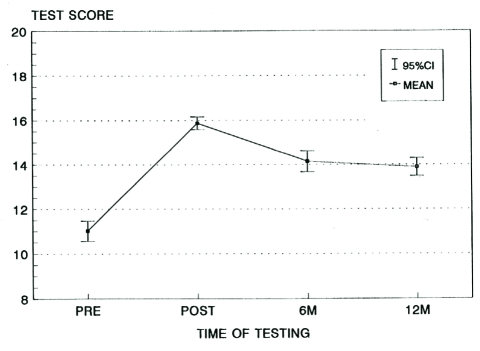
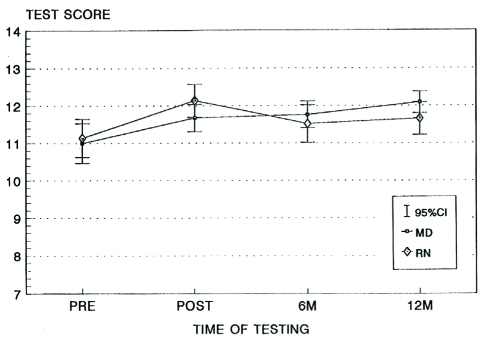
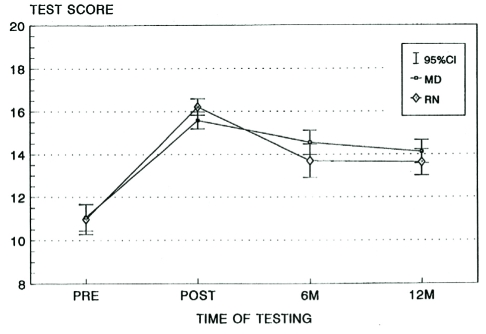
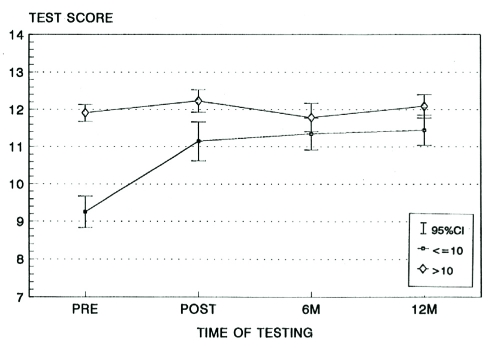
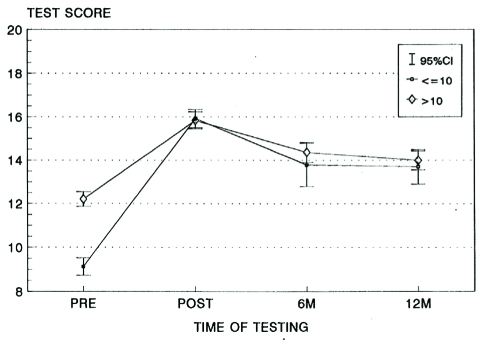
Results: A significant improvement in both theoretical knowledge and practical skills was seen immediately after the course. Throughout the study, no difference was observed in the performance of nursing staff compared with that of medical staff, nor among the institutions involved. No significant difference in the decline of either theoretical knowledge or practical skills was seen among those who scored well in the original pre-test compared with those who scored poorly.
Conclusions: Neonatal resuscitation should be an integral part of continuing education for all personnel involved in obstetrical care because it improves both tested knowledge and performance. Practical skills appear to decline faster than theoretical knowledge. Inservice instruction is required, at least, every six months.
OBJECTIFS :: Évaluer les répercussions d’un cours de réanimation néonatale sur les connaissances théoriques et les compétences pratiques du personnel de la salle d’accouchement, ainsi que la performance de ces compétences à diverses intervalles après le cours.
MÉTHODOLOGIE :: Évaluation d’un programme au moyen d’une étude de cohorte avant et après le cours
ÉTABLISSEMENT :: Sept centres périnatals de niveau II de la région centre-est de l’Ontario
PARTICIPANTS :: Sept cent trente-sept individus (personnel médical, infirmières et inhalothérapeutes) qui travaillaient dans des salles d’accouchement
INTERVENTION :: Pendant une période de huit mois, un cours sur la réanimation néonatale a été donné dans les centres périnatals. Une cohorte de 108 (15 %) participants a été évaluée avant et après le cours. Les connaissances théoriques et la performance pratique de 62 de ces participants ont été réévaluées six et douze mois après le cours.
RÉSULTATS :: Une amélioration notable tant des connaissances théoriques que des compétences pratiques s’observait immédiatement après le cours. Pendant l’étude, on n’a remarqué de différence ni dans la performance du personnel infirmier par rapport à celle du personnel médical ni entre les établissements en cause. Par ailleurs, on n’a observé aucune différence marquée dans la diminution des connaissances théoriques ou des compétences pratiques chez ceux qui ont obtenu des bons résultats dans la préévaluation originale par rapport à ceux dont les résultats étaient mauvais.
CONCLUSIONS :: La réanimation néonatale devrait faire partie intégrante de la formation continue de tout le personnel en obstétrique parce qu’elle améliore à la fois les connaissances évaluées et la performance. Les compétences pratiques semblent diminuer plus rapidement que les connaissances théoriques. Des ateliers interactifs sont nécessaires au moins tous les six mois au sein du service.
Keywords: Neonatal resuscitation; Skill retention.
Figures
References
-
- McManus F, Rang M, Chance G, Whittake J. Is cerebral palsy a preventable disease? Obstet Gynecol. 1977;50:71–7. - PubMed
-
- National Guidelines for Neonatal Resuscitation. Ottawa: Canadian Institute of Child Health; 1994.
-
- Bloom RJ, Cropley C. Textbook of Neonatal Resuscitation Dallas: American Heart Association and American Academy of Pediatrics. 1994.
-
- Moser DK, Coleman S. Recommendations for improving cardiopulmonary skills retention. Heart Lung. 1992;21:372–80. - PubMed
LinkOut - more resources
Full Text Sources