


The discriminative effects of the kappa-opioid hallucinogen salvinorin A in nonhuman primates: dissociation from classic hallucinogen effects
- PMID: 20084367
- PMCID: PMC2866021
- DOI: 10.1007/s00213-009-1771-5
The discriminative effects of the kappa-opioid hallucinogen salvinorin A in nonhuman primates: dissociation from classic hallucinogen effects
Abstract
Rationale: The widely available hallucinogen salvinorin A is a unique example of a plant-derived compound selective for kappa-opioid receptors and may produce effects distinct from those of other compounds with classic hallucinogenic or dissociative properties which are also abused in humans.
Objectives: The objective of this study is to characterize the salvinorin A discriminative cue in nonhuman primates with high kappa-receptor genetic homology to humans.
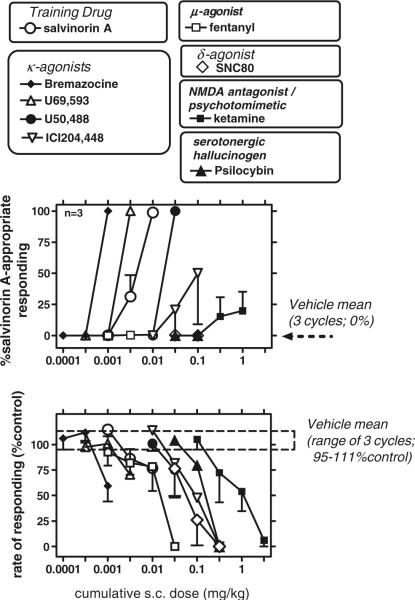
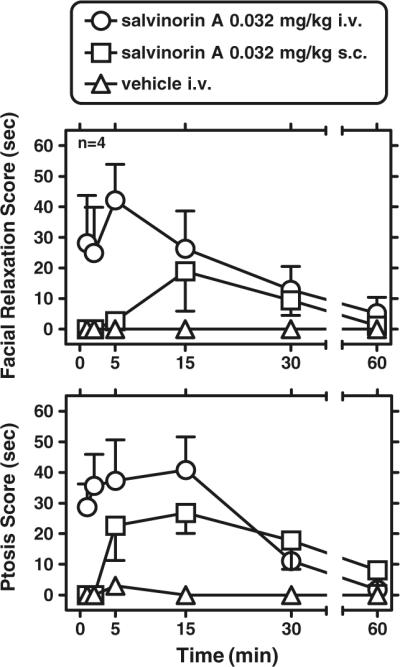
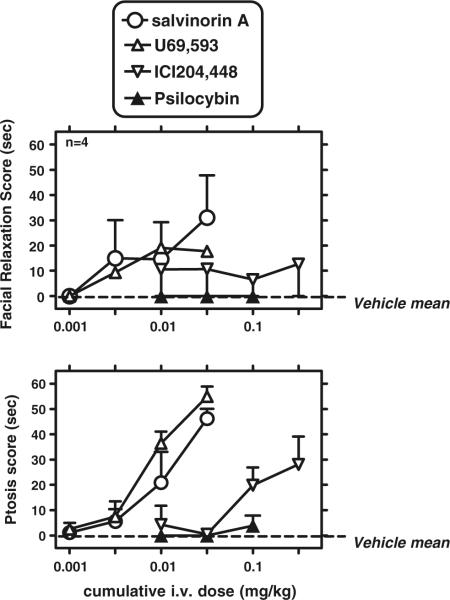
Methods: Adult rhesus monkeys (n = 3) were trained to discriminate salvinorin A (0.015 mg/kg, s.c.) from vehicle, in a food-reinforced operant discrimination assay. Parallel studies, using unconditioned behavioral endpoints (facial relaxation and ptosis) also evaluated the kappa-opioid receptor mediation of salvinorin A in vivo function.
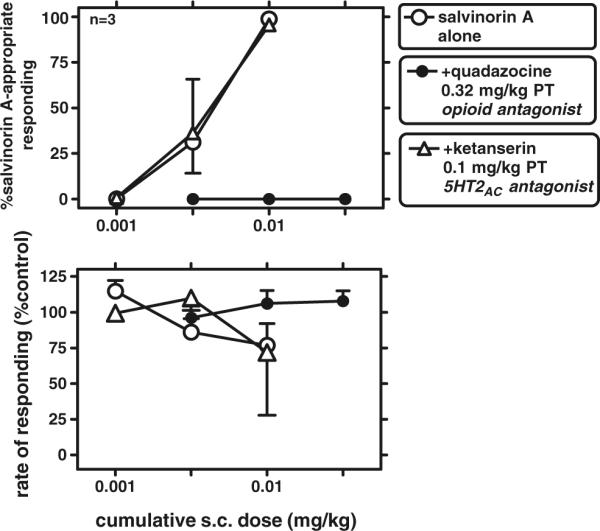
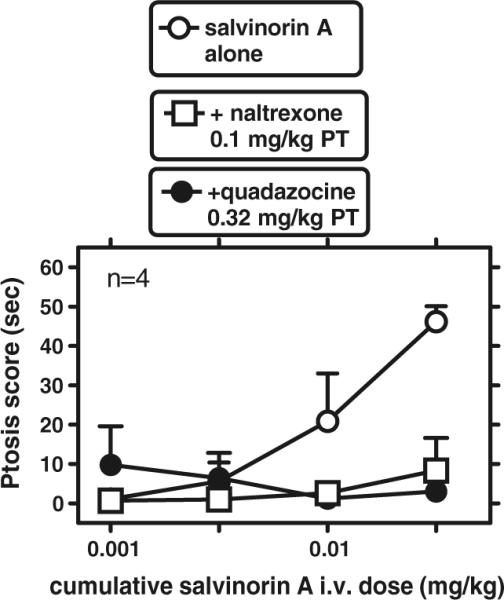
Results: Monkeys trained to discriminate salvinorin A generalized structurally diverse, centrally penetrating kappa-agonists (bremazocine, U69,593, and U50,488). By contrast, mu- and delta-opioid agonists (fentanyl and SNC80, respectively) were not generalized, nor were the serotonergic 5HT2 hallucinogen psilocybin or the dissociative N-methyl-D-aspartic acid antagonist, ketamine. The discriminative effects of salvinorin A were blocked by the opioid antagonist quadazocine (0.32 mg/kg), but not by the 5HT2 antagonist ketanserin (0.1 mg/kg). Consistent with these findings, salvinorin and kappa-agonists (e.g., U69,593) produce effects in the unconditioned endpoints (e.g., ptosis), whereas psilocybin was inactive.
Conclusions: These findings support the conclusion that the interoceptive/discriminative cue produced by salvinorin A is mediated by agonism at kappa-receptors and is mechanistically distinct from that produced by a classic serotonergic hallucinogen.
Figures
References
-
- Baker LE, Panos JJ, Killinger BA, Peet MM, Bell LM, Haliw LA, Walker SL. Comparison of the discriminative stimulus effects of salvinorin A and its derivatives to U69, 593 and U50, 488 in rats. Psychopharmacology. 2009;203:203–211. - PubMed
-
- Brandt MR, Negus SS, Mello NK, Furness MS, Zhang X, Rice KC. Discriminative stimulus effects of the nonpeptidic delta-opioid agonist SNC80 in rhesus monkeys. J Pharmacol Exp Ther. 1999;290:1157–1164. - PubMed
-
- Butelman ER, Harris TJ, Kreek MJ. Effects of E-2078, a stable dynorphin A(1–8) analog, on sedation and serum prolactin levels in rhesus monkeys. Psychopharmacology (Berl) 1999;147:73–80. - PubMed
-
- Butelman ER, Harris TJ, Kreek MJ. The plant-derived hallucinogen, salvinorin A, produces kappa-opioid agonist-like discriminative effects in rhesus monkeys. Psychopharmacology. 2004;172:220–224. - PubMed
-
- Butelman ER, Mandau M, Tidgewell K, Prisinzano TE, Yuferov V, Kreek MJ. Effects of salvinorin A, a kappa-opioid hallucinogen, on a neuroendocrine biomarker assay in non-human primates with high kappa-receptor homology to humans. J Pharmacol Exp Ther. 2007;320:300–306. - PubMed
Publication types
MeSH terms
Substances
Grants and funding
LinkOut - more resources
Full Text Sources
Other Literature Sources
Research Materials
