. 2010 Jan 19:11:49.
doi: 10.1186/1471-2164-11-49.

Identification of interacting transcription factors regulating tissue gene expression in human

Affiliations

Identification of interacting transcription factors regulating tissue gene expression in human

Zihua Hu et al. BMC Genomics. .

Abstract

Background: Tissue gene expression is generally regulated by multiple transcription factors (TFs). A major first step toward understanding how tissues achieve their specificity is to identify, at the genome scale, interacting TFs regulating gene expression in different tissues. Despite previous discoveries, the mechanisms that control tissue gene expression are not fully understood.

Results: We have integrated a function conservation approach, which is based on evolutionary conservation of biological function, and genes with highest expression level in human tissues to predict TF pairs controlling tissue gene expression. To this end, we have identified 2549 TF pairs associated with a certain tissue. To find interacting TFs controlling tissue gene expression in a broad spatial and temporal manner, we looked for TF pairs common to the same type of tissues and identified 379 such TF pairs, based on which TF-TF interaction networks were further built. We also found that tissue-specific TFs may play an important role in recruiting non-tissue-specific TFs to the TF-TF interaction network, offering the potential for coordinating and controlling tissue gene expression across a variety of conditions.

Conclusion: The findings from this study indicate that tissue gene expression is regulated by large sets of interacting TFs either on the same promoter of a gene or through TF-TF interaction networks.


Figures
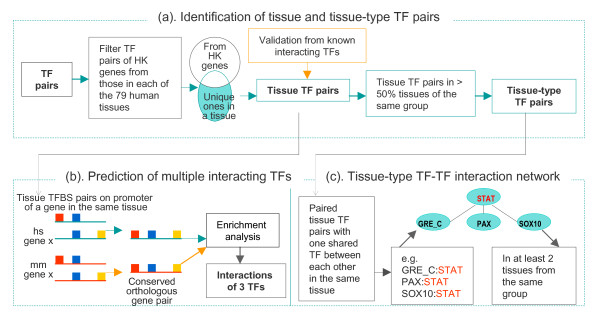
Figure 1
Figure 1
Flowchart of analysis procedures. (a) Identification of tissue and tissue-type TF pairs. (b) Prediction of interactions of three TFs. (c) Reconstruction of tissue-type TF-TF interaction networks. HK: housekeeping genes; hs: human; mm: mouse.
Figure 2
Figure 2
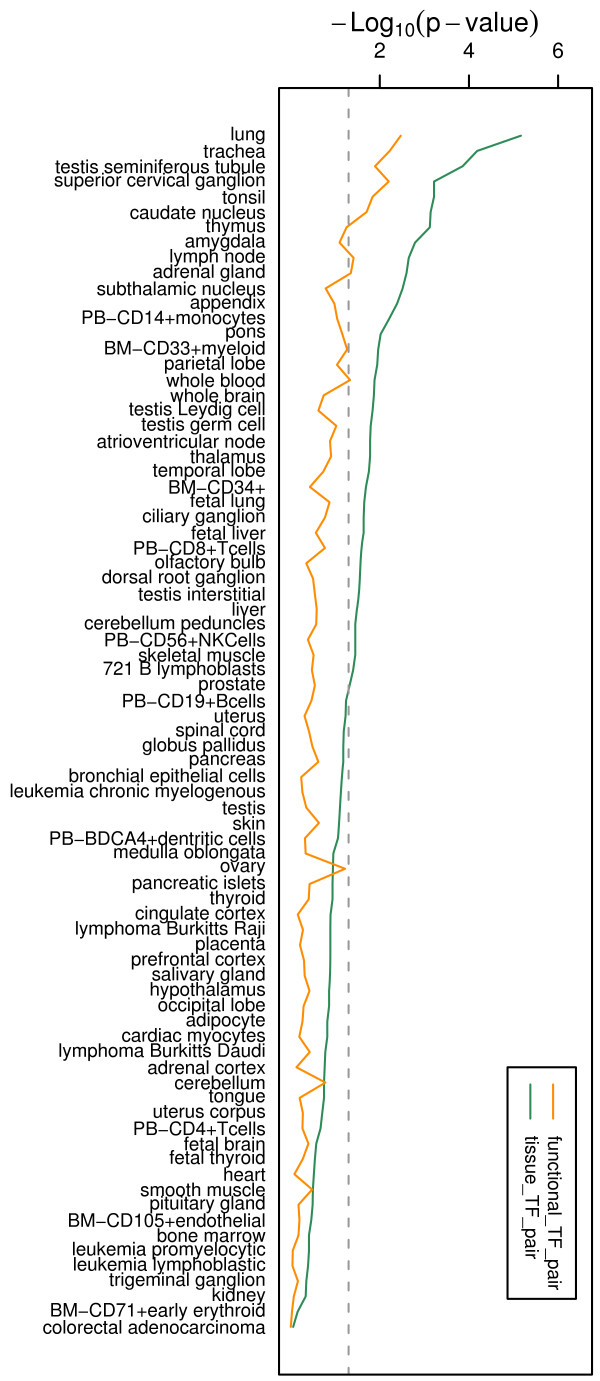
Statistical significance for the occurrence of known interacting TFs. Validation results (-log10(p-values)) for predicted TF pairs (orange) and tissue TF pairs (green) in the 79 human tissues. Dash line indicates significant p-value cutoff which is < 0.05 above the dash line. Known interacting TFs display enrichment more in the tissue TF pairs than in predicted TF pairs for both the number of tissues (37 vs. 9) and the degree of enrichment (Binomial test: p = 3.2 × 10⁻² to 6.8 × 10⁻⁶ vs. p = 4 × 10⁻² to 3.4 × 10⁻⁴).
Figure 3
Figure 3
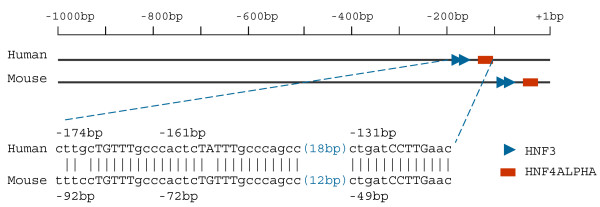
Conservation of identified HNF3 and HNF4ALPHA binding sites in human and mouse APOA1 genes. Both schematic and sequence alignments for the predicted HNF3 and HNF4ALPHA binding sites between human and mouse promoter sequences are depicted. In the sequence alignment the core motifs are shown in upper case letters and the distances between adjacent binding sites are shown in brackets. Also shown are the locations of each binding site in relation to the transcriptional starting site.
Figure 4
Figure 4
Hierarchical clustering over tissue TF pairs from the 79 human tissues. The distance matrix was built using the "binary" method, and hierarchical clustering was performed using the "complete" agglomeration method. Arrows and numbers indicate the selected tissue groups for further analysis.
Figure 5
Figure 5
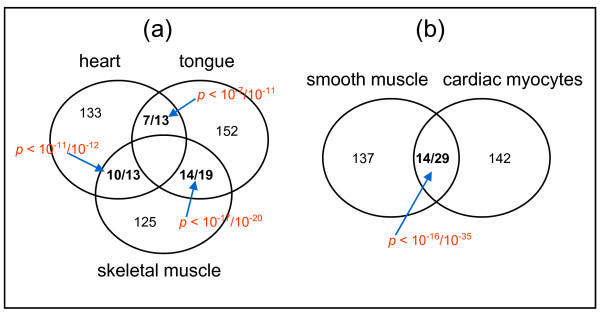
Overlapping tissue TF pairs and their functions between muscle tissues. (a) Venn diagram displaying the significant overlap for both tissue TF pairs and their functions in the group of skeletal muscle. (b) Significant overlap for both tissue TF pairs and their functions in the group of smooth muscle. Each circle indicates the number of tissue TF pairs. The number of overlapping tissue TF pairs and TF functions between two tissues is indicated in bold (# function/# TF). Also shown are their corresponding p-values from hypergeometric tests.
Figure 6
Figure 6
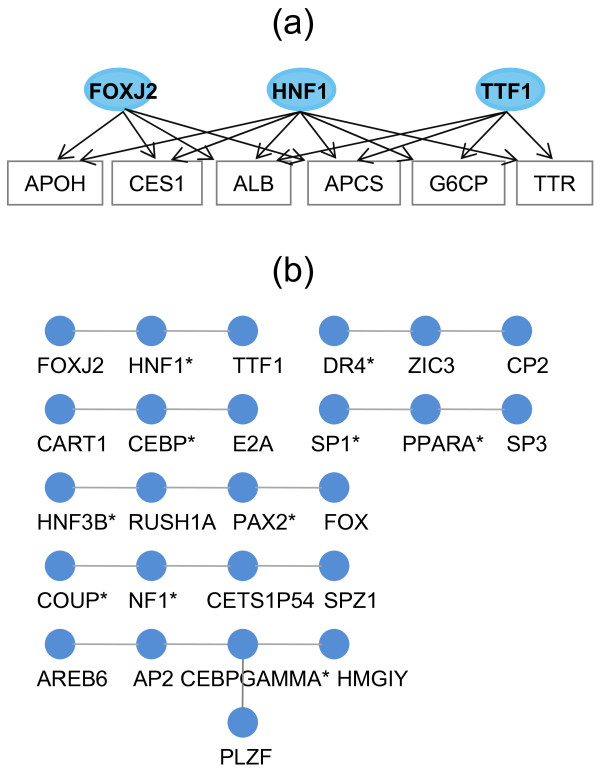
Tissue-type TF-TF interaction networks for liver tissues. (a) Multi-input network motif for TFs of FOXJ2, HNF1, and TTF1 and their target genes which are regulated by either two or three TFs. (b) Topology of seven tissue-type TF-TF interaction networks for liver tissues. Each node represents a TF and each edge (link) represents a significant synergy between two TFs from tissue TF pairs. Previously known liver-specific TFs are labeled with an asterisk.

Similar articles

Cited by

References

    1. Arnone MI, Davidson EH. The hardwiring of development: organization and function of genomic regulatory systems. Development (Cambridge, England) 1997;124(10):1851–1864. - PubMed
    1. Odom DT, Dowell RD, Jacobsen ES, Nekludova L, Rolfe PA, Danford TW, Gifford DK, Fraenkel E, Bell GI, Young RA. Core transcriptional regulatory circuitry in human hepatocytes. Molecular systems biology. 2006;2:2006 0017. doi: 10.1038/msb4100059. - DOI - PMC - PubMed
    1. Metzger S, Halaas JL, Breslow JL, Sladek FM. Orphan receptor HNF-4 and bZip protein C/EBP alpha bind to overlapping regions of the apolipoprotein B gene promoter and synergistically activate transcription. The Journal of biological chemistry. 1993;268(22):16831–16838. - PubMed
    1. Costa RH, Grayson DR. Site-directed mutagenesis of hepatocyte nuclear factor (HNF) binding sites in the mouse transthyretin (TTR) promoter reveal synergistic interactions with its enhancer region. Nucleic Acids Res. 1991;19(15):4139–4145. doi: 10.1093/nar/19.15.4139. - DOI - PMC - PubMed
    1. Rada-Iglesias A, Wallerman O, Koch C, Ameur A, Enroth S, Clelland G, Wester K, Wilcox S, Dovey OM, Ellis PD. et al.Binding sites for metabolic disease related transcription factors inferred at base pair resolution by chromatin immunoprecipitation and genomic microarrays. Human molecular genetics. 2005;14(22):3435–3447. doi: 10.1093/hmg/ddi378. - DOI - PubMed

Publication types

Substances

LinkOut - more resources