. 2010 Apr;77(4):593-600.
doi: 10.1124/mol.109.060806. Epub 2010 Jan 19.

A thermally stable form of bacterial cocaine esterase: a potential therapeutic agent for treatment of cocaine abuse

Affiliations

A thermally stable form of bacterial cocaine esterase: a potential therapeutic agent for treatment of cocaine abuse

Remy L Brim et al. Mol Pharmacol. 2010 Apr.

Abstract

Rhodococcal cocaine esterase (CocE) is an attractive potential treatment for both cocaine overdose and cocaine addiction. CocE directly degrades cocaine into inactive products, whereas traditional small-molecule approaches require blockade of the inhibitory action of cocaine on a diverse array of monoamine transporters and ion channels. The usefulness of wild-type (wt) cocaine esterase is hampered by its inactivation at 37 degrees C. Herein, we characterize the most thermostable form of this enzyme to date, CocE-L169K/G173Q. In vitro kinetic analyses reveal that CocE-L169K/G173Q displays a half-life of 2.9 days at 37 degrees C, which represents a 340-fold improvement over wt and is 15-fold greater than previously reported mutants. Crystallographic analyses of CocE-L169K/G173Q, determined at 1.6-A resolution, suggest that stabilization involves enhanced domain-domain interactions involving van der Waals interactions and hydrogen bonding. In vivo rodent studies reveal that intravenous pretreatment with CocE-L169K/G173Q in mice provides protection from cocaine-induced lethality for longer time periods before cocaine administration than wt CocE. Furthermore, intravenous administration (pretreatment) of CocE-L169K/G173Q prevents self-administration of cocaine in a time-dependent manner. Termination of the in vivo effects of CoCE seems to be dependent on, but not proportional to, its clearance from plasma as its half-life is approximately 2.3 h and similar to that of wt CocE (2.2 h). Taken together these data suggest that CocE-L169K/G173Q possesses many of the properties of a biological therapeutic for treating cocaine abuse but requires additional development to improve its serum half-life.


Figures
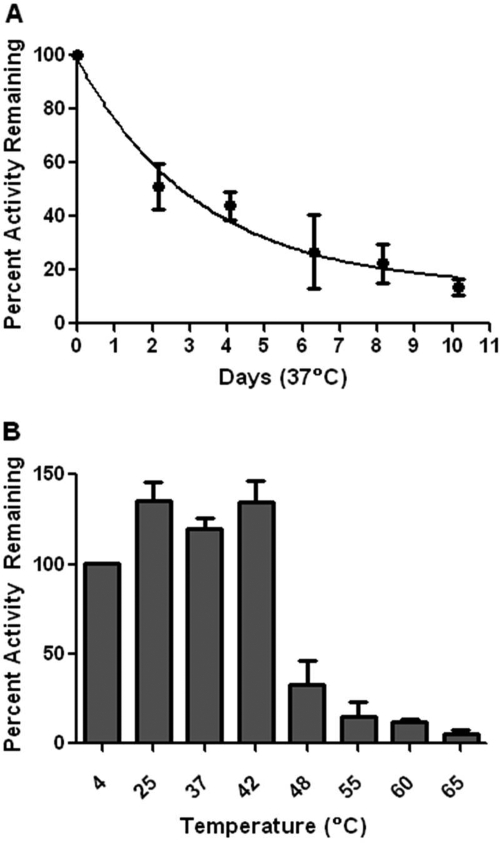
Fig. 1.
Fig. 1.
In vitro stability of CocE-L169K/G173Q. A, 10-day time course of CocE activity at 37°C. CocE was incubated at 60 μg/ml for the time indicated. Activity was assessed using the spectrophotometric cocaine hydrolysis assay. Vmax and kcat were determined and the catalytic efficiency was plotted as a percentage of the catalytic efficiency of nonincubated enzyme. A single-phase exponential decay model shows that 50% activity is retained until approximately 2.9 days. B, heat inactivation of CocE-L169K/G173Q. CocE was incubated at 60 μg/ml at the temperatures indicated for 10 min. Incubations were stopped on ice, and Vmax was determined by the spectrophotometric assay. Vmax activity was plotted as a percentage of the unincubated CocE Vmax kept at 4°C. CocE-L169K/G173Q retains over 50% activity up to 42°C. At higher temperatures, the activity rapidly drops, but residual activity is observed up to 65°C.
Fig. 2.
Fig. 2.
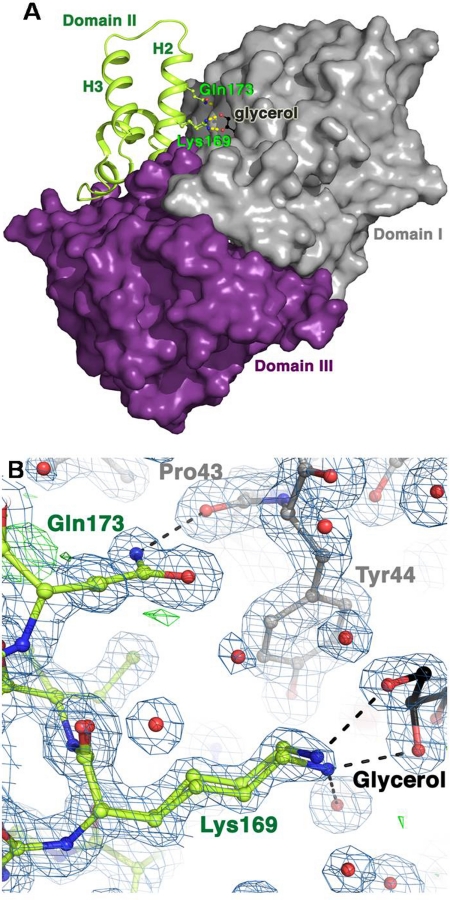
Crystal structure of CocE-L169K/G173Q. A, domain structure of CocE. Domain I (gray) contains the catalytic residues and domain II (green) is helical, with two pronounced antiparallel helices (H2 and H3). Domain III is shown in purple. The active site is formed at their intersection. Domains I and III are shown as their solvent-excluded surfaces. The L169K and G173Q mutations (ball-and-stick side chains) are found in H2 of domain II, close to the entrance to the active site, partially occupied here by a molecule of glycerol. B, refined model of CocE-L169K/G173Q. 2|Fo| − |Fc| electron density is shown as a blue wire cage contoured at the 1 σ level, with |Fo| − |Fc| density show in green contoured at 3 σ and red at −3 σ. Lys169 is observed in two distinct conformations that interact with a bound molecule of glycerol from the harvesting solution. Carbon atoms are shown as their respective domain colors (see A), oxygens are red, and nitrogens blue.
Fig. 3.
Fig. 3.
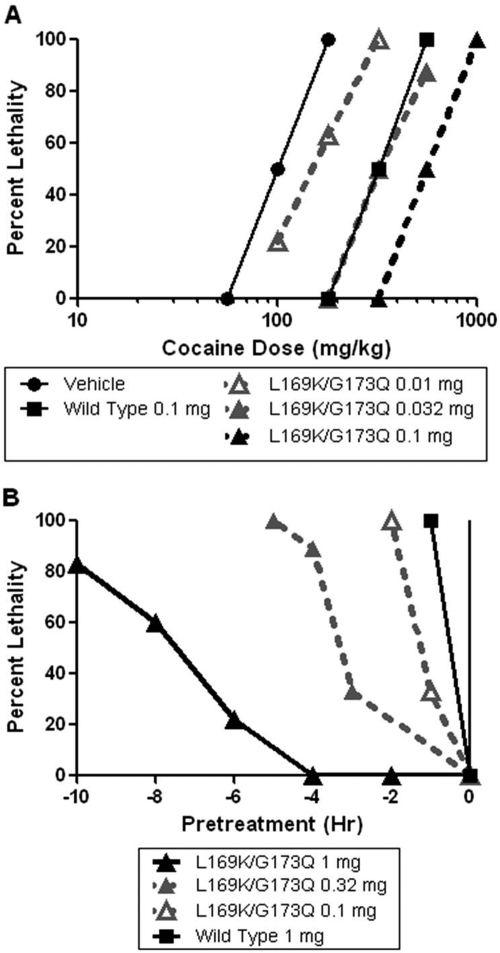
In vivo potency and duration of action of CocE-L169K/G173Q. A, potency of CocE-L169K/G173Q against cocaine induced lethality. CocE-L169K/G173Q was administered to NIH Swiss mice intravenously 1 min before a cocaine challenge given intraperitoneally. Increasing doses of CocE-L169K/G173Q cause significant rightward shifts in the cocaine dose-response curve. B, CocE-L169K/G173Q pretreatment protects against cocaine lethality more than wt CocE. CocE is administered intravenously at time of pretreatment. A lethal dose of 180 mg/kg is used as a challenge dose at time 0. The percentage of mice experiencing lethality after a 1-h postcocaine period is plotted.
Fig. 4.
Fig. 4.
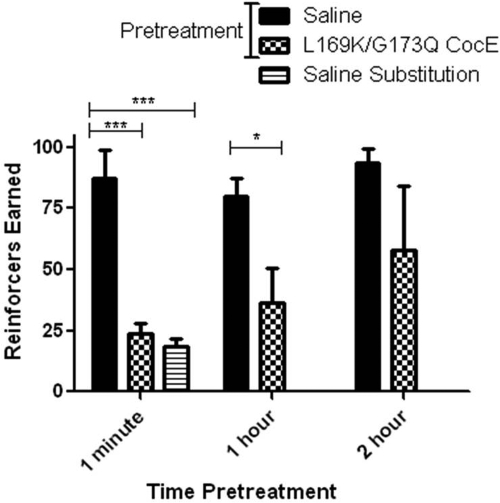
CocE-L169K/G173Q protection against cocaine-reinforced operant responding in Sprague-Dawley rats. CocE-L169K/G173Q (1 mg) was given as a pretreatment to cocaine self-administration sessions at the times indicated. Rats in the saline substitution condition received no cocaine from nose-pokes during the session. ***, one-way ANOVA F(2,12) = 27.4; Bonferroni post test, p < 0.001. *, Student's t test p < 0.05.
Fig. 5.
Fig. 5.
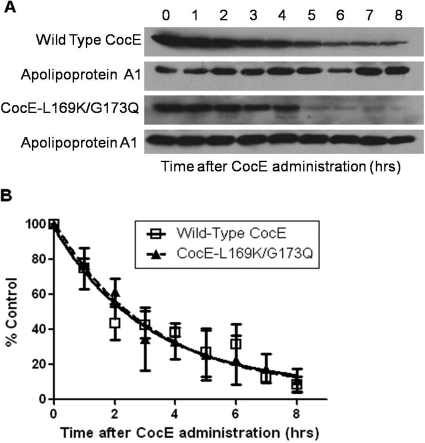
In vivo CocE plasma half-life. A, representative Western blots of CocE from mouse serum over time. CocE (L169K/G173Q or wt) was administered to mice intravenously via the lateral tail vein. Blood samples were taken at the times indicated by submandibular sampling. Serum was collected and 20 μg of total serum protein was run on a 10% SDS polyacrylamide gel. Blotting was performed with rabbit anti-CocE antibody and rabbit anti-Apolipoprotein A1 antibody. Wild-type and CocE-L169K/G173Q were both tested in three independent groups of animals followed by serum analysis. B, quantification of wt and CocE-L169K/G173Q Western blot densities analyzed with Image J software. All time points are adjusted as a fraction of the apoA1 loading control. Fit to a one-phase exponential decay model, the half-life of CocE-L169K/G173Q was determined to be 2.3 h after administration (wt = 2.2 h). two-way ANOVA, p = 0.92.

References

    1. Benowitz NL. (1993) Clinical pharmacology and toxicology of cocaine. Pharmacol Toxicol 72:3–12 - PubMed
    1. Billman GE. (1990) Mechanisms responsible for the cardiotoxic effects of cocaine. FASEB J 4:2469–2475 - PubMed
    1. Bresler MM, Rosser SJ, Basran A, Bruce NC. (2000) Gene cloning and nucleotide sequencing and properties of a cocaine esterase from Rhodococcus sp. strain MB1. Appl Environ Microbiol 66:904–908 - PMC - PubMed
    1. Brimijoin S, Gao Y, Anker JJ, Gliddon LA, Lafleur D, Shah R, Zhao Q, Singh M, Carroll ME. (2008) A cocaine hydrolase engineered from human butyrylcholinesterase selectively blocks cocaine toxicity and reinstatement of drug seeking in rats. Neuropsychopharmacology 33:2715–2725 - PMC - PubMed
    1. Browne SP, Slaughter EA, Couch RA, Rudnic EM, McLean AM. (1998) The influence of plasma butyrylcholinesterase concentration on the in vitro hydrolysis of cocaine in human plasma. Biopharm Drug Dispos 19:309–314 - PubMed

Publication types

Substances