


Evaluation of Fab and F(ab')2 fragments and isotype variants of a recombinant human monoclonal antibody against Shiga toxin 2
- PMID: 20086088
- PMCID: PMC2825921
- DOI: 10.1128/IAI.00867-09
Evaluation of Fab and F(ab')2 fragments and isotype variants of a recombinant human monoclonal antibody against Shiga toxin 2
Abstract
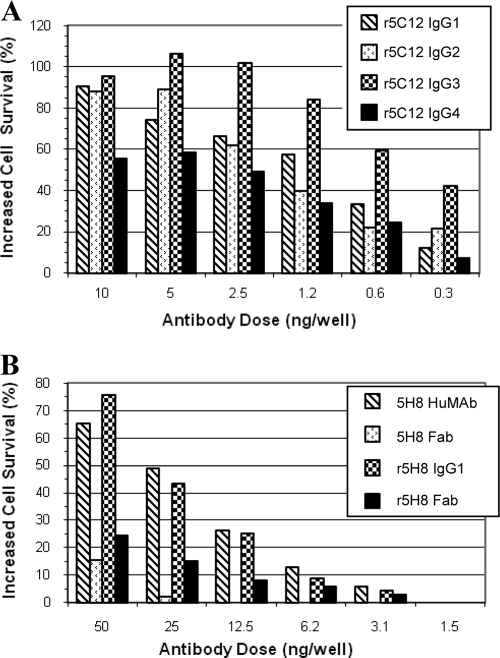
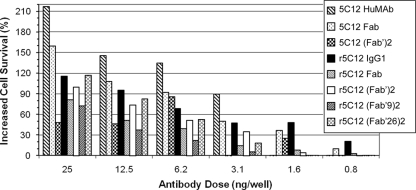
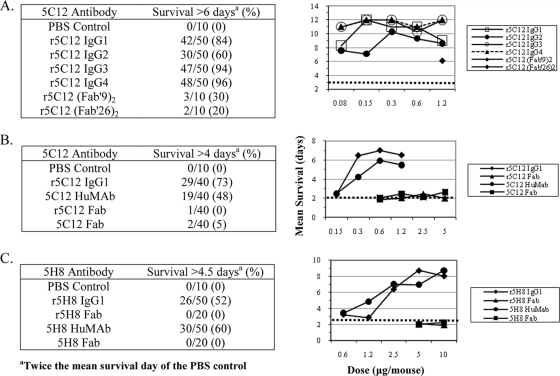
5C12 HuMAb is a human monoclonal antibody against the A subunit of Shiga toxin 2 (Stx2). We have previously shown that 5C12 HuMAb effectively neutralizes the cytotoxic effects of this toxin by redirecting its transport within the cell and also by neutralizing the toxin's ability to inhibit protein synthesis. The 5C12 HuMAb and its recombinant IgG1 version protect mice at a dose of 0.6 microg against a lethal challenge of Stx2. The contribution of the Fc region to this observed neutralization activity of the 5C12 antibody against Stx2 was investigated in this study. Using recombinant DNA technology, 5C12 isotype variants (IgG1, IgG2, IgG3, and IgG4) and antibody fragments [Fab, F(ab')(2)] were expressed in Chinese hamster ovary cells and evaluated in vitro and in vivo. All four 5C12 isotype variants showed protection in vitro, with the IgG3 and IgG4 variants showing the highest protection in vivo. The Fab and F(ab')(2) fragments also showed protection in vitro but no protection in the mouse toxicity model. Similar results were obtained for a second HuMAb (5H8) against the B subunit of Stx2. The data suggest the importance of the Fc region for neutralization activity, but it is not clear if this is related to the stability of the full-length antibody or if the Fc region is required for effective elimination of the toxin from the body.
Figures
References
-
- Akiyoshi, D. E., C. M. Rich, S. O'Sullivan-Murphy, L. Richard, J. Dilo, A. Donohue-Rolfe, A. S. Sheoran, S. Chapman-Bonofiglio, and S. Tzipori. 2005. Characterization of a human monoclonal antibody against Shiga toxin 2 expressed in Chinese hamster ovary cells. Infect. Immun. 73:4054-4061. - PMC - PubMed
-
- Andrew, S. M., and J. A. Titus. 2003. Fragmentation of immunoglobulin G. Curr. Protoc. Cell Biol. 16:16.4. - PubMed
-
- Bonifacino, J. S., and R. Rojas. 2006. Retrograde transport from endosomes to the trans-Golgi network. Nat. Rev. Mol. Cell Biol. 7:568-579. - PubMed
-
- Cherla, R. P., S. Y. Lee, and V. L. Tesh. 2003. Shiga toxins and apoptosis. FEMS Microbiol. Lett. 228:159-166. - PubMed
-
- Edwards, A. C., A. R. Melton-Celsa, K. Arbuthnott, J. R. Stinson, C. K. Schmitt, H. C. Wong, and A. O'Brien. 1998. Vero cell neutralization and mouse protective efficacy of humanized monoclonal antibodies against Escherichia coli toxins Stx1 and Stx2, p. 388-392. In J. B. Kasper and A. D. O'Brien (ed.), Escherichia coli O157:H7 and other Shiga toxin-producing E. coli strains. American Society for Microbiology, Washington, DC.
Publication types
MeSH terms
Substances
Grants and funding
LinkOut - more resources
Full Text Sources
Medical
