


Postural compensation for vestibular loss and implications for rehabilitation
- PMID: 20086283
- PMCID: PMC2965039
- DOI: 10.3233/RNN-2010-0515
Postural compensation for vestibular loss and implications for rehabilitation
Abstract
Purpose: This chapter summarizes the role of the vestibular system in postural control so that specific and effective rehabilitation can be designed that facilitates compensation for loss of vestibular function.
Methods: Patients with bilateral or unilateral loss of peripheral vestibular function are exposed to surface perturbations to quantify automatic postural responses. Studies also evaluated the effects of audio- and vibrotactile-biofeedback to improve stability in stance and gait.
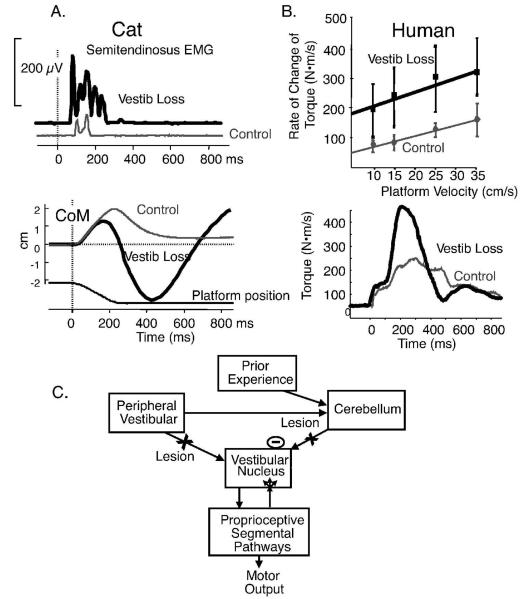
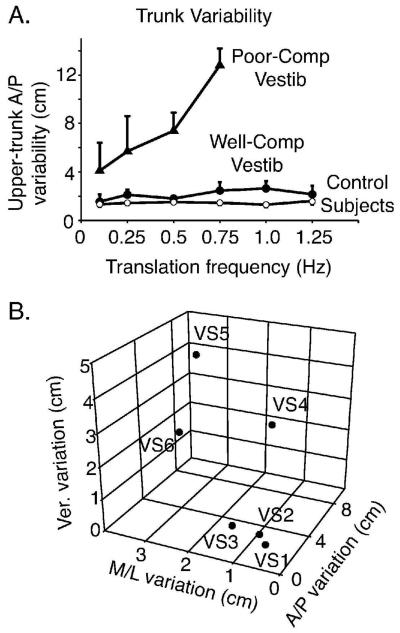
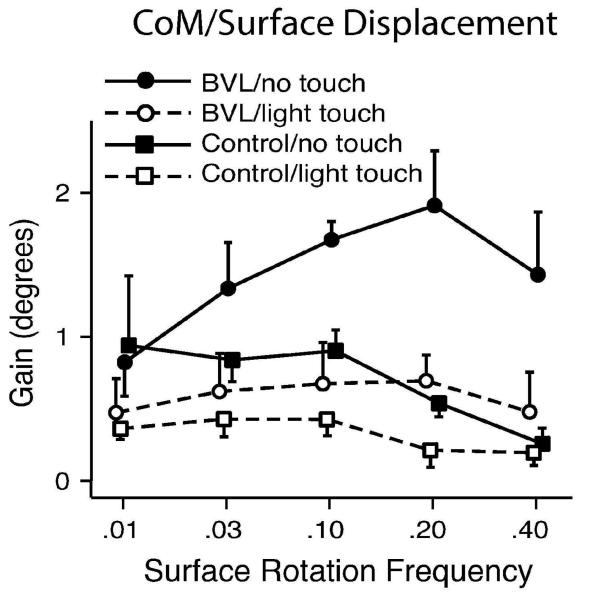
Results: The most important role of vestibular information for postural control is to control orientation of the head and trunk in space with respect to gravitoinertial forces, particularly when balancing on unstable surfaces. Vestibular sensory references are particularly important for postural control at high frequencies and velocities of self-motion, to reduce trunk drift and variability, to provide an external reference frame for the trunk and head in space; and to uncouple coordination of the trunk from the legs and the head-in-space from the body CoM.
Conclusions: The goal of balance rehabilitation for patients with vestibular loss is to help patients 1) use remaining vestibular function, 2) depend upon surface somatosensory information as their primary postural sensory system, 3) learn to use stable visual references, and 4) identify efficient and effective postural movement strategies.
Figures
References
-
- Inglis JT, Macpherson JM. Bilateral labyrinthectomy in the cat: effects on the postural response to translation. Journal of Neurophysiology. 1995 Mar;73(3):1181–91. - PubMed
-
- Horak FB. Adaptation of automatic postural responses. In: Bloedel J, Ebner TJ, Wise SP, editors. Acquisition of Motor Behavior in Vertebrates. MIT Press; Cambridge: 1996. pp. 57–85.
-
- Horak FB, Nashner LM, Diener HC. Postural strategies associated with somatosensory and vestibular loss. Exp. Brain Res. 1990;82:167–177. - PubMed
-
- Buchanan JJ, Horak FB. Vestibular loss disrupts control of head and trunk on a sinusoidally moving platform. J. Vestibular Res. 2001-2002;11(6):371–89. - PubMed
-
- Creath R, Kiemel T, Horak F, Jeka JJ. Limited control strategies with the loss of vestibular function. Exp. Brain Res. 2002;145(3):323–33. - PubMed
Publication types
MeSH terms
Grants and funding
LinkOut - more resources
Full Text Sources
Medical
