


Plasma organochlorine levels and risk of non-Hodgkin lymphoma in a cohort of men
- PMID: 20087190
- PMCID: PMC2957873
- DOI: 10.1097/EDE.0b013e3181cb610b
Plasma organochlorine levels and risk of non-Hodgkin lymphoma in a cohort of men
Abstract
Background: Environmental exposure to polychlorinated biphenyls (PCBs) and p,p'-dichlorodiphenyldichloroethylene (p, p'-DDE) has been associated with the risk of non-Hodgkin lymphoma.
Methods: We conducted a case-control study nested within the Physicians' Health Study, a prospective cohort established in 1982. We measured concentrations of PCBs and p,p'-DDE in baseline blood samples from 205 men later diagnosed with non-Hodgkin lymphoma and 409 age- and race-matched controls. Lipid-adjusted organochlorine concentrations were categorized into quintiles based on the distribution among controls. We used conditional logistic regression to estimate the odds ratios (ORs) and 95% confidence intervals (CIs) for each quintile relative to the lowest quintile. We also evaluated these associations for major histologic subtypes of non-Hodgkin lymphoma.
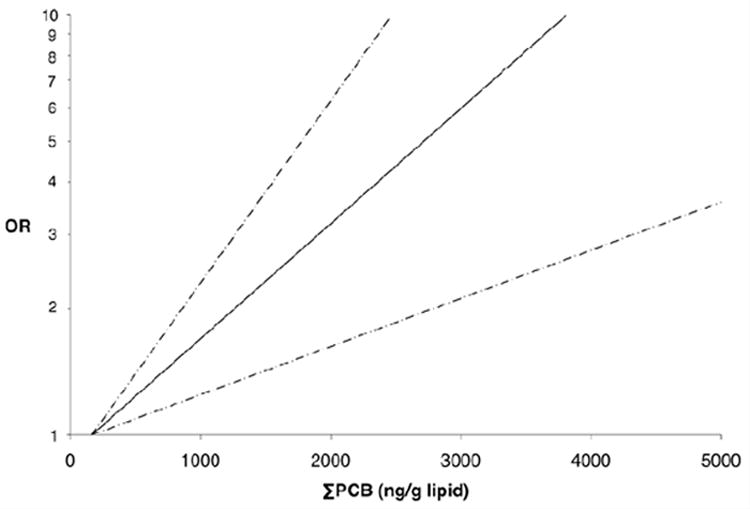
Results: The risk of non-Hodgkin lymphoma was positively associated with the sum of 51 PCB congeners assayed (SigmaPCB); the group of immunotoxic congeners; the individual congeners 118, 138, 153, and 180; and the sum of these 4 congeners. The simple OR for the highest quintile of lipid-adjusted SigmaPCB versus the lowest was 1.9 (95% CI = 1.1-3.2; test for trend, P = 0.001), with similar trends for individual congeners and groups defined as above. Adjustment for height, body mass index, alcohol intake, smoking, and fish intake did not substantially change the effect estimates. No association was observed for p,p'-DDE. There was no evidence of statistical heterogeneity in effects by histologic subtype of lymphoma; however, this analysis was underpowered.
Conclusions: These results support the hypothesis of a positive association between PCB exposure and development of NHL in men.
Figures
References
-
- Ries LAG, Melbert D, Krapcho M, et al., editors. SEER Cancer Statistics Review, 1975-2004. Bethesda, MD: National Cancer Institute; 2007.
-
- Grulich AE, Vajdic CM. The epidemiology of non-Hodgkin lymphoma. Pathology. 2005;37:409–419. - PubMed
-
- Hartge P, Devesa SS. Quantification of the impact of known risk factors on time trends in non-Hodgkin’s lymphoma incidence. Cancer Res. 1992;52:5566s–5569s. - PubMed
-
- Eltom MA, Jemal A, Mbulaiteye SM, Devesa SS, Biggar RJ. Trends in Kaposi’s sarcoma and non-Hodgkin’s lymphoma incidence in the United States from 1973 through 1998. J Natl Cancer Inst. 2002;94:1204–1210. - PubMed
-
- Cocco P, Brennan P, Ibba A, et al. Plasma polychlorobiphenyl and organochlorine pesticide level and risk of major lymphoma subtypes. Occup Environ Med. 2008;65:132–140. - PubMed
Publication types
MeSH terms
Substances
Grants and funding
LinkOut - more resources
Full Text Sources
