


Discharge behaviors of trapezius motor units during exposure to low and high levels of acute psychosocial stress
- PMID: 20087201
- PMCID: PMC2856657
- DOI: 10.1097/WNP.0b013e3181cb81d3
Discharge behaviors of trapezius motor units during exposure to low and high levels of acute psychosocial stress
Abstract
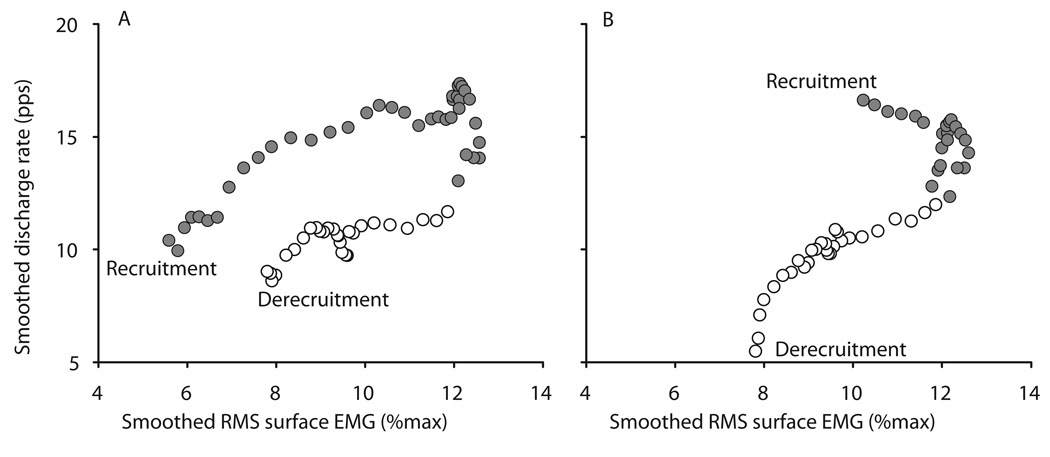
This study investigated the effects of acute psychosocial stress on trapezius single motor unit discharge behaviors. Twenty-one healthy women performed feedback-controlled isometric contractions under conditions of low and high psychosocial stress in the same experimental session. Psychosocial stress was manipulated using a verbal math task combined with social evaluative threat that significantly increased perceived anxiety, heart rate, and blood pressure (P < 0.001). Motor unit discharge behaviors including the threshold and discharge rate at recruitment [7.7% (5.7%) maximal voluntary isometric contraction and 7.3 pulses per second (pps) (6.8 pps), P > 0.121, N = 103] and derecruitment [6.0% (4.4%) maximal voluntary isometric contraction and 6.5 pps (4.1 pps), P > 0.223, N = 99], the mean [11.3 pps (2.3 pps), P = 0.309, N = 106] and variability [2.5 pps (0.91 pps), P = 0.958, N = 106] of discharge rate, and the proportion of motor units exhibiting double discharges (21%, P = 0.446) did not change across stress conditions. Discharge rate modulation with changes in contraction intensity was highly variable and similar across stress conditions (P > 0.308, N = 89). Rate-rate modulation of concurrently active motor units was also highly variable (r = -0.84 to 1.00, N = 75). Estimates of DeltaF for motor unit pairs with rate-rate modulation >or=0.7 were positive and similar across stress conditions [4.7 pps (2.0 pps), P = 0.405, N = 16]. The results indicate that acute psychosocial stress does not alter trapezius motor unit discharge behaviors during a precisely controlled motor task in healthy women.
Figures



References
-
- Ariens GA, van Mechelen W, Bongers PM, Bouter LM, van der Wal G. Psychosocial risk factors for neck pain: a systematic review. American journal of industrial medicine. 2001;39:180–193. - PubMed
-
- Bawa P, Pang MY, Olesen KA, Calancie B. Rotation of motoneurons during prolonged isometric contractions in humans. Journal of neurophysiology. 2006;96:1135–1140. - PubMed
Publication types
MeSH terms
Grants and funding
LinkOut - more resources
Full Text Sources
Medical
