


Validation of reference genes for quantitative RT-PCR studies of gene expression in perennial ryegrass (Lolium perenne L.)
- PMID: 20089196
- PMCID: PMC2827471
- DOI: 10.1186/1471-2199-11-8
Validation of reference genes for quantitative RT-PCR studies of gene expression in perennial ryegrass (Lolium perenne L.)
Abstract
Background: Perennial ryegrass (Lolium perenne L.) is an important pasture and turf crop. Biotechniques such as gene expression studies are being employed to improve traits in this temperate grass. Quantitative reverse transcription-polymerase chain reaction (qRT-PCR) is among the best methods available for determining changes in gene expression. Before analysis of target gene expression, it is essential to select an appropriate normalisation strategy to control for non-specific variation between samples. Reference genes that have stable expression at different biological and physiological states can be effectively used for normalisation; however, their expression stability must be validated before use.
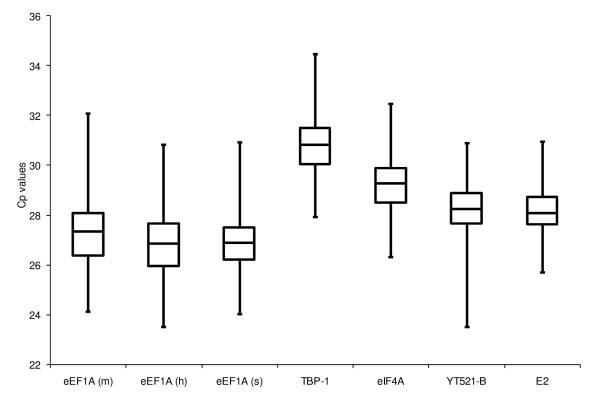
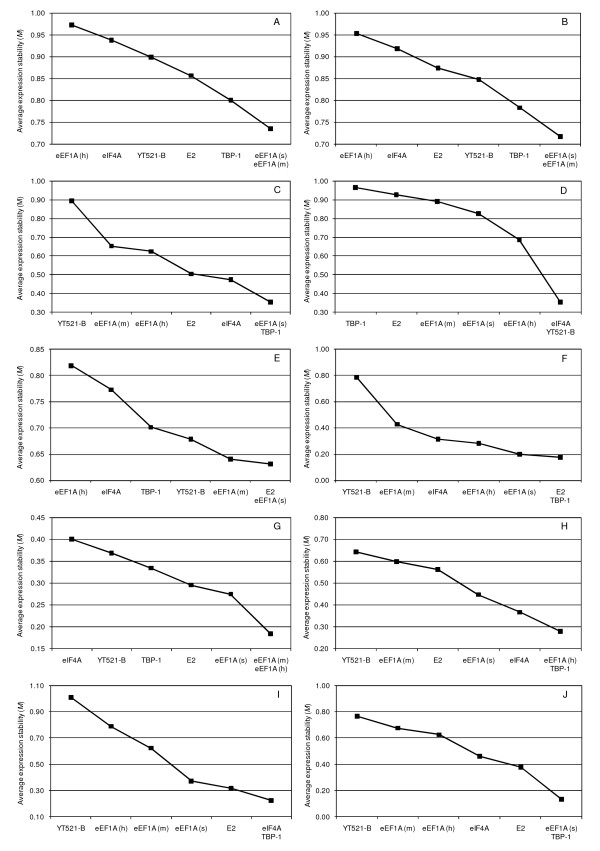
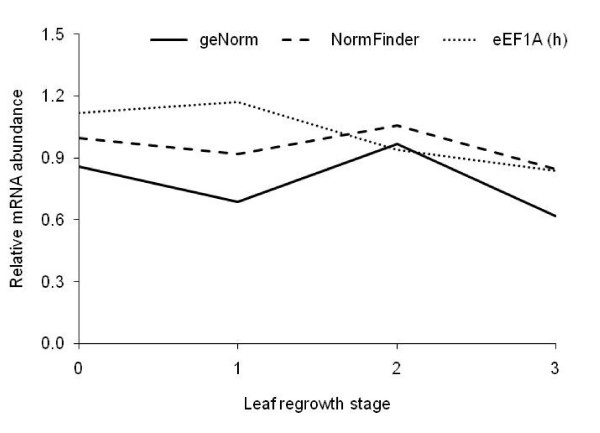
Results: Existing Serial Analysis of Gene Expression data were queried to identify six moderately expressed genes that had relatively stable gene expression throughout the year. These six candidate reference genes (eukaryotic elongation factor 1 alpha, eEF1A; TAT-binding protein homolog 1, TBP-1; eukaryotic translation initiation factor 4 alpha, eIF4A; YT521-B-like protein family protein, YT521-B; histone 3, H3; ubiquitin-conjugating enzyme, E2) were validated for qRT-PCR normalisation in 442 diverse perennial ryegrass (Lolium perenne L.) samples sourced from field- and laboratory-grown plants under a wide range of experimental conditions. Eukaryotic EF1A is encoded by members of a multigene family exhibiting differential expression and necessitated the expression analysis of different eEF1A encoding genes; a highly expressed eEF1A (h), a moderately, but stably expressed eEF1A (s), and combined expression of multigene eEF1A (m). NormFinder identified eEF1A (s) and YT521-B as the best combination of two genes for normalisation of gene expression data in perennial ryegrass following different defoliation management in the field.
Conclusions: This study is unique in the magnitude of samples tested with the inclusion of numerous field-grown samples, helping pave the way to conduct gene expression studies in perennial biomass crops under field-conditions. From our study several stably expressed reference genes have been validated. This provides useful candidates for reference gene selection in perennial ryegrass under conditions other than those tested here.
Figures
References
-
- Kemp PD, Matthew C, Lucas RJ, White J, Hodgson J. New Zealand Pasture and Crop Science. Auckland: Oxford University Press; 2000. Pasture species and cultivars; pp. 83–100.
-
- Roche JR, Turner LR, Lee JM, Edmeades DC, Donaghy DJ, Macdonald KA, Penno JW, Berry DP. Weather, herbage quality and milk production in pastoral systems. Temporal patterns and intra-relationships in herbage quality and mineral concentration parameters. Anim Prod Sci. 2009;49(3):200–210. doi: 10.1071/EA07308. - DOI
-
- Fulkerson WJ, Slack K. Leaf number as a criterion for determining defoliation time for Lolium perenne: 2. Effect of defoliation frequency and height. Grass Forage Sci. 1995;50(1):16–20. doi: 10.1111/j.1365-2494.1995.tb02289.x. - DOI
-
- Turner LR. Ph.D. Hobart, Australia: University of Tasmania; 2006. Investigating the physiology and management of cocksfoot (Dactylis glomerata L.) and prairie grass (Bromus willdenowii Kunth.) as alternative perennial grass species for the dairy industry in southern Australia.
-
- Lee JM, Donaghy DJ, Roche JR. The effect of grazing severity and fertiliser application during winter on herbage regrowth and quality of perennial ryegrass (Lolium perenne L.) Aust J Exp Agric. 2007;47(7):825–832. doi: 10.1071/EA06037. - DOI
Publication types
MeSH terms
Substances
LinkOut - more resources
Full Text Sources
Other Literature Sources
Miscellaneous
