Histopathologic features aid in predicting risk for progression of IgA nephropathy
- PMID: 20089495
- PMCID: PMC2827572
- DOI: 10.2215/CJN.06530909
Histopathologic features aid in predicting risk for progression of IgA nephropathy
Abstract
Background and objectives: IgA nephropathy (IgAN) is the most common primary glomerular disease worldwide. Accurately identifying patients who are at risk for progressive disease is challenging. The extent to which histopathologic features improves prognostication is uncertain.
Design, setting, participants, & measurements: We studied a retrospective cohort with biopsy-proven IgAN in Calgary, Canada. Renal biopsies were reviewed by a nephropathologist with histopathologic data abstracted using a standardized form. The primary outcome was the composite of doubling of serum creatinine, ESRD, or death. Spline models defined significant levels of interstitial fibrosis, glomerulosclerosis, hypertension, proteinuria, and creatinine. The prognostic significances of clinical and histopathologic parameters were determined using Cox proportional hazards models.
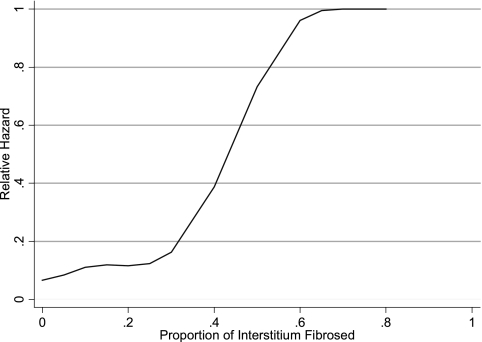
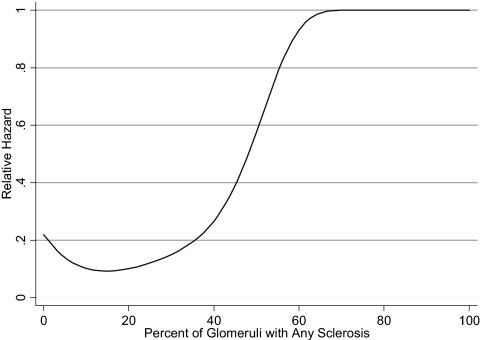
Results: Data from 146 cases were available for analysis with a median follow-up of 5.8 years. Greater than 25% interstitial fibrosis, >40% glomerular sclerosis, and a systolic BP >150 mmHg were risk thresholds. In univariable analyses, baseline creatinine, proteinuria, systolic BP, glomerular sclerosis, interstitial fibrosis, and crescentic disease were predictors of the primary outcome. In multivariable models adjusted for clinical characteristics, interstitial fibrosis (hazard ratio [HR]2.7; 95% confidence interval [CI] 1.2 to 6.0), glomerular sclerosis (HR 2.6; 95% CI 1.2 to 4.5), and crescents (HR 2.4; 95% CI 1.2 to 5.1) remained independent predictors of the primary outcome and significantly improved model fit compared with clinical characteristics alone.
Conclusions: Baseline histopathologic parameters are independent predictors of adverse outcomes in IgAN even after taking into consideration clinical characteristics. Relatively small degrees of interstitial fibrosis confer an increased risk for progressive IgAN.
Figures
References
-
- Alamartine E, Sabatier JC, Guerin C, Berliet JM, Berthoux F: Prognostic factors in mesangial IgA glomerulonephritis: An extensive study with univariate and multivariate analyses. Am J Kidney Dis 18: 12–19, 1991 - PubMed
-
- D'Amico G: Influence of clinical and histological features on actuarial renal survival in adult patients with idiopathic IgA nephropathy, membranous nephropathy, and membranoproliferative glomerulonephritis: Survey of the recent literature. Am J Kidney Dis 20: 315–323, 1992 - PubMed
-
- Haas M: Histologic subclassification of IgA nephropathy: A clinicopathologic study of 244 cases. Am J Kidney Dis 29: 829–842, 1997 - PubMed
-
- Johnston PA, Brown JS, Braumholtz DA, Davison AM: Clinico-pathological correlations and long-term follow-up of 253 United Kingdom patients with IgA nephropathy: A report from the MRC Glomerulonephritis Registry. Q J Med 84: 619–627, 1992 - PubMed
-
- Katafuchi R, Oh Y, Hori K, Komota T, Yanase T, Ikeda K, Omura T, Fujimi S: An important role of glomerular segmental lesions on progression of IgA nephropathy: A multivariate analysis. Clin Nephrol 41: 191–198, 1994 - PubMed
Publication types
MeSH terms
Substances
LinkOut - more resources
Full Text Sources
Other Literature Sources
Medical
Miscellaneous