


Behavioural asymmetry affects escape performance in a teleost fish
- PMID: 20089537
- PMCID: PMC2880054
- DOI: 10.1098/rsbl.2009.0904
Behavioural asymmetry affects escape performance in a teleost fish
Abstract
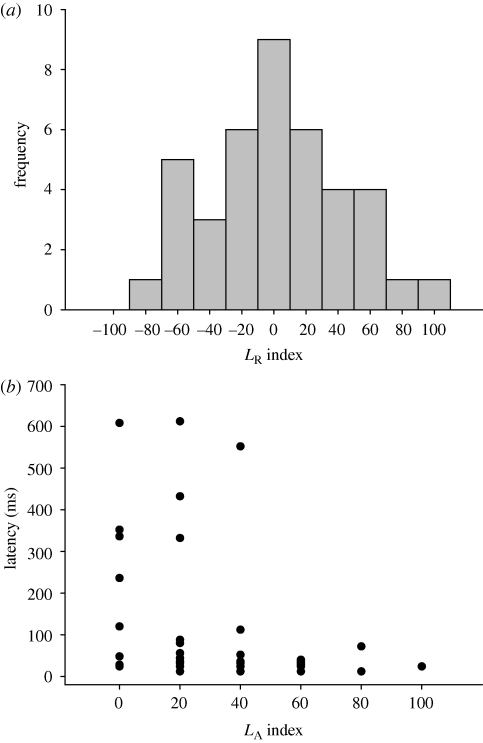
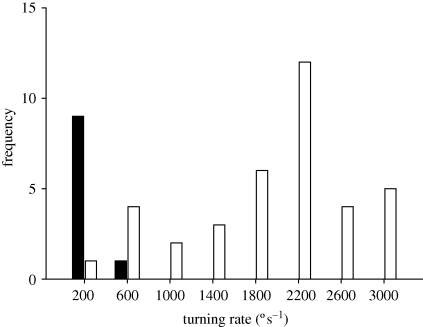
Escape performance is fundamental for survival in fish and most other animals. While previous work has shown that both intrinsic (e.g. size, shape) and extrinsic (e.g. temperature, hypoxia) factors can affect escape performance, the possibility that behavioural asymmetry may affect timing and locomotor performance in startled fish is largely unexplored. Numerous studies have found a relationship between brain lateralization and performance in several cognitive tasks. Here, we tested the hypothesis that behavioural lateralization may affect escape performance in a teleost, the shiner perch Cymatogaster aggregata. Escape responses were elicited by mechanical stimulation and recorded using high-speed video (250 Hz). A number of performance variables were analysed, including directionality, escape latency, turning rate and distance travelled within a fixed time. A lateralization index was obtained by testing the turning preference of each subject in a detour test. While lateralization had no effect on escape directionality, strongly lateralized fish showed higher escape reactivity, i.e. shorter latencies, which were associated with higher turning rates and longer distances travelled. Therefore, lateralization is likely to result in superior ability to escape from predator attacks, since previous work has shown that escape timing, turning rate and distance travelled are among the main determinants of escape success.
Figures
References
-
- Ades C., Ramires E. N.2002Asymmetry of leg use during prey handling in the spider Scytodes globula (Scytodidae). J. Insect Behav. 15, 563–570 (doi:10.1023/A:1016337418472) - DOI
-
- Agrillo C., Dadda M., Bisazza A.2009Escape behaviour elicited by a visual stimulus. A comparison between lateralised and non-lateralised female topminnows. Laterality 14, 300–314 - PubMed
-
- Bisazza A., Dadda M.2005Enhanced schooling performance in lateralized fishes. Proc. R. Soc. B 272, 1677–1681 (doi:10.1098/rspb.2005.3145) - DOI - PMC - PubMed
-
- Bisazza A., Facchin L., Pignatti R., Vallortigara G.1998Lateralization of detour behaviour in poeciliid fish: the effect of species, gender and sexual motivation. Behav. Brain Res. 91, 157–164 (doi:10.1016/S0166-4328(97)00114-9) - DOI - PubMed
-
- Dadda M., Zandonà E., Agrillo C., Bisazza A.2009The costs of hemispheric specialization in a fish. Proc. R. Soc. B 276, 4399–4407 (doi:10.1098/rspb.2009.1406) - DOI - PMC - PubMed
Publication types
MeSH terms
LinkOut - more resources
Full Text Sources
