Predominance and emergence of clones of hospital-acquired methicillin-resistant Staphylococcus aureus in Malaysia
- PMID: 20089756
- PMCID: PMC2832418
- DOI: 10.1128/JCM.01112-09
Predominance and emergence of clones of hospital-acquired methicillin-resistant Staphylococcus aureus in Malaysia
Abstract
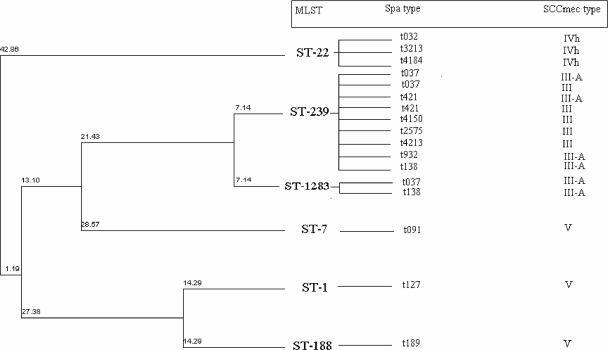
We define the epidemiology of predominant and sporadic methicillin-resistant Staphylococcus aureus (MRSA) strains in a central teaching and referral hospital in Kuala Lumpur, Malaysia. This is done on the basis of spa sequencing, multilocus sequence typing (MLST), staphylococcal cassette chromosome mec (SCCmec) typing, and virulence gene profiling. During the period of study, the MRSA prevalence was 44.1%, and 389 MRSA strains were included. The prevalence of MRSA was found to be significantly higher in the patients of Indian ethnicity (P < 0.001). The majority (92.5%) of the isolates belonged to ST-239, spa type t037, and possessed the type III or IIIA SCCmec. The arginine catabolic mobile element (ACME) arcA gene was detected in three (1.05%) ST-239 isolates. We report the first identification of ACME arcA gene-positive ST-239. Apart from this predominant clone, six (1.5%) isolates of ST-22, with two related spa types (t032 and t4184) and a singleton (t3213), carrying type IVh SCCmec, were detected for the first time in Asia. A limited number of community-acquired (CA) MRSA strains were also detected. These included ST-188/t189 (2.1%), ST-1/t127 (2.3%), and ST-7/t091 (1%). Panton-Valentin leukocidin (PVL) was detected in all ST-1 and ST-188 strains and in 0.7% of the ST-239 isolates. The majority of the isolates carried agr I, except that ST-1 strains were agr III positive. Virulence genes seg and sei were seen only among ST-22 isolates. In conclusion, current results revealed the predominance of ST-239-SCCmec III/IIIA and the penetration of ST-22 with different virulence gene profiles. The emergence in Malaysia of novel clones of known epidemic and pathogenic potential should be taken seriously.
Figures
References
-
- Arciola, C. R., D. Campoccia, S. Gamberini, L. Baldassarri, and L. Montanaro. 2005. Prevalence of cna, fnbA and fnbB adhesin genes among Staphylococcus aureus isolates from orthopedic infections associated to different types of implant. FEMS Microbiol. Lett. 246:81-86. - PubMed
-
- Berglund, C., T. Ito, X. X. Ma, M. Ikeda, S. Watanabe, B. Söderquist, and K. Hiramatsu. 2009. Genetic diversity of methicillin-resistant Staphylococcus aureus carrying type IV SCCmec in Orebro County and the western region of Sweden. J. Antimicrob. Chemother. 63:32-41. - PubMed
-
- Campbell, S., H. Deshmukh, C. Nelson, I. Bae, M. Stryjewski, J. Federspiel, G. Tonthat, T. Rude, S. Barriere, R. Corey, and V. J. Fowler. 2008. Genotypic characteristics of Staphylococcus aureus isolates from a multinational trial of complicated skin and skin structure infections. J. Clin. Microbiol. 46:678-684. - PMC - PubMed
Publication types
MeSH terms
Substances
LinkOut - more resources
Full Text Sources
Medical