


Binding of complement regulators to invasive nontypeable Haemophilus influenzae isolates is not increased compared to nasopharyngeal isolates, but serum resistance is linked to disease severity
- PMID: 20089757
- PMCID: PMC2832458
- DOI: 10.1128/JCM.01654-09
Binding of complement regulators to invasive nontypeable Haemophilus influenzae isolates is not increased compared to nasopharyngeal isolates, but serum resistance is linked to disease severity
Abstract
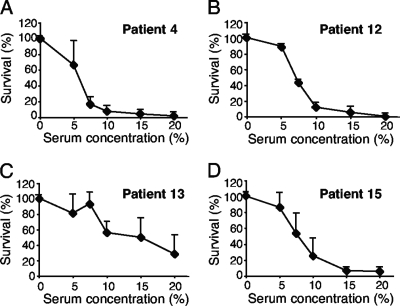
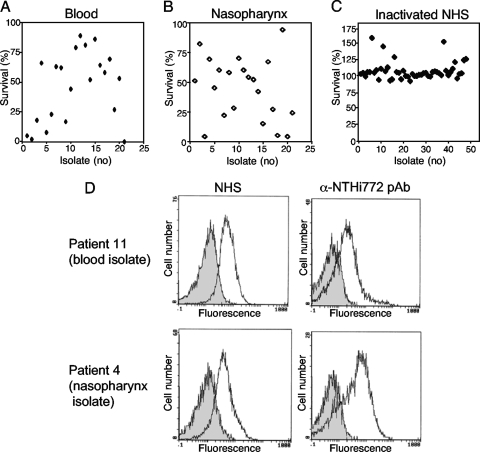
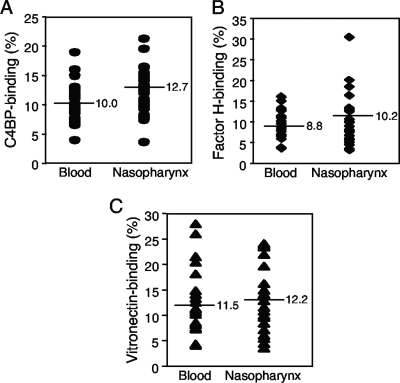
The aim of the present study was to analyze the importance of nontypeable Haemophilus influenzae (NTHi) isolated from patients with sepsis (invasive isolates) compared to nasopharyngeal isolates from patients with upper respiratory tract infection for resistance to complement-mediated attack in human serum and to correlate this result with disease severity. We studied and characterized cases of invasive NTHi disease in detail. All patients with invasive NTHi isolates were adults, and 35% had a clinical presentation of severe sepsis according to the ACCP/SCCM classification of sepsis grading. Moreover, 41% of the patients had evidence of immune deficiency. The different isolates were analyzed for survival in human serum and for binding of 125I-labeled, purified human complement inhibitors C4b-binding protein (C4BP), factor H, and vitronectin, in addition to binding of regulators directly from serum. No significant differences were found when blood-derived and nasopharyngeal isolates were compared, suggesting that interactions with the complement system are equally important for NTHi strains, irrespective of isolation site. Interestingly, a correlation between serum resistance and invasive disease severity was found. The ability to resist the attack of the complement system seems to be important for NTHi strains infecting the respiratory tract as well as the bloodstream.
Figures
References
-
- Ahren, I. L., D. L. Williams, P. J. Rice, A. Forsgren, and K. Riesbeck. 2001. The importance of a beta-glucan receptor in the nonopsonic entry of nontypeable Haemophilus influenzae into human monocytic and epithelial cells. J. Infect. Dis. 184:150-158. - PubMed
-
- Aubrey, R., and C. Tang. 2003. The pathogenesis of disease due to type b Haemophilus influenzae. Methods Mol. Med. 71:29-50. - PubMed
-
- Bandi, V., M. A. Apicella, E. Mason, T. F. Murphy, A. Siddiqi, R. L. Atmar, and S. B. Greenberg. 2001. Nontypeable Haemophilus influenzae in the lower respiratory tract of patients with chronic bronchitis. Am. J. Respir. Crit. Care. Med. 164:2114-2119. - PubMed
-
- Bandi, V., M. Jakubowycz, C. Kinyon, E. O. Mason, R. L. Atmar, S. B. Greenberg, and T. F. Murphy. 2003. Infectious exacerbations of chronic obstructive pulmonary disease associated with respiratory viruses and non-typeable Haemophilus influenzae. FEMS Immunol. Med. Microbiol. 37:69-75. - PMC - PubMed
-
- Bath, S. 2002. Progress towards elimination of Haemophilus influenzae type b invasive disease among infants and children—United States 1998-2000. MMWR Morb. Mortal. Wkly. Rep. 51:234-237. - PubMed
Publication types
MeSH terms
Substances
LinkOut - more resources
Full Text Sources
Medical
Miscellaneous
