Immunization of mice with single PspA fragments induces antibodies capable of mediating complement deposition on different pneumococcal strains and cross-protection
- PMID: 20089795
- PMCID: PMC2837969
- DOI: 10.1128/CVI.00430-09
Immunization of mice with single PspA fragments induces antibodies capable of mediating complement deposition on different pneumococcal strains and cross-protection
Abstract
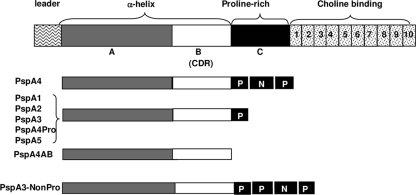
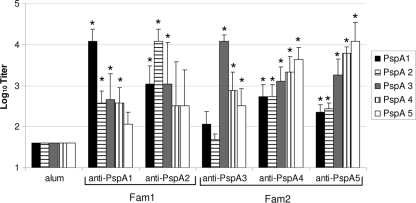
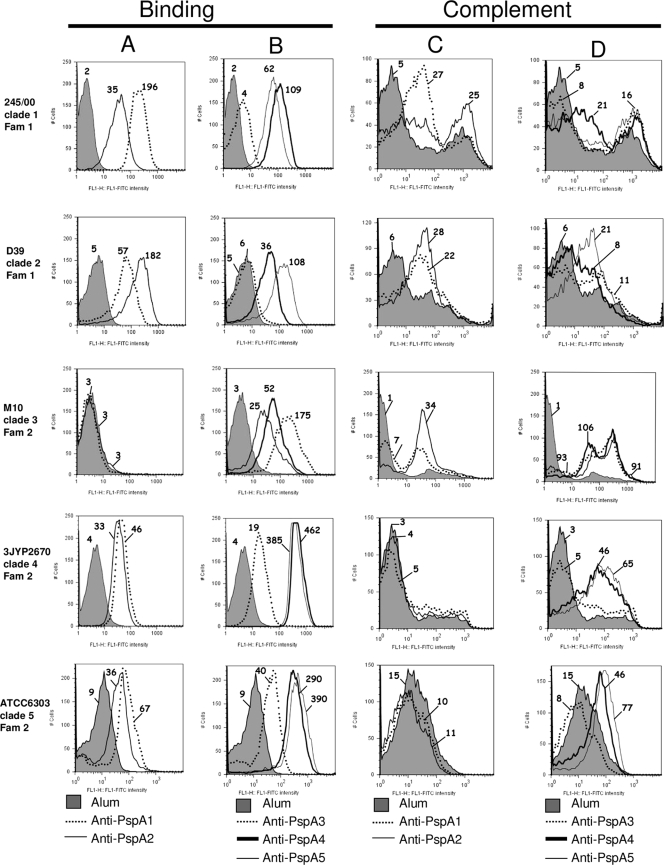
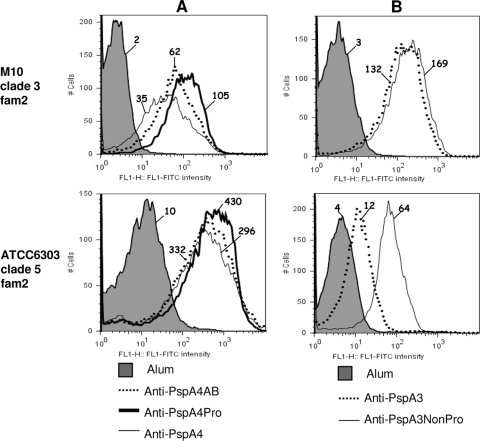
PspA is an important candidate for a vaccine with serotype-independent immunity against pneumococcal infections. Based on sequence relatedness, PspA has been classified into three families comprising six clades. We have previously addressed the cross-reactivity of antibodies against PspA fragments containing the N-terminal and proline-rich regions of PspA from clades 1 to 5 (PspA1, PspA2, PspA3, PspA4, and PspA5) by Western blot analysis and reported that anti-PspA4 and anti-PspA5 were able to recognize pneumococci expressing PspA proteins from all of the clades analyzed. We have now analyzed the functional capacity of these antibodies to bind and to mediate complement deposition on intact bacteria in vitro. Our results show that both PspA4 and PspA5 elicit antibodies that are able to bind and to mediate complement deposition efficiently on pneumococcal strains bearing PspA proteins from clades 1 to 5. Moreover, mice immunized with PspA4 and PspA5 were protected against an intranasal lethal challenge with strains expressing PspA proteins from the two major families. PspA4 and PspA5 are thus able to induce antibodies with a high degree of cross-reactivity in vitro, which is reflected in cross-protection of mice. We have also analyzed the contribution of the nonproline (NonPro) block within the conserved proline-rich region to the reactivity of anti-PspA antibodies, and the results indicate that N-terminal alpha-helical region, the blocks of proline repeats, and the NonPro region can influence the degree of cross-reactivity of antibodies to PspA.
Figures
References
-
- Arulanandam, B. P., J. M. Lynch, D. E. Briles, S. Hollingshead, and D. W. Metzger. 2001. Intranasal vaccination with pneumococcal surface protein A and interleukin-12 augments antibody-mediated opsonization and protective immunity against Streptococcus pneumoniae infection. Infect. Immun. 69:6718-6724. - PMC - PubMed
-
- Briles, D. E., E. Ades, J. C. Paton, J. S. Sampson, G. M. Carlone, R. C. Huebner, A. Virolainen, E. Swiatlo, and S. K. Hollingshead. 2000. Intranasal immunization of mice with a mixture of the pneumococcal proteins PsaA and PspA is highly protective against nasopharyngeal carriage of Streptococcus pneumoniae. Infect. Immun. 68:796-800. - PMC - PubMed
-
- Briles, D. E., S. K. Hollingshead, J. King, A. Swift, P. A. Braun, M. K. Park, L. M. Ferguson, M. H. Nahm, and G. S. Nabors. 2000. Immunization of humans with recombinant pneumococcal surface protein A (rPspA) elicits antibodies that passively protect mice from fatal infection with Streptococcus pneumoniae bearing heterologous PspA. J. Infect. Dis. 182:1694-1701. - PubMed
-
- Briles, D. E., S. K. Hollingshead, J. C. Paton, E. W. Ades, L. Novak, F. W. van Ginkel, and W. H. Benjamin, Jr. 2003. Immunizations with pneumococcal surface protein A and pneumolysin are protective against pneumonia in a murine model of pulmonary infection with Streptococcus pneumoniae. J. Infect. Dis. 188:339-348. - PubMed
Publication types
MeSH terms
Substances
LinkOut - more resources
Full Text Sources
Other Literature Sources
Medical
Molecular Biology Databases