


Improvement of secondary metabolite production in Streptomyces by manipulating pathway regulation
- PMID: 20091304
- PMCID: PMC3472513
- DOI: 10.1007/s00253-009-2428-3
Improvement of secondary metabolite production in Streptomyces by manipulating pathway regulation
Abstract
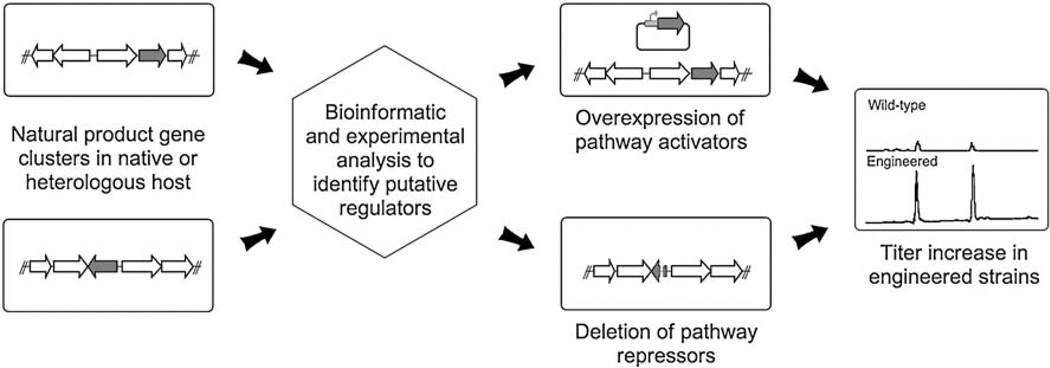
Titer improvement is a constant requirement in the fermentation industry. The traditional method of "random mutation and screening" has been very effective despite the considerable amount of time and resources it demands. Rational metabolic engineering, with the use of recombinant DNA technology, provides a novel, alternative strategy for titer improvement that complements the empirical method used in industry. Manipulation of the specific regulatory systems that govern secondary metabolite production is an important aspect of metabolic engineering that can efficiently improve fermentation titers. In this review, we use examples from Streptomyces secondary metabolism, the most prolific source of clinically used drugs, to demonstrate the power and utility of exploiting natural regulatory networks, in particular pathway-specific regulators, for titer improvement. Efforts to improve the titers of fredericamycin, C-1027, platensimycin, and platencin in our lab are highlighted.
Figures

References
-
- Adrio JL, Demain AL. Genetic improvement of process yielding microbial products. FEMS Microbiol Rev. 2006;30:187–214. - PubMed
-
- Bibb MJ. Regulation of secondary metabolism in streptomycetes. Curr Opin Microbiol. 2005;8:208–215. - PubMed
-
- Bruheim P, Sletta H, Bibb MJ, White J, Levine DW. High-yield actinorhodin production in fed-batch culture by a Streptomyces lividans strain overexpressing the pathway-specific activator gene actll-ORF4. J Ind Microbiol Biotech. 2002;28:103–111. - PubMed
-
- Chen Y, Luo Y, Ju J, Wendt-Pienkowski E, Rajski SR, Shen B. Identification of fredericamycin E from Streptomyces griseus: insight into fredericamycin A biosynthesis highlighting carbaspirocycle formation. J Nat Prod. 2008a;71:431–437. - PubMed
Publication types
MeSH terms
Substances
Grants and funding
LinkOut - more resources
Full Text Sources
Other Literature Sources
Miscellaneous
