


Debridement of diabetic foot ulcers
- PMID: 20091547
- PMCID: PMC7144817
- DOI: 10.1002/14651858.CD003556.pub2
Debridement of diabetic foot ulcers
Abstract
Background: Foot ulceration is thought to affect 15% of people with diabetes at some time in their lives. Debridement is widely regarded as an effective intervention to speed up ulcer healing. The most effective method is unclear.
Objectives: To assess the effects of debridement interventions on the healing of diabetic foot ulcers.
Search strategy: For this third update we searched the Cochrane Wounds Group Specialised Register (June 2009); The Cochrane Central Register of Controlled Trials (CENTRAL) - The Cochrane Library 2009, Issue 2; Ovid MEDLINE - 1950 to June Week 3 2009; Ovid EMBASE - 1980 to 2009 Week 25 and Ovid CINAHL - 1982 to June Week 3 2009.
Selection criteria: Randomised controlled trials (RCTs) evaluating any method of debriding diabetic foot ulcers and measuring complete healing or rate of healing. There was no restriction on articles/trials based on language or publication status.
Data collection and analysis: Data extraction and assessment of study quality were undertaken by one review author and checked by an Editor of the Wounds Group.
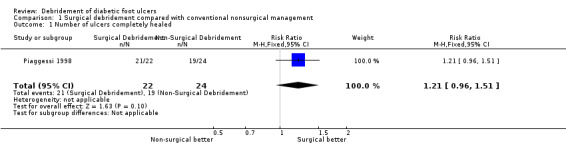
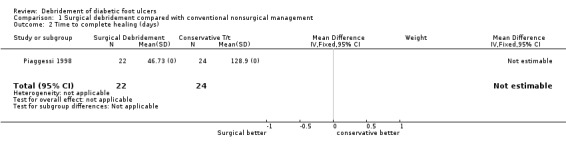
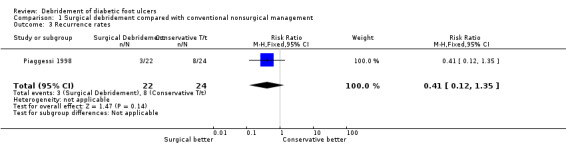
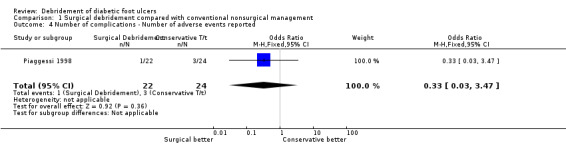
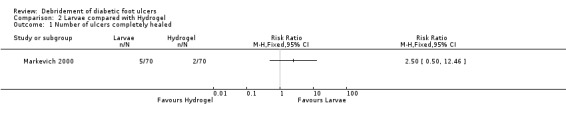
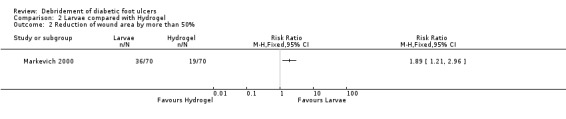
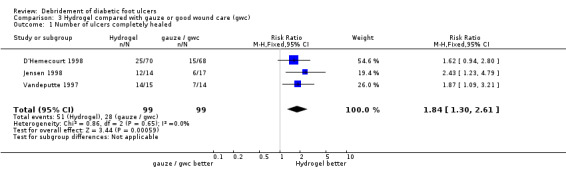
Main results: Six RCTs of debridement were identified: four assessed hydrogels, with an additional study evaluating larval therapy against hydrogel and one evaluated surgical debridement. Pooling the three RCTs which compared hydrogel with gauze or standard care suggested that hydrogels are significantly more effective in healing diabetic foot ulcers (Relative Risk 1.84, 95% Confidence Interval (CI)1.3 to 2.61). Surgical debridement showed no significant benefit over standard treatment. One small trial suggested that larvae resulted in a more than 50% reduction in wound area compared with hydrogel. Other debridement methods such as enzyme preparations or polysaccharide beads have not been evaluated in diabetic foot ulcers.
Authors' conclusions: There is evidence to suggest that hydrogel increases the healing rate of diabetic foot ulcers compared with gauze dressings or standard care and larval therapy resulted in significantly greater reduction in wound area than hydrogel. More research is needed to evaluate the effects of a range of widely used debridement methods and of debridement per se.
Conflict of interest statement
None known.
Figures
Update of
-
Debridement of diabetic foot ulcers.Cochrane Database Syst Rev. 2002;(4):CD003556. doi: 10.1002/14651858.CD003556. Cochrane Database Syst Rev. 2002. Update in: Cochrane Database Syst Rev. 2010 Jan 20;(1):CD003556. doi: 10.1002/14651858.CD003556.pub2. PMID: 12519603 Updated.
References
References to studies included in this review
D'Hemecourt 1998 {published data only}
-
- D'Hemecourt PA, Smiell JM, Karim MR. Sodium carboxymethyl cellulose aqueous‐based gel vs becaplermin gel in patients with nonhealing lower extremity diabetic ulcers. Wounds 1998;10(3):69‐75.
Jensen 1998 {published data only}
-
- Jensen JL, Seeley J, Gillin B. Diabetic foot ulcerations: a controlled, randomized comparison of two moist wound healing protocols: Carrasyn Hydrogel wound dressing and wet‐to‐moist saline gauze. Advances in Wound Care 1998;11(7):1‐4. - PubMed
Markevich 2000 {published data only}
-
- Markevich YO, McLeod‐Roberts J, Mousley M, Melloy E. Maggot therapy for diabetic neuropathic foot wounds. Diabetologia: Proceedings of the 36th Annual Meeting of the European Association for the Study of Diabetes 2000;43:Suppl 1: A15.
Piaggessi 1998 {published data only}
-
- Piaggesi A, Schipani E, Campi F, Romanelli M, Baccetti F, Arvia C, et al. Conservative surgical approach versus non‐surgical management for diabetic neuropathic foot ulcers: a randomized trial. Diabetic Medicine 1998;15(5):412‐7. - PubMed
-
- Piaggessi A, Rizzo L, Campi F, Schipani E. Conservative surgical approach versus non‐operative treatment for diabetic neuropathic foot ulcers: a randomized trial. Journal of Endocrinological Investigation 1998;21(7):193. - PubMed
Vandeputte 1997 {published data only}
-
- Vandeputte J, Gryson L. Diabetic foot infection controlled by immuno‐modulating hydrogel containing 65% glycerine. Presentation of a clinical trial. 6th European Conference on Advances in Wound Management, Amsterdam October 1996. 1997:50‐3.
Whalley 2001 {published data only}
-
- Capillas R, Whalley A, Boulton AMJ, Dargis V, Harding K, Acker K. Performance characteristics and safety of hydrogels using a non‐adhesive foam dressing as secondary dressing in the treatment of diabetic foot ulcers. 12th Conference of the European Wound Management Association;2002, 23‐25 May; Granada, Spain. 2002:261.
-
- Aker K, Dargis V, Boulton AJM. Performance Characteristics and Safety of Purilon Gel versus Intrasite Gel using biatain non‐adhesive dressing as secondary dressing in the treatment of diabetic foot ulcers. Tenth Annual Meeting of the European Tissue Repair Society; 2000, 24‐27 May; Brussels, Belgium. 2000:A435.
-
- Whalley A, Boulton AJM, Harding K, Acker K, Capillas R. Performance characteristics and safety of purilon gel versus intrasite using biatain non‐adhesive dressing as secondary dressing in the treatment of diabetic foot ulcers. 11th European Tissue Repair Society Annual Conference; 2001 5‐8 September; Cardiff, Wales. 2001:49.
References to studies excluded from this review
Abbruzzese 2009 {published data only}
-
- Abbruzzese L, Rizzo L, Fanelli G, Tedeschi A, Scatena A, Goretti C, Macchiarini S, Piaggesi A. Effectiveness and safety of a novel gel dressing in the management of neuropathic leg ulcers in diabetic patients: a prospective double‐blind randomized trial. International Journal of Lower Extremity Wounds 2009;8(3):134‐40. - PubMed
Apelqvist 1990 {published data only}
-
- Apelqvist J, Larsson J, Stenström A. Topical treatment of necrotic foot ulcers in diabetic patients: a comparative trial of DuoDerm and MeZinc. British Journal of Dermatology 1990;123(6):787‐92. - PubMed
Apelqvist 1994 {published data only}
-
- Apelqvist J, Larsson J, Tennvall GR. A comparative trial between Iodosorb and standard treatment of deep diabetic ulcers including an evaluation of cost‐effectiveness. 3rd European Conference on Advances in Wound Management; 1993, 19‐22 October; Harrogate, UK. 1994:126.
Armstrong 2000 {published data only}
-
- Armstrong DG, Nguyen HC. Improvement in healing with aggressive edema reduction after debridement of foot infection in persons with diabetes. Archives of Surgery 2000;135:1405‐9. - PubMed
Baker 1994 {published data only}
-
- Baker NR, Creevy J. A randomised comparative pilot study to evaluate Allevyn hydrocellular dressings and Sorbsan calcium alginate dressings in the treatment of diabetic foot ulcers. 3rd European Conference on Advances in Wound Management; 1993, 19‐22 October; Harrogate, UK. 1994:170.
Callaghan 1993 {published data only}
-
- Callaghan DP . Assessment of the effectiveness of Debrisan in healing ulceration on pressure areas of diabetic patients' feet. 2nd European Conference on Advances in Wound Management; 1992, 20‐23 October; Harrogate, UK. 1993:82.
Dolynchuk 2001 {published data only}
-
- Dolynchuk K. The use of collagenase in the debridement of diabetic foot ulcers: a double‐blind prospective randomized study. 7th Annual Conference of the Canadian Association of Wound Care 1‐3 November 2001 London, Ontario, Canada. 2001:56.
Gottrup 2001 {published data only}
-
- Gottrup F, Hahn TW, Thomsen JK. Cost‐effectiveness of hydrogel treatment in diabetic foot ulcers. 12th Conference of the European Wound Management Association 23‐25 May 2002 Granada, Spain. 2002:101.
Gough 1997 {published data only}
-
- Gough A, Clapperton M, Rolando N, Foster AV, Philpott‐Howard J, Edmonds ME. Randomised placebo‐controlled trial of granulocyte‐colony stimulating factor in diabetic foot infection. Lancet 1997;350:855‐9. - PubMed
Grayson 1994 {published data only}
-
- Grayson ML, Gibbons GW, Habershaw GM, Freeman DV, Pomposelli FB, Rosenblum BI, et al. Use of ampicillin/sulbactam versus imipenem/cilastatin in the treatment of limb‐threatening foot infections in diabetic patients. Clinical Infectious Diseases 1994;18:683‐93. - PubMed
Jude 2004 {published data only}
-
- Jude E. Non‐Ischemic Diabetic Foot Ulcers: Effects of Aquacel Ag with Hydrofiber versus Alginate Dressing. 2nd World Union of Wound Healing Societies Meeting; 2004 ,8‐13 July; Paris. 2004:21.
Jude 2007 {published data only}
-
- Jude E, Apelqvist, Spraul M, Martini J. Randomized controlled study of diabetic foot ulcers dressed with Hydrofiber® containing ionic silver or calcium alginate dressings. European Wound Management Association Conference; 2005, 15‐17 September; Stuttgart, Germany . 2005 ; Vol. V33‐4:106.
-
- Jude EB, Apelqvist J, Spraul M, Martini J, the Silver Dressing Study Group. Prospective randomized controlled study of Hydrofiber® dressing containing ionic silver or calcium alginate dressings in non‐ischaemic diabetic foot ulcers. Diabetic Medicine 2007;24:280‐288. - PubMed
Krupski 1991 {published data only}
-
- Krupski WC, Reilly LM, Perez S, Moss KM, Crombleholme PA, Rapp JH. A prospective randomized trial of autologous platelet‐derived wound healing factors for treatment of chronic nonhealing wounds: a preliminary report. Journal of Vascular Surgery 1991;14:526‐32. - PubMed
Li 2006 {published data only}
-
- Li X‐Q, Zhu J‐Y, Chen D, Zhu B, Tang B, Zhong Z‐F, et al. Effect of wound bed preparation on local treatment of diabetic foot ulcer. Chinese Journal of Clinical Rehabilitation 2006;10(24):48‐51.
Martinez‐de‐Jesus 97 {published data only}
-
- Martinez‐de‐Jesus FR, Morales‐Guzman M, Castaneda M, Perez‐Morales A, Garcia‐Alonso J, Mendiola‐Segura I. Randomized single‐blind trial of topical ketanserin for healing acceleration of diabetic foot ulcers. Archives of Medical Research 1997;28:95‐9. - PubMed
Mulder 1994a {published data only}
-
- Mulder GD, Patt LM, Sanders L, Rosenstock J, Altman MI, Hanley ME, et al. Enhanced healing of ulcers in patients with diabetes by topical treatment with glycyl‐L‐histidyl‐L‐lysine copper. Zeitschrift fur Hautkrankheiten 1994;2:259‐69. - PubMed
Mulder 1994b {published data only}
-
- Mulder GD, Jensen JL, Seeley JE, Peak Andrews K. A controlled randomized study of an amorphous hydrogel to expedite closure of diabetic ulcers. 4th European Tissue Repair Society Meeting; 1994, 25‐28 August; Oxford, England. 1994:130 (Abstract 90).
Piaggesi 2001 {published data only}
-
- Piaggesi A, Baccetti F, Rizzo L, Romanelli M, Navalesi R, Benzi L. Sodium carboxyl‐methyl‐cellulose dressings in the management of deep ulcerations of diabetic foot. Diabetic Medicine 2001;18:320‐4. - PubMed
Pollak 1997 {published data only}
-
- Pollak RA, Edington H, Jensen JL, Kroeker RO, Gentzkow GD. A human dermal replacement for the treatment of diabetic foot ulcers. Wounds 1997;9:175‐83.
Razzak 1997 {published data only}
-
- Razzak FA, Alam MK, Khan S, Al‐Bunyan AR, Al‐Eshawy S, Al‐Khelawi A. Local insulin therapy in diabetic foot. JK Practitioner 1997;4:6‐8.
Saap 2002 {published data only}
-
- Saap LJ, Falanga V. Debridement performance index and its correlation with complete closure of diabetic foot ulcers.. Wound Repair and Regeneration 2002;10(6):354‐9. - PubMed
Seidel 1994 {published data only}
-
- Seidel C, Buhler Singer S, Tacke J, Hornstein OP. Therapeutic superiority of regional retrograde venous antibiotic pressure infusion versus systemic venous infusions in diabetic patients with infected neuropathic plantar ulcers. Hautarzt 1994;45:74‐9. - PubMed
Steed 1996 {published data only}
-
- Steed DL, Donohoe D, Webster M, Lindsley L, PDGF Study Group. Extensive debridement of human diabetic foot ulcers is a vital adjunct to healing. 5th Annual Meeting of the European Tissue Repair Society; 1995, August 30‐September 2; Padova, Italy. 1995:371.
-
- Steed DL, Donohoe D, Webster MW, Lindsley L ‐ Diabetic Ulcer Study Group. Effect of extensive debridement and treatment on the healing of diabetic foot ulcers. Journal of the American College of Surgeons 1996;183:61‐4. - PubMed
Varma 2006 {published data only}
-
- Varma AK, Bal A, Kumar H, Kesav R, Nair S. Efficacy of polyurethane foam dressing in debrided diabetic lower limb wounds. Wounds: A Compendium of Clinical Research and Practice 2006;18(10):300‐6.
Wieman 1998 {published data only}
-
- Wieman TJ, Smiell JM, Su Y. Efficacy and safety of a topical gel formulation of recombinant human platelet‐derived growth factor‐BB (becaplermin) in patients with chronic neuropathic diabetic ulcers. A phase III randomized placebo‐controlled double‐blind study. Diabetes Care 1998;21:822‐7. - PubMed
References to studies awaiting assessment
Biliaieva 2009 {published data only}
-
- Biliaieva OO, Neshta VV, Kurylyshyn VP. Effect of new generation application sorbents on the results of complex treatment in patients with diabetic foot syndrome. Klinichna khirurhiia / Ministerstvo okhorony zdorov'ia Ukrainy, Naukove tovarystvo khirurhiv Ukrainy 2009;5:35‐7. - PubMed
Cardinal 2009 {published data only}
-
- Cardinal M, Eisenbud DE, Armstrong DG, Zelen C, Driver V, Attinger C, et al. Serial surgical debridement: a retrospective study on clinical outcomes in chronic lower extremity wounds. Wound Repair and Regeneration 2009;17(3):306‐11. - PubMed
Singh 2006 {published data only}
-
- Singh A. Usage of ultrasound in wound management comparison between ultrasonic wound debridement and sharp debridement in diabetic foot ulcers : A randomized clinical trial. University of Malaya 2006.
Additional references
Abbott 1990
-
- Abbott RDF, Brand FN, Kannel WB. Epidemilogy of some peripheral arterial findings in diabetic men and women: experiences from the Framingham study. American Journal of Medicine 1990;88:376‐81. - PubMed
Bauer 2000
-
- Bauer ES. Foot ulcers. Primary Care 2000;343:(11):787‐93. - PubMed
Boulton 2000
-
- Boulton A. The Pathway to Ulceration: Aetiopathogenesis. In: Boulton A, Connor H, Cavanagh PR editor(s). The Foot in Diabetes. 3rd Edition. Chichester: John Wiley & Sons Ltd, 2000:19‐31.
Bradley 1999
-
- Bradley M, Cullum N, Sheldon T. The debridement of chronic wounds: A systematic review. Health Technology Assessment 1999; Vol. 3, issue 17:1‐2. - PubMed
Calman 1998
-
- Calman K. On the state of the public health. The Annual Report of The Chief Medical Officer of The Department Of Health For The Year 1997. The Stationery Office, 1998.
Cutting 1999
-
- Cutting K. Glossary. In: Miller M, Glover G editor(s). Wound Management Theory and Practice. London: Johnson & Johnson Medical Ltd, 1999:170‐3.
Davies 1989
-
- Davies M. Metabolic Disorders. In: Neale D, Adams I editor(s). Common Foot Disorders. 3rd Edition. Edinburgh: Churchill Livingstone, 1989:353‐61.
Deeks 1998
Devereaux 2002
-
- Devereaux PJ, Mohit Bhandari MD, Montori VM, Manns BJ, Ghali WA, Guyatt GH. “Double blind, you are the weakest link ‐ goodbye!”. Evidence Based Medicine 2002;7:4‐5.
Dorland's 1998 [Computer program]
-
- Dorland. Dorland's Electronic Medical Dictionary (CD‐ROM). Version 28th. W.B. Saunders Company, 1998.
EBN 2001
-
- Notebook. Assessing allocation concealment and blinding in randomised controlled trials: why bother?. Evidence Based Nursing 2001;4:4‐6. - PubMed
Edmonds 2000a
-
- Edmonds M, Foster A. Stage 2: The high‐risk foot. Managing the Diabetic Foot. London: Blackwell Science, 2000:35‐44.
Edmonds 2000b
-
- Edmonds M, Foster A. Stage 3: The ulcerated foot. Managing the Diabetic Foot.. London: Blakewell Science, 2000:45‐76.
Faris 1991a
-
- Faris I. Vascular disease. In: Faris I editor(s). The Management of the Diabetic Foot. 2nd Edition. Edinburgh: Churchill Livingstone, 1991:9‐40.
Faris 1991b
-
- Faris I. Mechanisms for the development of foot lesions. In: Faris I editor(s). The Management of the Diabetic Foot. 2nd Edition. Edinburgh: Churchill Livingstone, 1991:5‐9.
King's Fund 1996
-
- King's Fund. Counting the Cost. The real impact of non‐insulin dependent diabetes. London: England: King's Fund Policy Unit, 1996.
Le Quesne 1991
-
- Quesne P, Parkhouse N, Faris I. Neuropathy. In: Faris I editor(s). The Management of the Diabetic Foot. 2nd Edition. Edinburgh: Churchill Livingstone, 1991:41‐64.
Lefebvre 2011
-
- Lefebvre C, Manheimer E, Glanville J, on behalf of the Cochrane Information Retrieval Methods Group. Chapter 6: Searching for studies. In: Higgins JPT, Green S (editors). Cochrane Handbook for Systematic Reviews of Interventions Version 5.1.0 [updated March 2011]. The Cochrane Collaboration, 2011. Available from www.cochrane‐handbook.org.
Macleod 1991
-
- Macleod AF, Williams DR, Sonksen PH, Boulton AJ. Risk factors for foot ulcers in diabetic patients attending a hospital clinic. Diabetologia 1991;34(Suppl):A39.
Margolis 1999
-
- Margolis D, Kantor J, Berlin J. Healing of Diabetic Neuropathic Foot Ulcers Receiving Standard Treatment. Diabetes Care 1999;22:692‐5. - PubMed
Pecoraro 1990
-
- Pecoraro RE, Reiber GE, Burgess EM. Pathways to diabetic limb amputation: basis for prevention. Diabet Care 1990;13:513‐21. - PubMed
RCGP 2000
-
- Royal College of General Practioners, British Diabetic Association, Royal College of Physicians, Royal College of Nursing (collaborative programme). Prevention and Management of Foot Problems. Clinical Guidelines for Type 2 Diabetes.. London, March 2000.
Reiber 1999
-
- Reiber GE, Vileikyte L, Boyko EJ, Aguila M, Smith DG, Lavery L. Casual Pathways for incident lower extremity ulcers in patients with diabetes from two settings. Diabetes Care 1999;22:157‐62. - PubMed
SIGN 1997
-
- Scottish Intercollegiate Guidelines Network. Management of diabetic Foot Disease. Implementation of the St. Vincent Declaration. The Care of Patients in Scotland 1997.
SIGN 2009
-
- Scottish Intercollegiate Guidelines Network (SIGN). Search filters. http://www.sign.ac.uk/methodology/filters.html#random (accessed 22 June 2009).
Siitonen 1993
-
- Siitonen OI, Niskanen LK, Laakso M, Siitonen JF, Pyorala K. Lower extremity amputation in diabetic and non‐diabetic patients: a population‐based study in Eastern Finland. Diabetes Care 1993;16:16‐20. - PubMed
Spencer 2000
SVD 1990
-
- The St Vincent Declaration. Diabetes Care and Research in Europe. Diabetic Medicine 1990;7:360. - PubMed
Young 2000
-
- Young M.J. Classification of Ulcers and Its Relevance to Management. In: Boulton A. Connor H, Cavanagh P editor(s). The Foot in Diabetes. third. Chichester: John Wiley & Sons Ltd, 2000:61‐72.
Publication types
MeSH terms
Substances
LinkOut - more resources
Full Text Sources
Other Literature Sources
Medical
