


Exercises for prevention of recurrences of low-back pain
- PMID: 20091596
- PMCID: PMC8078403
- DOI: 10.1002/14651858.CD006555.pub2
Exercises for prevention of recurrences of low-back pain
Abstract
Background: Back pain is a common disorder that has a tendency to recur. It is unclear if exercises, either as part of treatment or as a post-treatment programme, can reduce back pain recurrences.
Objectives: To investigate the effectiveness of exercises for preventing new episodes of low-back pain or low-back pain-associated disability.
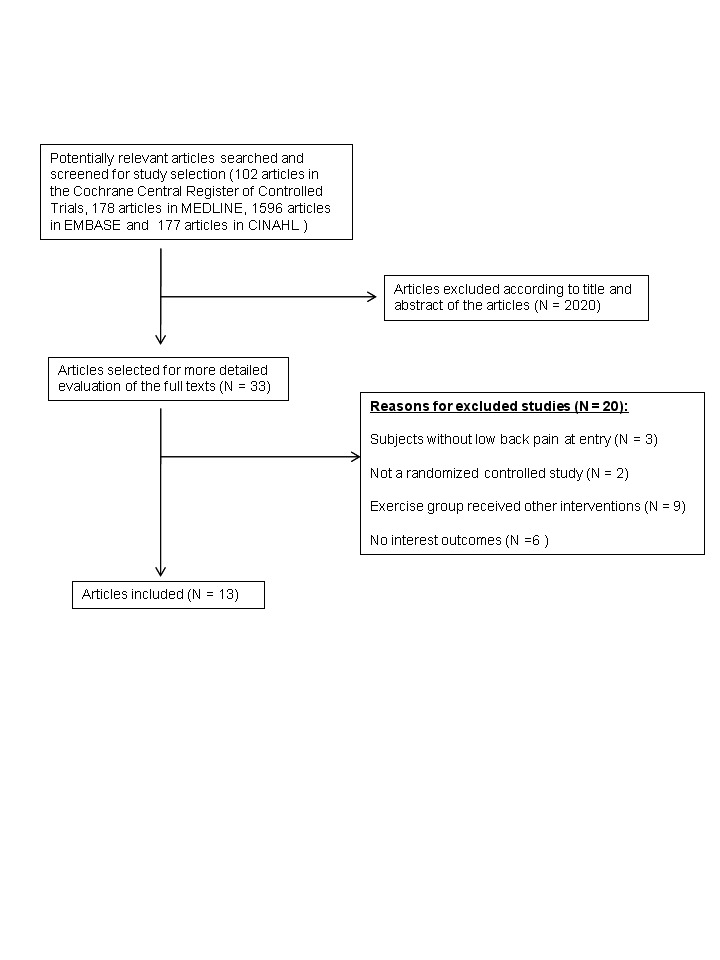
Search strategy: We searched CENTRAL (The Cochrane Library 2009, issue 3), MEDLINE, EMBASE and CINAHL up to July 2009.
Selection criteria: Inclusion criteria were: participants who had experienced back pain before, an intervention that consisted of exercises without additional specific treatment and outcomes that measured recurrence of back pain or time to recurrence.
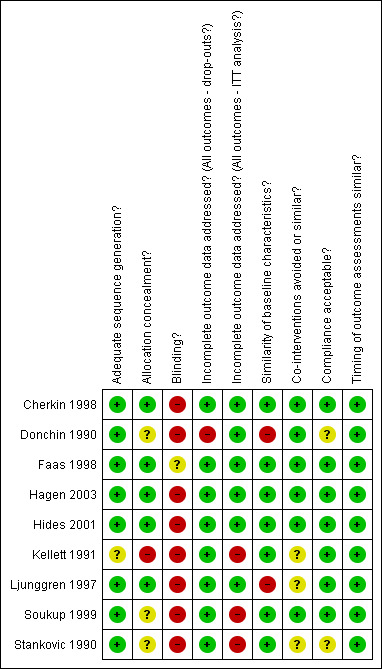
Data collection and analysis: Two review authors independently judged if references met the inclusion criteria. The same review authors independently extracted data and judged the risk of bias of the studies. Studies were divided into post-treatment intervention programmes and treatment studies. Study results were pooled with meta-analyses if participants, interventions, controls and outcomes were judged to be sufficiently homogenous.
Main results: We included 13 articles reporting on nine studies with nine interventions. Four studies with 407 participants evaluated post-treatment programmes and five studies with 1113 participants evaluated exercise as a treatment modality. Four studies had a low risk of bias, one study a high risk and the remainder an unclear risk of bias.We found moderate quality evidence that post-treatment exercises were more effective than no intervention for reducing the rate of recurrences at one year (Rate Ratio 0.50; 95% Confidence Interval 0.34 to 0.73). There was moderate quality evidence that the number of recurrences was significantly reduced in two studies (Mean Difference -0.35; 95% CI -0.60 to -0.10) at one-half to two years follow-up. There was very low quality evidence that the days on sick leave were reduced by post-treatment exercises (Mean Difference -4.37; 95% CI -7.74 to -0.99) at one-half to two years follow-up.We found conflicting evidence for the effectiveness of exercise treatment in reducing the number of recurrences or the recurrence rate.
Authors' conclusions: There is moderate quality evidence that post-treatment exercise programmes can prevent recurrences of back pain but conflicting evidence was found for treatment exercise. Studies into the validity of measurement of recurrences and the effectiveness of post-treatment exercise are needed.
Conflict of interest statement
There is no potential conflict of interest among the review authors.
Figures
Update of
References
References to studies included in this review
Cherkin 1998 {published data only}
-
- Cherkin, DC, R A Deyo, M Battie, J Street, W Barlow. A comparison of physical therapy, chiropractic manipulation, and provision of an educational booklet for the treatment of patients with low back pain. New England Journal of Medicine 1998;339(15):1021‐9. - PubMed
Donchin 1990 {published data only}
-
- Donchin, M, O Woolf, L Kaplan, Y Floman. Secondary prevention of low‐back pain. A clinical trial. Spine 1990;15(12):1317‐20. - PubMed
Faas 1998 {published data only}
-
- Faas, A, A W Chavannes, J T van Eijk, J W Gubbels. A randomized, placebo‐controlled trial of exercise therapy in patients with acute low back pain. Spine 1993;18(11):1388‐95. - PubMed
Hagen 2003 {published data only}
-
- Hagen EM, Grasdal A, Eriksen HR. Does early intervention with a light mobilization program reduce long‐term sick leave for low back pain: A 3‐year follow‐up study. Spine 2003;28(20):2309‐15. - PubMed
Hides 2001 {published data only}
-
- Hides JA, Jull GA, Richardson CA. Long‐term effects of specific stabilizing exercises for first‐episode low back pain. Spine 2001;26(11):E243‐8. - PubMed
Kellett 1991 {published data only}
-
- Kellett KM, Kellett DA, Nordholm LA. Effects of an exercise program on sick leave due to back pain. Physical Therapy 1991;71(4):283‐93. - PubMed
Ljunggren 1997 {published data only}
-
- Ljunggren AE, Weber H, Kogstad O, Thom E, Kirkesola G, Nordin M. Effect of exercise on sick leave due to low back pain: A randomized, comparative, long‐term study. Spine 1997;22(14):1610‐7. - PubMed
Soukup 1999 {published data only}
-
- Glomsrød B, Lønn JH, Soukup MG, Bo K, Larsen S. "Active back school", prophylactic management for low back pain: three‐year follow‐up of a randomized, controlled trial. Journal of Rehabilitation Medicine 2001;33(1):26‐30. - PubMed
-
- Lønn JH, Glømsrod B, Soukup MG, Bo K, Larsen S. Active back school: prophylactic management for low back pain: A randomized, controlled, 1‐year follow‐up study. Spine 1999;24(9):865‐71. - PubMed
-
- Soukup MG, Glømsrod B, Lønn JH, Bo K, Larsen S. The effect of a Mensendieck exercise program as secondary prophylaxis for recurrent low back pain. A randomized, controlled trial with 12‐month follow‐up. Spine 1999;24(15):1585‐91; discussion 1592. - PubMed
-
- Soukup MG, Lønn J, Glømsrod B, Bo K, Larsen S. Exercises and education as secondary prevention for recurrent low back pain. Physiotherapy research international : the journal for researchers and clinicians in physical therapy 2001;6:27‐39. - PubMed
Stankovic 1990 {published data only}
-
- Stankovic R, Johnell O. Conservative treatment of acute low back pain. A 5‐year follow‐up study of two methods of treatment. Spine 1995;20(4):469‐72. - PubMed
-
- Stankovic R, Johnell O. Conservative treatment of acute low‐back pain. A prospective randomized trial: McKenzie method of treatment versus patient education in "mini back school". Spine 1990;15(2):120‐3. - PubMed
References to studies excluded from this review
Alexandre 2001 {published data only}
-
- Alexandre NMC, Moraes MAA, Correa Filho HR, Jorge SA. Evaluation of a program to reduce back pain in nursing personnel. Revista de Saude Publica 2001;35(4):356‐61. - PubMed
Amako 2003 {published data only}
-
- Amako M, Oda T, Masuoka K, Yokoi H, Campisi P. Effect of static stretching on prevention of injuries for military recruits. Military Medicine 2003;168(6):442‐6. - PubMed
Buchbinder 2002 {published data only}
-
- Buchbinder R, Hoving J. Specific spinal exercise substantially reduces the risk of low back pain recurrence. Australian Journal of Physiotherapy 2002; Vol. 48, issue 1:55. - PubMed
Cairns 2006 {published data only}
-
- Cairns MC, Foster NE, Wright C. Randomized controlled trial of specific spinal stabilization exercises and conventional physiotherapy for recurrent low back pain. Spine 2006;31(19):E670‐81. - PubMed
Gundewall 1993 {published data only}
-
- Gundewall B, Liljeqvist M, Hansson T. Primary prevention of back symptoms and absence from work: A prospective randomized study among hospital employees. Spine 1993;18(5):587‐94. - PubMed
Helewa 1999 {published data only}
-
- Helewa A, Goldsmith CH, Lee P, Smythe HA, Forwell L. Does strengthening the abdominal muscles prevent low back pain ‐ A randomized controlled trial. Journal of Rheumatology 1999;26(8):1808‐15. - PubMed
Hides 1996 {published data only}
-
- Hides JA, Richardson CA, Jull GA. Multifidus muscle recovery is not automatic after resolution of acute, first‐episode low back pain. Spine 1996;21:2763‐9. - PubMed
Hlobil 2005 {published data only}
-
- Hlobil, H, J B Staal, J Twisk, A Koke, G Ariens, T Smid, W van Mechelen. The effects of a graded activity intervention for low back pain in occupational health on sick leave, functional status and pain: 12‐month results of a randomized controlled trial. Journal of Occupational Rehabilitation 2005;15(4):569‐80. - PubMed
Kofotolis 2005 {published data only}
-
- Kofotolis N, Sambanis M. The influence of exercise on musculoskeletal disorders of the lumbar spine. Journal of Sports Medicine & Physical Fitness 2005;45(1):84‐92. - PubMed
Koumantakis 2005 {published data only}
-
- Koumantakis GA, Watson PJ, Oldham JA. Supplementation of general endurance exercise with stabilisation training versus general exercise only. Physiological and functional outcomes of a randomized controlled trial of patients with recurrent low back pain. Clinical Biomechanics, 2005;20(5):474‐82. - PubMed
Koumantakis 2005a {published data only}
-
- Koumantakis GA, Watson PJ, Oldham JA. Trunk muscle stabilization training plus general exercise versus general exercise only: randomized controlled trial of patients with recurrent low back pain. Physical Therapy 2005;85(3):209‐25. - PubMed
Kuukkanen 2000 {published data only}
-
- Kuukkanen TM, Malkia EA. An experimental controlled study on postural sway and therapeutic exercise in subjects with low back pain. Clinical Rehabilitation 2000;14(2):192‐202. - PubMed
Leclaire 1996 {published data only}
-
- Leclaire R, Esdaile JM, Suissa S, Rossignol M, Proulx R, Dupuis M. Back school in a first episode of compensated acute low back pain: a clinical trial to assess efficacy and prevent relapse. Archives of physical medicine and rehabilitation 1996;77:673‐9. - PubMed
Maul 2005 {published data only}
Medina 1995 {published data only}
-
- Medina MF, Brotons RJ, Manrique SJ. Comparative study on the influence of health education on perceived recurrences after physiotherapy [Spanish]. Atencion Primaria 1995;16(8):464‐8. - PubMed
Sjogren 2006 {published data only}
-
- Sjogren T, Nissinen KJ, Jarvenpaa SK, Ojanen MT, Vanharanta H, Malkia EA. Effects of a workplace physical exercise intervention on the intensity of low back symptoms in office workers: A cluster randomized controlled cross‐over design. Journal of Back & Musculoskeletal Rehabilitation 2006;19(1):13‐24.
Staal 2004 {published data only}
-
- Staal JB, Hlobil H, Twisk JW, Smid T, Koke AJ, Mechelen W. Graded activity for low back pain in occupational health care. Annals of Internal Medicine 2004;140(2):77‐84. - PubMed
Suni 2006 {published data only}
-
- Suni J, Rinne M, Natri A, Statistisian MP, Parkkari J, Alaranta H. Control of the lumbar neutral zone decreases low back pain and improves self‐evaluated work ability: a 12‐month randomized controlled study. Spine 2006;31(18):E611‐20. - PubMed
Additional references
ACSM 2006
-
- ACSM. Benefits and Risks associated with Physical Activity. In: Whaley MH editor(s). ACSM's guidelines for exercise testing and prescription. 7th Edition. London: Lippincott Williams & Wilkins, 2006.
Andersson 1999
-
- Andersson GB. Epidemiological features of chronic low‐back pain. Lancet 1999;354:581‐5. - PubMed
Bergquist 1977
-
- Bergquist‐Ullman M, Larsson U. Acute low back pain in industry. A controlled prospective study with special reference to therapy and confounding factors. Acta Orthopaedica Scandinavica 1977;170:1‐117. - PubMed
Carey 1999
-
- Carey TS, Garrett JM, Jackman A, Hadler N. Recurrence and care seeking after acute back pain: results of a long‐term follow‐up study. North Carolina back pain project. Medical Care 1999;37(2):157‐64. - PubMed
Cassidy 1998
-
- Cassidy JD, Carroll LJ, Côté P. The Saskatchewan health and back pain survey. The prevalence of low back pain and related disability in Saskatchewan adults. Spine 1998;23(17):1860‐7. - PubMed
De Vet 2002
-
- Vet HCW, Heymans MW, Dunn KM, Pope DP, Beek AJ, Macfarlane GJ, et al. Episodes of Low Back Pain: A proposal for Uniform definitions to be used in research. Spine 2002;27:2409‐16. - PubMed
Deyo 2006
-
- Deyo RA, Mirza SK, Martin BI. Back pain prevalence and visit rates: estimates from U.S. national surveys, 2002. Spine 2006;31(23):2724‐7. - PubMed
Druss 2000
-
- Druss BG, Rosenheck RA, Sledge WH. Health and disability costs of depressive illness in a major U.S. corporation. American Journal of Psychiatry 2000;157(8):1274‐8. - PubMed
Egger 1997
Furlan 2009
-
- Furlan AD, Pennick V, Bombardier C, Tulder M, Editorial Board, Cochrane Back Review Group. 2009 updated method guidelines for systematic reviews in the Cochrane Back Review Group. Spine 2009; Vol. 34, issue 18:1929‐41. - PubMed
Hagen 2004
Harreby 1996
-
- Harreby M, Kjer J, Hesselsoe G, Neergaard K. Epidemiological aspects and risk factors for low back pain in 38‐year‐old men and women: a 25‐year prospective cohort study of 640 school children. European Spine Journal 1996;5(5):312‐8. - PubMed
Hayden 2005
Higgins 2008
-
- Higgins JPT, Green S (editors). Cochrane Handbook for Systematic Reviews of Interventions. Chichester: John Wiley & Sons, 2008.
Ihlebaek 2006
-
- Ihlebaek C, Hansson TH, Laerum E, Brage S, Eriksen HR, Holm SH, et al. Prevalence of low back pain and sickness absence: a "borderline" study in Norway and Sweden. Scandinavian Journal of Public health 2006;34(5):555‐8. - PubMed
Lahad 1994
-
- Lahad A, Malter AD, Berg AO, Deyo RA. The effectiveness of four interventions for the prevention of low back pain. JAMA. 1994;272(16):1286‐91. - PubMed
Linton 2001
-
- Linton SJ, Tulder MW. Preventive interventions for back and neck pain problems: what is the evidence?. Spine 2001;26(7):778‐87. - PubMed
Maniadakis 2000
-
- Maniadakis N, Gray A. The economic burden of back pain in the UK. Pain 2000;84(1):95‐103. - PubMed
McKinnon 1997
-
- McKinnon ME, Vickers MR, Ruddock VM, Townsend J, Meade TW. Community studies of the health service implications of low back pain. Spine 1997;22(18):2161‐6. - PubMed
RevMan 2003 [Computer program]
-
- The Nordic Cochrane Centre, The Cochrane Collaboration. Review Manager (RevMan). Version 4.2 for Windows. Copenhagen: The Nordic Cochrane Centre, The Cochrane Collaboration, 2003.
Stanton 2009
-
- Stanton TR, Latimer J, Maher CG, Hancock M. Definitions of Recurrence of an Episode of Low Back Pain: A Systematic Review. Spine 2009;34(9):E316‐22. - PubMed
Strauss 1993
-
- Strauss S, Guthrie F, Nicolisi F. Prevalence of pain complaints in a general population: an Australian study. Australian Association Musculoskeletal Medicine Bulletin 1993;9:54–61.
Tse 2003
-
- Tse LY, Lam TH, Yip HK. Physical Health. Report on Population Health Survey. Department of Health, Hong Kong. 2003/2004:31.
van Tulder 2003
-
- Tulder M, Furlan A, Bombardier C, Bouter L. Updated method guidelines for systematic reviews in the Cochrane Collaboration Back Review Group. Spine 2003;28(12):1290‐9. - PubMed
Verbeek 2004
-
- Verbeek J, Sengers MJ, Riemens L, Haafkens J. Patient expectations of treatment for back pain: a systematic review of qualitative and quantitative studies. Spine 2004;29(20):2309‐18. - PubMed
Von Korff 1993
-
- Korff M, Deyo RA, Cherkin D, Barlow W. Back pain in primary care. Outcomes at 1 year. Spine 1993;18(7):855‐62. - PubMed
Wasiak 2003
-
- Wasiak R, Pransky G, Verma S, Webster B. Recurrence of low back pain: definition‐sensitivity analysis using administrative data. Spine 2003;28(19):2283‐91. - PubMed
Wasiak 2009
-
- Wasiak R, Young AE, Dunn KM, Côté P, Gross DP, Heymans MW, et al. Back Pain Recurrence: An Evaluation of Existing Indicators and Direction for Future Research. Spine 2009;34(9):970‐7. - PubMed
Woolf 2003
-
- Woolf AD, Hazes JM, Akesson K, Khaltaev N, Cimmino M, Dieppe P, et al. The Burden of Musculoskeletal Conditions at the Start of the New Millennium. Report of a WHO Scientific Group, in WHO Technical Report Series; 919. 2003:102‐3.
Publication types
MeSH terms
LinkOut - more resources
Full Text Sources
Medical
Miscellaneous
