


Microporous cell-laden hydrogels for engineered tissue constructs
- PMID: 20091766
- PMCID: PMC2847036
- DOI: 10.1002/bit.22667
Microporous cell-laden hydrogels for engineered tissue constructs
Abstract
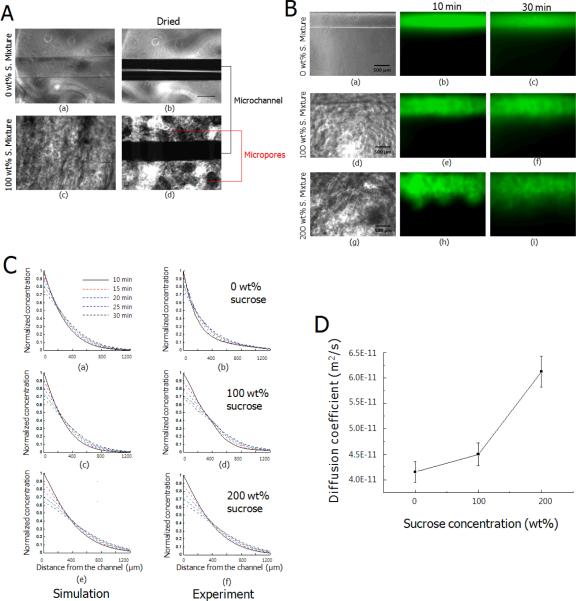
In this article, we describe an approach to generate microporous cell-laden hydrogels for fabricating biomimetic tissue engineered constructs. Micropores at different length scales were fabricated in cell-laden hydrogels by micromolding fluidic channels and leaching sucrose crystals. Microengineered channels were created within cell-laden hydrogel precursors containing agarose solution mixed with sucrose crystals. The rapid cooling of the agarose solution was used to gel the solution and form micropores in place of the sucrose crystals. The sucrose leaching process generated homogeneously distributed micropores within the gels, while enabling the direct immobilization of cells within the gels. We also characterized the physical, mechanical, and biological properties (i.e., microporosity, diffusivity, and cell viability) of cell-laden agarose gels as a function of engineered porosity. The microporosity was controlled from 0% to 40% and the diffusivity of molecules in the porous agarose gels increased as compared to controls. Furthermore, the viability of human hepatic carcinoma cells that were cultured in microporous agarose gels corresponded to the diffusion profile generated away from the microchannels. Based on their enhanced diffusive properties, microporous cell-laden hydrogels containing a microengineered fluidic channel can be a useful tool for generating tissue structures for regenerative medicine and drug discovery applications.
Figures




References
-
- Aymard P, Martin DR, Plucknett K, Foster TJ, Clark AH, Norton IT. Influence of thermal history on the structural and mechanical properties of agarose gels. Biopolymers. 2001;59(3):131–44. - PubMed
-
- Bakshi A, Fisher O, Dagci T, Himes BT, Fischer I, Lowman A. Mechanically engineered hydrogel scaffolds for axonal growth and angiogenesis after transplantation in spinal cord injury. J Neurosurg Spine. 2004;1(3):322–9. - PubMed
-
- Bignon A, Chouteau J, Chevalier J, Fantozzi G, Carret JP, Chavassieux P, Boivin G, Melin M, Hartmann D. Effect of micro- and macroporosity of bone substitutes on their mechanical properties and cellular response. Journal of Materials Science-Materials in Medicine. 2003;14(12):1089–1097. - PubMed
-
- Bryant SJ, Anseth KS. Controlling the spatial distribution of ECM components in degradable PEG hydrogels for tissue engineering cartilage. J Biomed Mater Res A. 2003;64(1):70–9. - PubMed
-
- Burdick JA, Anseth KS. Photoencapsulation of osteoblasts in injectable RGD-modified PEG hydrogels for bone tissue engineering. Biomaterials. 2002;23(22):4315–23. - PubMed
Publication types
MeSH terms
Substances
Grants and funding
LinkOut - more resources
Full Text Sources
Other Literature Sources
