


Trends in survival and recovery from stroke: evidence from the National Long-Term Care Survey/Medicare data
- PMID: 20093634
- PMCID: PMC2847575
- DOI: 10.1161/STROKEAHA.109.572339
Trends in survival and recovery from stroke: evidence from the National Long-Term Care Survey/Medicare data
Abstract
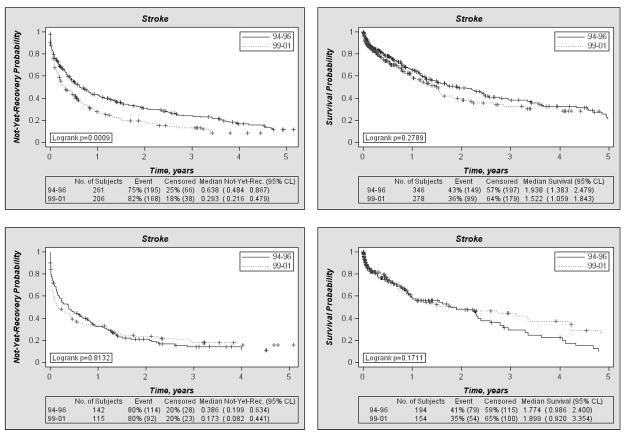
Background and purpose: Improvements in recovery rates may contribute to an increase in healthy life expectancy. It is unclear, however, whether such changes take place because health researchers traditionally deal with changes in incidence and survival from diseases. The purpose of this study was to test for the presence of time trends in the recovery rate from stroke.
Methods: We compared age patterns of recovery rates from stroke evaluated in 2 subcohorts represented in the National Long-Term Care Survey data linked with the Medicare service use files.
Results: We found a statistically significant increase in recovery rate between 1994 and 1999 for females but not for males.
Conclusions: Time trends in recovery rate from stroke exist and can be detected from available data. The roles of influential factors and causes of sex difference in recovery improvement deserve further studies.
Conflict of interest statement
None
Figures
Comment in
-
Trends in survival and recovery from stroke and compression of morbidity.Stroke. 2010 Mar;41(3):415-6. doi: 10.1161/STROKEAHA.109.574459. Epub 2010 Jan 21. Stroke. 2010. PMID: 20093632 No abstract available.
References
-
- Rothwell PM, Coull AJ, Giles MF, Howard SC, Silver LE, Bull LM, Gutnikov SA, Edwards P, Mant D, Sackley CM, Farmer A, Sandercock PAG, Dennis MS, Warlow CP, Bamford JM, Anslow P. Change in stroke incidence, mortality, case-fatality, severity, and risk factors in Oxfordshire, UK from 1981 to 2004 (Oxford Vascular Study) Lancet. 2004;363:1925–1933. - PubMed
-
- Pessah-Rasmussen H, Engstrom G, Jerntorp I, Janzon L. Increasing stroke incidence and decreasing case fatality, 1989–1998: A study from the Stroke Register in Malmo, Sweden. Stroke. 2003;34:913–918. - PubMed
-
- Sarti C, Stegmayr B, Tolonen H, Mahonen M, Tuomilehto J, Asplund K. Are changes in mortality from stroke caused by changes in stroke event rates or case fatality? Results from the WHO MONICA Project. Stroke. 2003;34:1833–1840. - PubMed
-
- Ukraintseva S, Sloan F, Arbeev K, Yashin A. Increasing rates of dementia at time of declining mortality from stroke. Stroke. 2006;37:1155–1159. - PubMed
-
- Akushevich I, Yashin AI. Circulatory Diseases and Aging. In: Heggenhougen K, Quah S, editors. International Encyclopedia of Public Health. San Diego: Academic Press; 2008.
Publication types
MeSH terms
Grants and funding
LinkOut - more resources
Full Text Sources
Medical
