


Hand sanitisers for reducing illness absences in primary school children in New Zealand: a cluster randomised controlled trial study protocol
- PMID: 20096128
- PMCID: PMC2823737
- DOI: 10.1186/1745-6215-11-7
Hand sanitisers for reducing illness absences in primary school children in New Zealand: a cluster randomised controlled trial study protocol
Abstract
Background: New Zealand has relatively high rates of morbidity and mortality from infectious disease compared with other OECD countries, with infectious disease being more prevalent in children compared with others in the population. Consequences of infectious disease in children may have significant economic and social impact beyond the direct effects of the disease on the health of the child; including absence from school, transmission of infectious disease to other pupils, staff, and family members, and time off work for parents/guardians. Reduction of the transmission of infectious disease between children at schools could be an effective way of reducing the community incidence of infectious disease. Alcohol based no-rinse hand sanitisers provide an alternative hand cleaning technology, for which there is some evidence that they may be effective in achieving this. However, very few studies have investigated the effectiveness of hand sanitisers, and importantly, the potential wider economic implications of this intervention have not been established.
Aims: The primary objective of this trial is to establish if the provision of hand sanitisers in primary schools in the South Island of New Zealand, in addition to an education session on hand hygiene, reduces the incidence rate of absence episodes due to illness in children. In addition, the trial will establish the cost-effectiveness and conduct a cost-benefit analysis of the intervention in this setting.
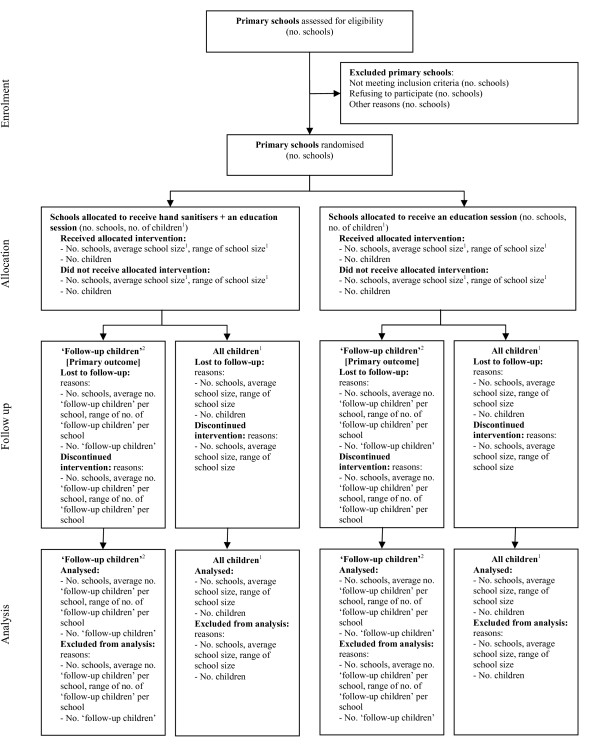
Methods/design: A cluster randomised controlled trial will be undertaken to establish the effectiveness and cost-effectiveness of hand sanitisers. Sixty-eight primary schools will be recruited from three regions in the South Island of New Zealand. The schools will be randomised, within region, to receive hand sanitisers and an education session on hand hygiene, or an education session on hand hygiene alone. Fifty pupils from each school in years 1 to 6 (generally aged from 5 to 11 years) will be randomly selected for detailed follow-up about their illness absences, providing a total of 3400 pupils. In addition, absence information will be collected on all children from the school rolls. Investigators not involved in the running of the trial, outcome assessors, and the statistician will be blinded to the group allocation until the analysis is completed.
Trial registration: ACTRN12609000478213.
Figures
References
-
- Ministry of Health. An Integrated Approach to Infectious Disease: A discussion document. Wellington: Ministry of Health; 2001.
-
- Cowling BJ, Chan KH, Fang VJ, Cheng CK, Fung RO, Wai W, Sin J, Seto WH, Yung R, Chu DW, Chiu BC, Lee PW, Chiu MC, Lee HC, Uyeki TM, Houck PM, Peiris JS, Leung GM. Facemasks and Hand Hygiene to Prevent Influenza Transmission in Households: A Randomized Trial. Ann Intern Med. 2009;151(7):437–6. - PubMed
Publication types
MeSH terms
Substances
LinkOut - more resources
Full Text Sources
Medical
