


Determinants of outcomes of sinus surgery: a multi-institutional prospective cohort study
- PMID: 20096224
- PMCID: PMC2815335
- DOI: 10.1016/j.otohns.2009.10.009
Determinants of outcomes of sinus surgery: a multi-institutional prospective cohort study
Abstract
Objectives: 1) To measure the proportion of patients with chronic rhinosinusitis (CRS) who experience clinically significant improvement after endoscopic sinus surgery (ESS) in a prospective, multi-institutional fashion. 2) To identify preoperative characteristics that predict clinically significant improvement in quality of life (QOL) after ESS.
Study design: Prospective, multi-institutional cohort study.
Setting: Academic tertiary care centers.
Subjects and methods: A total of 302 patients with CRS from three centers were enrolled between July 2004 and December 2008 and followed for an average of 17.4 months postoperatively. Preoperative patient characteristics, CT scan, endoscopy score, and pre- and postoperative quality of life (QOL) data were collected. Univariate and multivariate analyses were performed.
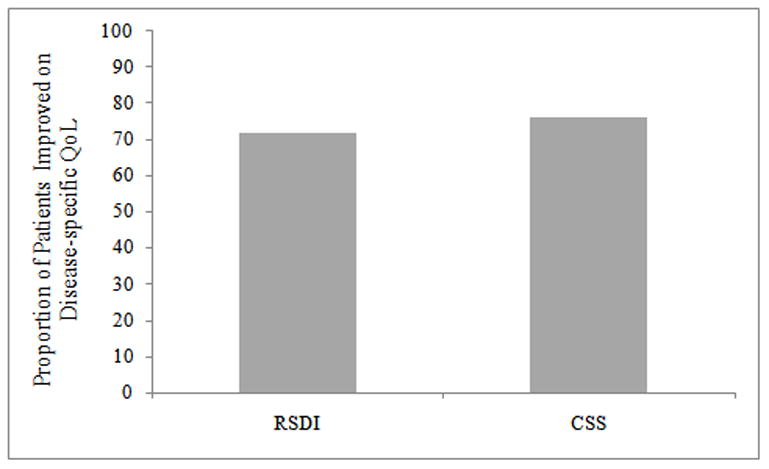
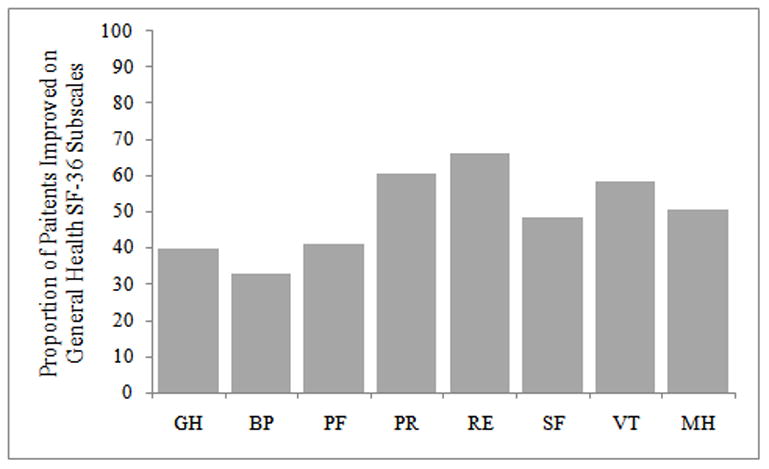
Results: Patients improved an average of 15.8 percent (18.9 points) on the Rhinosinusitis Disability Index and 21.2 percent (21.2 points) on the Chronic Sinusitis Survey (both P < 0.001). Patients significantly improved on all eight Medical Outcomes Study Short Form-36 (SF-36) subscales (all P < 0.001). Among patients with poor baseline QOL, 71.7 percent of patients experienced clinically significant improvement on the RSDI and 76.1 percent on the CSS. Patients undergoing primary surgery were 2.1 times more likely to improve on the RSDI (95% confidence interval [CI], 1.2, 3.4; P = 0.006) and 1.8 times more likely to improve on the CSS (95% CI, 1.1, 3.1; P = 0.020) compared with patients undergoing revision surgery.
Conclusion: In this prospective, multi-institutional study, most patients experienced clinically significant improvement across multiple QOL outcomes after ESS. Specific patient characteristics provided prognostic value with regard to outcomes.
Trial registration: ClinicalTrials.gov NCT00799097.
Figures
Comment in
-
Fatigue improvement following endoscopic sinus surgery: results consistently not seen by internists.Otolaryngol Head Neck Surg. 2010 Jun;142(6):920. doi: 10.1016/j.otohns.2010.02.031. Otolaryngol Head Neck Surg. 2010. PMID: 20493374 No abstract available.
References
-
- Cherry DK, Woodwell DA. National Ambulatory Medical Care Survey: 2000 Summary, National Center for Health Statistics, Hyattsville, MD. Vital Health Stat. 2000;328:1–32. - PubMed
-
- Anand VK. Epidemiology and economic impact of rhinosinusitis. Ann Otol Rhinol Laryngol Suppl. 2004;193:3–5. - PubMed
-
- Durr DG, Desrosiers MY, Dassa C. Impact of rhinosinusitis in health care delivery: the Quebec experience. J Otolaryngol. 2001;30(2):93–97. - PubMed
-
- Khalid AN, Quraishi SA, Kennedy DW. Long-term quality of life measures after functional endoscopic sinus surgery. Am J Rhinol. 2004;18(3):131–136. - PubMed
-
- Terris MH, Davidson TM. Review of published results for endoscopic sinus surgery. ENT Journal. 1994;73:574–580. - PubMed
